FROM THE BOOKSHELF / A PAGE TO KEEP
MCP: The USB Moment for AI Is Finally Here
Published on 2026-05-07
MCP (Model Context Protocol) is the open specification that standardizes how AI models connect to external tools, data sources, and services — solving the AI integration fragmentation problem the same way USB solved the peripheral fragmentation problem in the 1990s. Anthropic shipped it, major tool vendors are building for it, and the adoption curve could be faster than any previous protocol standard.
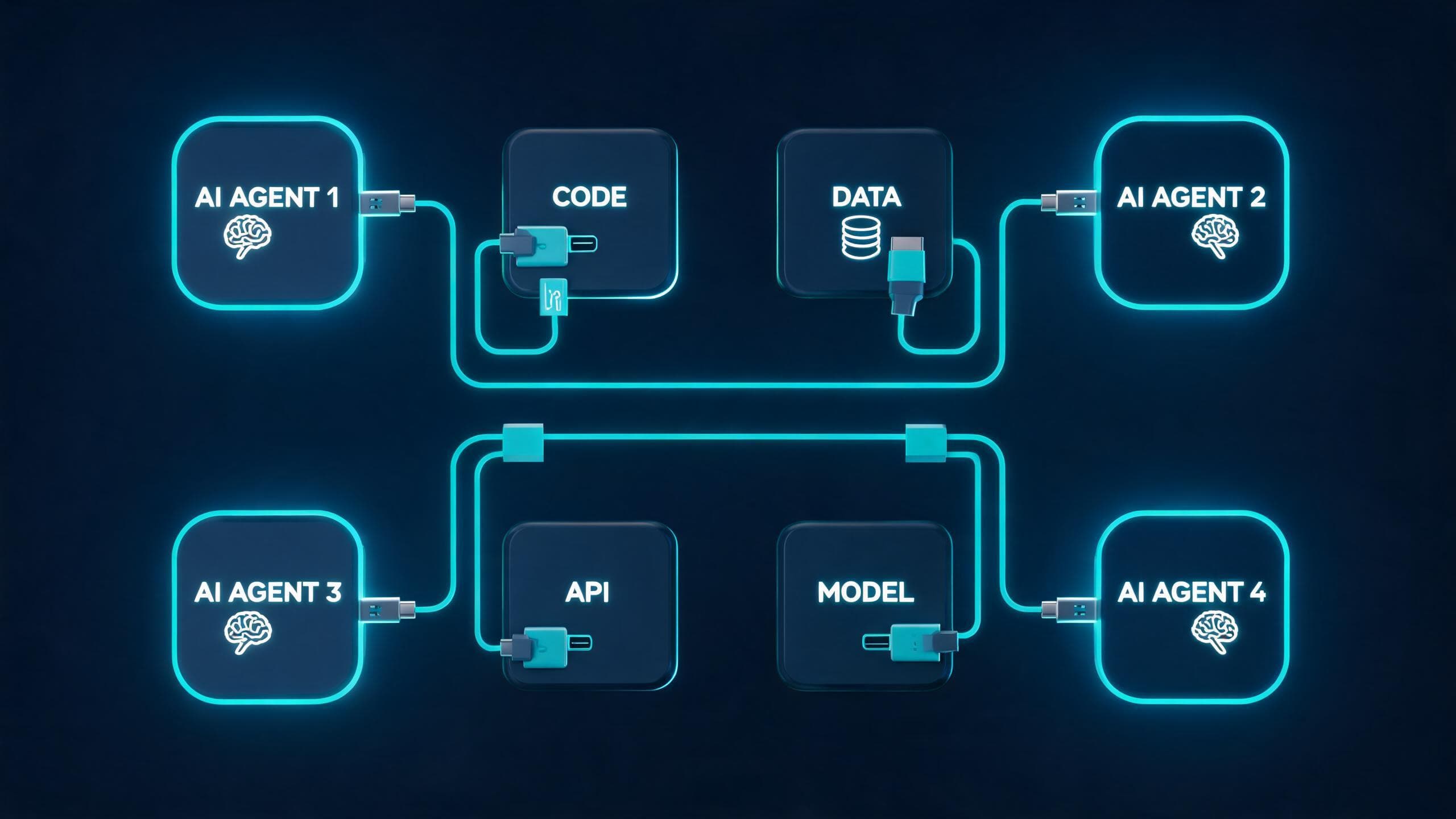
In 1996, your printer didn't work with your camera, which didn't work with your scanner. Every peripheral had its own proprietary cable, its own driver, its own ecosystem. Then came USB — and within a decade, everything connected to everything. The protocol won not because it was the most technically elegant solution, but because it made the entire industry interoperable by default.
We are living through the exact same fragmentation right now in AI — and the solution is arriving the same way.
The Integration Hell Is Real
Every serious AI deployment today is a custom integration nightmare. The model speaks one language. The tools speak different languages. The data lives in different places. Someone has to write the glue code.
Want your AI agent to search the web, read your Slack, update your CRM, and push code to GitHub? That requires four separate integrations, four different authentication flows, and ongoing maintenance as each API evolves independently. The moment one of them changes its rate limit or authentication scheme, your agent breaks.
This isn't a toy problem. It's the central engineering challenge of every production AI system today. And the naive solution — build everything in-house, point-to-point — is a trap. It creates technical debt, vendor lock-in, and an永远 you-hire-more-engineers treadmill.
Enter MCP: One Protocol to Rule Them All
The Model Context Protocol (MCP) is an open specification that defines a standardized way for AI models to connect to external tools, data sources, and services. Think of it as the USB of AI integrations — a single interface that abstracts away the complexity underneath.
The architecture is straightforward: a client-server model where the AI host (the "client") connects to MCP servers that expose capabilities as "resources," "tools," and "prompts."
- Resources are data sources the model can read — files, database queries, API responses.
- Tools are actions the model can invoke — sending emails, creating records, executing code.
- Prompts are pre-defined interaction templates that wrap complex multi-step workflows.
The model doesn't need to know how to talk to Salesforce or search the web. It just calls the MCP interface. The MCP server handles the translation. Swap out the underlying tool, and the model keeps working. Swap out the model, and the tools keep working.
Why This Moment Is Different
Standards attempts in AI are not new. Every year brings a new "AI integration protocol" that promises interoperability and delivers a ghost town. So why does MCP feel different?
Anthropic built it. The company behind Claude didn't publish a whitepaper and hope the industry adopted it. They shipped a working implementation, open-sourced the spec, and built it into Claude for Desktop. When your protocol ships inside the product that millions of people already use, adoption follows differently than when it's just a GitHub repo with good documentation.
The tool vendors are actually building for it. Snowflake, Notion, Slack, GitHub, Azure — the list of companies shipping native MCP servers grows longer every month. This isn't a standards body writing specifications in a conference room. It's the market converging on a working solution because the cost of not converging is higher.
The extensibility model is sound. MCP's design respects the reality that AI capabilities will evolve faster than any standard can anticipate. The protocol is deliberately minimal — it defines transport and interface, not capability. New tool types, new authentication flows, new data formats can be layered on without breaking existing implementations.
The USB Analogy, Taken Seriously
USB succeeded not just because it was a good technical standard, but because it solved a coordination problem that was costing the entire industry money. Every peripheral vendor had to maintain dozens of proprietary interfaces. Every host device manufacturer had to build dozens of custom ports. The ecosystem was paralyzed by complexity.
Sound familiar?
MCP solves the same coordination problem for AI. Tool vendors stop maintaining N integrations for N AI hosts. AI hosts stop building and maintaining M tool integrations for M tools. Everyone builds to one interface, and the entire ecosystem becomes composable by default.
The USB analogy has a second, less discussed chapter: USB took a decade to become truly ubiquitous because the transition required hardware redesigns. MCP's transition is pure software. The adoption curve can be orders of magnitude faster.
What's Still Missing
MCP is not a silver bullet. Three real problems remain.
Security and permission models are nascent. When every tool sits behind one protocol, the attack surface consolidates. A compromised MCP server can do a lot more damage than a compromised point-to-point integration. The spec is catching up here, but production deployments need robust permission scoping that doesn't yet exist as a standard.
Discovery is unsolved. USB had physical ports — you could see what was plugged in. MCP servers need a discovery mechanism so agents can find available tools dynamically rather than having them hardcoded. The ecosystem needs something closer to an app store for AI capabilities, not just a protocol spec.
Stateful workflows across tools remain hard. MCP handles discrete tool calls well. Long-running transactions that span multiple tools, with rollback semantics and partial failure handling, are a harder problem that no protocol spec fully solves today. This is the next frontier.
The Window Is Now
The protocols that win in technology are not always the best technically — they're the ones that arrive when the pain of fragmentation becomes unbearable and the cost of adoption drops low enough. USB hit that inflection point in the late 90s. MCP has hit that inflection point in AI right now.
The builders who treat MCP as a first-class architectural concern — not a nice-to-have integration — will be the ones who ship AI products that actually work in production, at scale, without dedicated integration teams burning out maintaining fragile glue code.
The USB moment for AI is here. The question is whether you're building on the standard or building another proprietary island that will have to be abandoned in three years.
The bet is obvious.