Microsoft Research ships MindTopo, a benchmark that pinpoints why VLMs ace static vision but fail at interactive planning — and what the engineering fix looks like.
VLMs Can See Topology. They Can't Act on It.
Microsoft Research just shipped a benchmark that pins the gap to one sentence: "performance was consistently stronger on static reasoning than on interactive planning, and both remained well below human performance" (Microsoft Research blog, August 12, 2026).
The benchmark is called MindTopo, and the sentence above is the load-bearing finding. Don't read past it. Strip the jargon out and you get a sharper version: today's VLMs are good at looking at a maze and bad at solving one.
If you only remember one thing from this article, remember that.
Why "looking good" hides a real failure
Most VLM benchmarks measure the wrong thing. They hand the model a static image, ask a multiple-choice question, score the answer. The model looks clever. The score looks high. Everyone goes home happy.
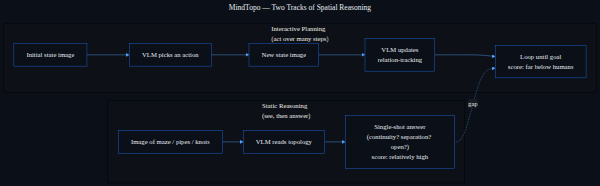
MindTopo splits that illusion in two. Every task comes in a pair:
Static reasoning — show the model a final-state image, ask "is this knot really tied? Is this pipe closed? Is the path connected?" The model can stare at pixels and answer.
Interactive planning — drop the model at the starting state and let it move. Ten, twenty, fifty steps. Each step the environment re-renders. The model has to keep the relations alive across moves.
The radar chart in the Microsoft Research post shows the shape clearly: the static line sits well above the planning line, and both sit well below the human ceiling. The exact numbers are not published in summary form, but the qualitative gap is the point.
The gap is not a calibration issue. It is a kind of failure.
#AI Agent#AI模型#Agent
VLMs See Topology but Can't Act on It — MindTopo Findings
What "topological" actually means (and why it matters)
Microsoft Research grounds the benchmark in five topological properties — continuity, separation, order, enclosure, knots. Those are the right ones, because Piaget and a century of developmental psychology have already shown humans build spatial cognition on top of exactly these invariants. A toddler can tell you whether a path goes through, whether a string is knotted, whether a fence encloses the sheep.
VLMs get the same content. They just don't get the same guarantees about it.
Why this matters for engineers: the five properties are precisely the layer a robot, a screen-reader, or an interactive coding assistant cannot outsource. If a coding agent says "yes, the constraint still holds after this refactor," that's a continuity claim. If a tool-use agent says "yes, this API call won't loop forever," that's a separation claim. If an accessibility agent says "yes, this navigation still respects the focus order," that's an order claim. The agents we are actually shipping this year are betting the farm on topological competence.
MindTopo is the first benchmark that puts a number on that bet.
What the failure actually looks like
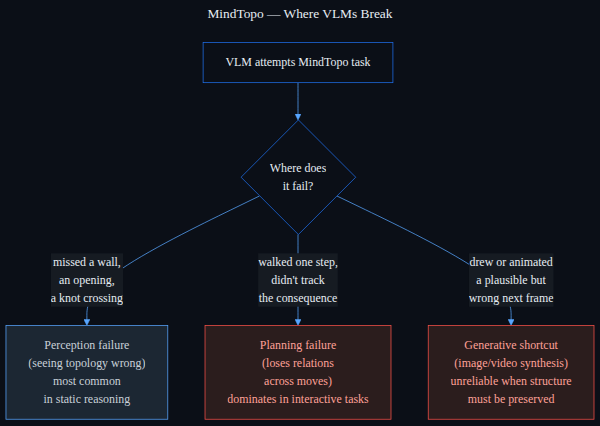
The blog walks through two failure families. They are not the same family, and conflating them is what most commentary gets wrong.
Perception failures show up early. The model "sees" a maze but misses a wall. It looks at two ropes and counts three crossings. It looks at a closed loop and reports an opening. These errors live in pixel space, and they are mostly the static-reasoning failures.
Planning failures show up after the first move. The model reads the scene correctly, picks a locally reasonable action, and the next state is no longer what it expected. It takes a second step. The relation it was tracking — "these two ends are linked, not just adjacent" — quietly breaks. The model doesn't notice, because no current frame gives it a clean signal that the relation broke. This is where the gap actually opens.
The blog's reading is sharp: "perception errors came from missing a wall, an opening, or a crossing; planning errors came after the model understood the scene but failed to track what came next." (Microsoft Research, MindTopo reveals VLMs' spatial reasoning abilities, Aug 2026)
There is a third family worth naming: generative shortcuts. When a model can sketch its imagined next state as an image or animate a planned sequence as a video, it sometimes looks like progress. The blog warns this is mostly illusion. Visual simulation helps when it preserves structure; it hurts when the synthesis quietly rewrites a relation to look smoother than it is. The takeaway: image and video generation are not, by themselves, a planning substrate.
The fix isn't bigger VLMs. It's a state.
If "see topology → act on topology" is a two-step problem, the obvious answer is "more data, more compute, more parameters." The Microsoft Research post, read carefully, is arguing against that answer.
The reason is in the benchmark mechanics. MindTopo's environments are controlled simulators. They expose exact ground-truth state. They enforce legal moves. They distinguish "you couldn't see it" from "you couldn't keep track of it." That means the failure mode the post is naming — losing relations across moves — is not a perception problem you can brute-force with more pixels. It is a representation problem. The model needs somewhere to write "this link still holds," not another chance to look.
So the engineering implication lands cleanly: what the next generation of agentic VLMs needs is a topology-aware world model, not another foundation model. A place to represent continuity, separation, order, enclosure, and knot status as first-class state, and to update that state on each environment step.
That is a different research agenda from "scale vision." It is also a different engineering agenda from "wrap the VLM in a tool-calling scaffold." It is closer in spirit to the old symbolic-planning literature than to the modern LLM-agent literature, and that is a useful tell.
What this changes for the people shipping agents right now
Three concrete reads from the MindTopo result, for engineers shipping agents this month.
First, don't trust static-reasoning scores on multimodal evals as a proxy for agent competence. They are not the same construct. A model that scores 80 on VQA can still fail 80% of the time on a ten-step interactive task, and MindTopo's design is exactly what shows the gap.
Second, assume your agent's world model is lossy until proven otherwise. The cleanest production move is to constrain the agent's action space so that the relations it has to track are minimal — pick the smallest environment where the topology it needs to maintain is a property of the data structure, not of free-form perception.
Third, treat generative media (image, video) as a debugging surface, not a planning substrate. The Microsoft Research post is unusually direct about this: "visual simulation is only useful when it preserves structure." If your agent uses image synthesis to plan, you have given it a worse version of the world, not a better one.
What it doesn't say
The benchmark is honest about what it does not measure. The published figures are not specific model scores; the qualitative radar chart is the headline. The blog does not claim a specific leaderboard. It does not claim one model is the gap-minimizer. It does not say that 2027 will solve it.
That restraint is itself a signal. A benchmark that names a gap without naming a winner is usually the one that lasts.
The question worth holding onto is the one the post itself ends on: should the next-generation VLM carry a small, topology-aware memory module alongside its perception stack? Not in lieu of the perception stack — alongside it. Continuity, separation, order, enclosure, knot status, maintained across steps, queryable as state.
If the answer turns out to be yes, MindTopo is the moment we started asking.