DeepSeek Just Changed the Agent Race — by Refusing to Race
胡新宇
发布于 2026-08-16
On August 13, 2026, DeepSeek released its Harness framework as v0.1.0-rc with no compatibility guarantee — and within 24 hours the community had shipped 600+ plugins. This is a strategy-level read on why the 'unfinished' version is the boldest move in the Agent race, what Cordis (the runtime underneath) actually enables, and how the platform-vs-product question just shifted.
DeepSeek Just Changed the Agent Race — by Refusing to Race
If you build frameworks, would you ever push v0.1.0-rc to GitHub and then write "we make no compatibility promise" in the README?
Most teams wouldn't. DeepSeek did.
On August 13, 2026, DeepSeek released DeepSeek Harness (DSH) under MIT — version 0.1.0-rc, no compatibility commitment, with the official repo positioned as "an idea, a reference, and an inspiration" rather than a canonical answer (https://github.com/deepseek-ai/deepseek-harness).
Within 24 hours, the GitHub topic dsh-plugin had attracted 600+ community plugin repositories. Long-term memory. Virtual pets. A Web retro-games collection. Terminal UIs.
That is not a normal open-source launch.
This might be the calmest high-stakes bet in the Agent space this year.
What DSH actually is
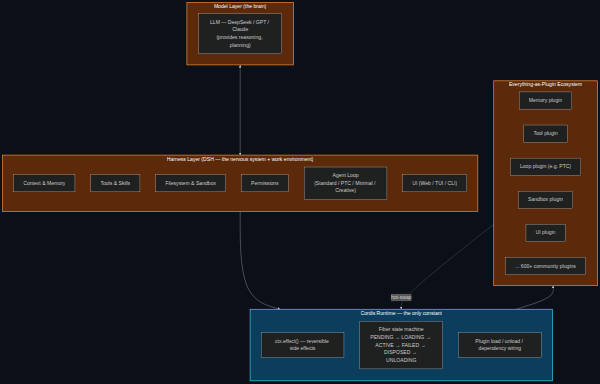
One sentence: DSH splits the Agent into two halves.
Agent = Model + Harness
The model is the brain. The Harness is the nervous system plus work environment — context, tools, filesystem, memory, permissions, sandbox, Agent Loop, and the interfaces that touch the real world.
But the interesting part isn't the formula. It's the foundation.
DSH is built on Cordis — Shigma's open-source Meta-Framework, vendored into the repo as @deepseek-ai/cordis. Cordis isn't new. It's been battle-tested in production by Koishi, a cross-platform chatbot framework that serves QQ, Discord, Telegram, and WeChat. Koishi's job every day is "dozens of plugins hot-swapping, configurable on the fly." That's the same shape as an Agent runtime — minus the LLM.
#AI Agent#开源#AI工程#Agent
Cordis's single promise: plugins can be installed — and cleanly uninstalled.
It gets there through two mechanisms.
ctx.effect() is the first. Every change to the shared context returns a disposer. Event handlers, services, timers, the disposables list — all tracked. Uninstall a plugin, every side effect rolls back. Cordis calls this temporal composability. In practice: you install a plugin to try something, it breaks, nothing else breaks with it.
The Fiber state machine is the second. Six states — PENDING, LOADING, ACTIVE, FAILED, DISPOSED, UNLOADING. A plugin declaring inject: ['tools', 'shell'] doesn't activate until both dependencies are live. That's spatial composability — components turn themselves on when their dependencies appear, and off when they don't.
The Cordis team's paper, A Programming Paradigm for Spatiotemporal Composability (https://github.com/cordiverse/paper), formalizes both. A Tencent engineer doing the architecture teardown drew the analogy well: killing a Docker container cleans everything but loses the cache; Cordis wants "uninstall equals complete reversal" without losing anything else.
The technology is solid. The strategy is what's wild.
Why "0.1.0-rc with no compatibility promise" is the boldest move
Read 0.1.0-rc literally. "Release Candidate" — we haven't decided yet, and we're not rushing to decide.
The main repo doesn't accept external pull requests at launch. Want to contribute? Build your own plugin. Write tutorials. File issues. The official repo stays in "an idea" mode and refuses to become "the standard answer."
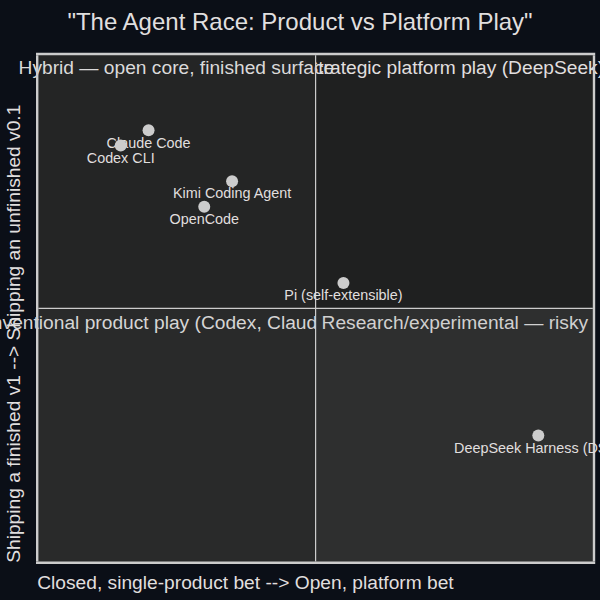
Every Agent product in the last two years has done the opposite. Claude Code ships a finished product. Codex ships a finished product. Everyone races on speed, reliability, cost-per-task.
DeepSeek shipped a reference implementation and said: figure it out.
The strategy holds because the Agent space hasn't converged. Model capabilities aren't converging. Harness architectures aren't converging. Any team that claims "we're done" right now is signing up for a rebuild in six months.
Dekox, writing in the Chinese tech press on August 14, put it cleanly:
DeepSeek didn't wait for all the answers to settle, then ship a "DeepSeek-flavor Claude Code." It chose — while neither model capability nor Harness paradigm had converged — to mobilize everyone.
Refusing to commit to compatibility is the biggest form of compatibility. The moment you commit, you lock yourself in. 0.1.0-rc says: this interface may change tomorrow, so don't build anything too permanent on top of it.
The community validated the play
600+ plugins in 24 hours.
The number itself isn't impressive. GitHub counts can be gamed. What's interesting is the kind of plugin: long-term memory, virtual pets, retro web games, terminal UIs. These aren't productivity tools — they're toys and experiments.
That's the signal. Developers aren't treating DSH as a serious production framework. They're treating it as a canvas. Nobody worries about compatibility because the framework told them not to. Nobody waits for the official answer because the framework said "I'm not the official answer."
The classic path — play around → find friction → refine into features — just got compressed. Every friction point the community surfaces drives Harness iteration. Every iteration feeds back into the model team — telling them which capabilities to train next. Dekox calls this a co-evolution loop.
DeepSeek didn't open-source code. It open-sourced the problem space itself.
A developer independently published a 120-page "Orange Paper" doing a full DSH architecture teardown, free and open-source (https://github.com/alchaincyf/deepseek-harness-orange-book). That kind of documentation usually takes an official team to produce. The community produced it themselves.
Even the Agent Loop is a plugin
One detail worth pulling out separately: PTC mode.
PTC — Programmatic Tool Calling — is exposed by DSH alongside Standard, Minimal, and Creative modes. The conventional Agent calls tools atomically: one call, wait for the result, call the next. PTC lets the model write code that composes multiple tool calls into one program.
What that means: even "how an Agent calls tools" is now optional. You can run the traditional model. You can run PTC. You can write your own — because the Agent Loop itself is a plugin, swappable at the config layer.
This is where "everything is a plugin" gets genuinely scary. Not just infrastructure. The Agent execution loop — the most central piece — is pluginized too. Cordis carries no specific Agent capabilities. It only handles load, unload, and dependency orchestration. Capabilities come from plugins.
That's why DSH can refuse compatibility. It only promises one thing: everything is replaceable.
The Agent race just changed shape
Watching this whole sequence play out, one judgment settles:
Before, the race was "who builds the strongest Agent."
DeepSeek rewrote the question: "who controls the place where the answer to 'what is an Agent' gets defined."
This isn't product competition. It's platform competition — deeper than the SDK-plus-API kind. It's a fight over the paradigm itself. The Harness layer becomes the operating system of the Agent ecosystem. DeepSeek moved in first with production-validated plugin operations (Cordis, from Koishi) and waited for everyone else to build applications on top.
Plenty of people will say: this is too early, too immature, no production value. They're right. 0.1.0-rcis early. But early is the point. By the time the paradigm converges, the first-mover advantage is gone.
I'm not sure DSH will become the platform that defines the paradigm. Cordis has been validated for chatbot workloads; whether it holds up under LLM-scale complexity is an open question. PTC mode is rough around the edges. Plenty of claims about plugin behavior need verification under real load.
One thing I'm confident about: from August 13, 2026 onward, any team still building an Agent framework as a "product" is a step behind.
DeepSeek used 0.1.0-rc and the phrase "we make no compatibility promise" to drag everyone onto a map that isn't finished yet. You can dislike the map. You can't pretend it doesn't exist.