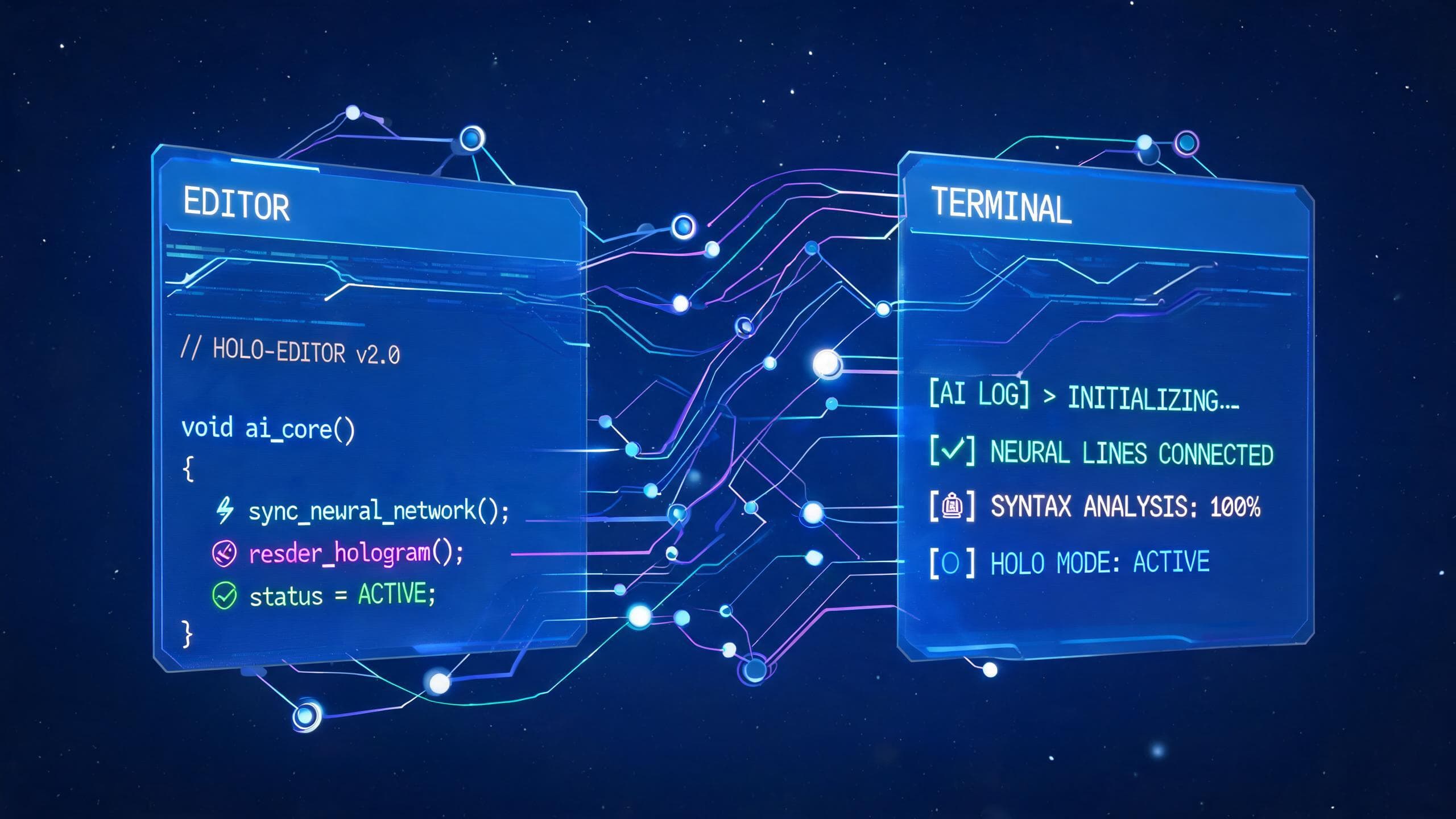
Agentic Coding — How AI Agents Are Rewriting the Rules of Software Development
Published on 2026-05-06
Agentic coding — AI systems that can reason, plan, execute, and self-correct across a full project — is reshaping what it means to develop software. This article explores the shift, the tooling ecosystem, the real challenges, and what developers should actually do today to stay valuable.
Agentic Coding — How AI Agents Are Rewriting the Rules of Software Development
There's a quiet revolution happening in software development, and most developers haven't felt it yet. Not because it isn't real — but because it's happening at the tool layer, below the surface of what we traditionally call "coding." AI coding assistants have graduated from autocomplete punchlines to autonomous agents that can reason, plan, execute, and revise code across an entire project. The question is no longer whether AI can write code. The question is: what does it mean to develop software when the machine can do the typing?
This is the world of agentic coding — and it is unlike anything the industry has seen before.
The Shift Nobody Announced
For decades, the mental model of software development has been: human writes code, machine runs code. Tools got better — IDEs, linters, type checkers — but the fundamental relationship stayed the same. The developer was the author.
Then Large Language Models arrived, and for a brief moment the industry settled into a comfortable rhythm: paste a prompt, get a snippet, paste it into your file. This was impressive and genuinely useful, but it was still human-driven — the human was the orchestrator, the LLM was a very fast junior dev who never pushed back.
Agentic coding breaks that contract. It says: what if the AI didn't just respond to you, but acted on your behalf? What if it could read your codebase, form a plan, write files, run tests, catch its own mistakes, and iterate until something works?
#Agent#AI工程#AI编程#上下文工程
Agentic Coding: How AI Agents Are Rewriting Software Development | AI Insights
That's not science fiction. That's what tools like Claude Code, OpenAI Codex, and GitHub Copilot's Agent mode are doing right now, in 2026.
What Agentic Coding Actually Means
Let's be precise, because "AI coding assistant" has been stretched to mean almost anything. Agentic coding refers to AI systems that can:
Pursue a goal across multiple steps, not just answer a single prompt
Use tools — read and write files, execute shell commands, run test suites, browse the web
Maintain context over long conversations and large codebases
Revise and self-correct when things break or tests fail
Operate autonomously with the human as reviewer rather than author
This is a fundamentally different interaction pattern. You're not writing code with the AI — you're directing the AI to write code. The model becomes the primary author; you become the architect and quality gate.
Think of it less like a smarter autocomplete and more like delegating a task to a capable engineer: "Build me a REST API with authentication, rate limiting, and a PostgreSQL backend. Keep the code clean and add tests." Then watch it scaffold the project, choose the libraries, write the handlers, configure the database, and flag the decisions it made along the way.
The Workflow Is Changing
In a traditional sprint, a developer might spend 60% of their time implementing and 40% thinking and planning. With agentic coding, that ratio inverts — at least for the implementation phase. The AI handles the mechanical work while the human focuses on architecture, requirements, and judgment.
Here's what a modern agentic coding session looks like in practice:
Spec out the goal — You describe what you want in plain English, or paste a GitHub issue, or point to a user story.
Agent reads the codebase — It understands the existing structure, patterns, and conventions before writing a single line.
Agent plans its approach — It might share a brief outline of what it intends to build and ask for confirmation.
Agent executes — Creates files, writes functions, adds imports, and builds out the feature end-to-end.
Agent tests and revises — Runs the test suite, catches its own errors, and fixes them without being asked.
Human reviews — You do a final review pass, approve or request changes.
The cycle time collapses dramatically. Features that would have taken a developer a full day can be prototyped in an hour. Not perfect code — but working, readable, testable code.
The Ecosystem Is Exploding
The tooling around agentic coding is maturing faster than almost any adjacent category in software. A few forces are converging:
Models are getting longer contexts and better at reasoning. Context windows of 200K+ tokens mean an AI agent can hold an entire medium-sized codebase in memory. Chain-of-thought reasoning lets the model think before it types, catching logical errors before they become bugs.
Tool use is becoming standardized. The Model Context Protocol (MCP) is rapidly becoming the USB-C of AI toolchains — a common interface for connecting AI models to filesystems, browsers, databases, and external APIs. When every AI agent speaks the same protocol, the ecosystem composes.
Specialized agents are emerging. Instead of one general-purpose AI, teams are deploying purpose-built agents for code review, documentation, CI/CD debugging, database schema migrations, and security scanning. The agent becomes an expert in its domain.
Human-in-the-loop patterns are maturing. The best agentic workflows don't eliminate humans — they reskill the human's role. The engineer becomes the "senior engineer reviewing PRs from an AI colleague." Code review, architectural oversight, and edge-case judgment remain human work.
The Hard Parts Nobody Talks About
It's not all clean diffs and passing test suites. Agentic coding introduces real friction points that the enthusiastic demos don't show:
Context windows are still finite. Large codebases exceed even generous context limits. Agents can lose the thread, forget earlier decisions, or hallucinate APIs that don't exist. The human has to catch this.
Agent-produced code can be confidently wrong. A model that has been fine-tuned to be helpful may produce code that looks correct but silently does the wrong thing. The confidence is high; the accuracy is not always matching. This is why human review isn't optional — it's load-bearing.
Debugging agent-generated code is harder. When the code wasn't written by a human who understood every line, diagnosing a subtle race condition or off-by-one error requires understanding what the agent was thinking, not just what it wrote.
Dependency on tool quality. Agentic coding is only as good as the tools it can use. Poorly documented APIs, rate-limited external services, and inconsistent CLI interfaces all break the agent's ability to act reliably.
Architectural drift. When an AI writes code incrementally over time, the resulting system can accumulate subtle architectural inconsistencies — different modules using different conventions, inconsistent error handling, divergent data models. A human architect would catch this; an agent needs explicit prompting to care about system-level coherence.
What Developers Should Actually Do Today
If you're a working developer, the question isn't "will agentic coding change my job?" It's "how do I stay valuable as it does." Here is a practical map:
Learn to delegate effectively. Prompting is a skill. The difference between "write me a function" and "build me a robust, testable module with error handling and documentation" is the difference between a rough draft and a merge-ready PR. Invest time in learning how to be specific, how to set constraints, and how to review AI output critically.
Deepen your systems thinking. As mechanical implementation becomes automated, systems design, architecture, and trade-off analysis become more valuable. The developer who understands why a system should be built a certain way — and can direct an AI to build it — will outcompete the developer who just writes the code line by line.
Get serious about testing. If an AI is writing your code, you need excellent test coverage to trust it. Writing tests is not the most exciting part of development, but it becomes the critical verification layer that makes agentic coding safe.
Understand the tools deeply. Each AI coding tool has different strengths, context limitations, and failure modes. Claude Code excels at multi-step reasoning and self-correction. Codex is deeply integrated into GitHub and CI workflows. Copilot has the largest training footprint for common patterns. Know your tools.
Stay close to the code. One risk of excessive delegation is losing touch with the details. The best developers using AI agents are the ones who can still read a stack trace, understand a diff, and spot a subtle logic error — even if they didn't write the code themselves.
The Metaphor That Helps Me Sleep at Night
Every wave of automation in software has followed the same pattern: the mechanical, repetitive work gets automated first, and the human moves up the stack to more creative and strategic work. Assembly language → compilers → high-level languages → cloud infrastructure → now AI agents. Each time, the industry claimed the human would be replaced. Each time, the human moved to a higher level of abstraction.
Agentic coding is the same pattern, one level higher. The code that implements a feature is now often written by the AI. The human's job is to decide what to build, why to build it, and whether it was built correctly.
That's not a demotion. That's a promotion to the interesting part.
The developers who thrive in this era won't be the ones who type fastest. They'll be the ones who think clearest about what to build and why — and who know how to direct a capable AI to get there efficiently.
Welcome to the new job description.
Cover image generated with Seedream 5.0 — AI-assisted creative workflow.