AT&T publicly disclosed 40% of internal AI traffic routes to open-weight models with a 60-70% target. Coding cost down 56% for 2% quality drop. Enterprise AI is splitting into two economies, and the frontier labs are being routed around.
AT&T Just Proved Enterprise AI Is Splitting Into Two Economies
AT&T, one of the biggest US telecoms, has been quietly publishing a number for two months. Last week it leaked via X and got reshared by every analyst who watches this market. 40% of AT&T's internal employee AI usage already routes to open-weight models. Their target is 60–70%. Coding costs are down 56% for only a 2% quality drop, on 45 billion tokens per day (Source: Latent Space AINews digest, 2026-08-20, summarizing @Hesamation).
One company. One quarter. One number. That is the first hard public evidence that the enterprise AI market is not behaving the way the frontier labs want it to.
The shape of the market is now visible, and it does not look like the funnel the labs drew.
Two economies, one router
The number to think about is not 40%. It's 56%. That is how much AT&T cut coding cost by rerouting to open-weight models, while only losing 2% on whatever internal scorecard they use. A 28-to-1 cost-to-quality ratio is the kind of curve that, in any other category, would be a market-reshaping event in its own right. Here it's getting reported as a sub-bullet.
The second number is the trajectory. AT&T is targeting 60–70% open-model routing. That is not a pilot. That is the policy. The closed-frontier labs are being deliberately downgraded from "default" to "specialist" inside one of the largest internal AI deployments in the world.
Think of it like enterprise storage circa 2012. AWS S3 ate 80% of object storage. High-IOPS block storage stayed premium for the workloads that needed it. The S3 curve did not kill premium storage. It just drew a line. AT&T's number draws the same line for AI. Open-weight models for the broad middle of internal usage. Closed frontier for the hard 20%.
This is not "OpenAI is dying". This is "OpenAI is becoming the high-IOPS tier". The revenue math changes. The valuation math changes. The strategy math changes.
<!-- 配图:双经济曲线对比 -->
Why now, three forces lined up
<!-- 配图:三力共振时序 -->
#商业分析#开源#AI模型
The shift is not one event. It is three trends reaching the same point at the same time.
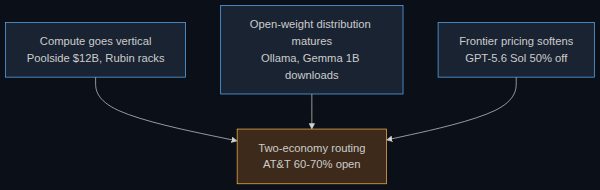
Compute is going vertical at the frontier. Poolside, a startup with fewer than 115 technical staff that built a credible foundation model, failed to close a $2 billion raise in 6 weeks last year. Their founder Eiso Kant said bluntly: "We didn't close it in time, and we lost the cluster." Jensen Huang licensed Poolside's factory and hired 109 of them into NVIDIA for a reported $12 billion reverse-execuhire (Source: Latent Space AINews, 2026-08-20). The action is not a normal acquisition. NVIDIA didn't want the company. They wanted the talent and the recipe. OpenAI's first NVIDIA Vera Rubin racks are now installed and running their next pretraining stack (Source: @udayruddarraju on X, 2026-08-19). The new generation of frontier compute needs an order of magnitude more than the previous one. That capital requirement is now binding. It is no longer a question of architecture. It is a question of who can afford the rack.
Open-weight distribution has matured. Kimi K3 now ships to over half of Ollama's subscription base with US/EU hosting and zero data retention (Source: @ollama on X, 2026-08-20). Google's Gemma crossed 1 billion downloads (Source: @Google on X, 2026-08-20). The biggest deployment friction for open models in 2024 was "where do I host it, how do I update it, who do I call". By mid-2026 that friction has dropped to near-zero. A procurement manager at AT&T who wants to route 60% of internal coding traffic to an open model now has a vendor list, hosting list, and integration list that did not exist 18 months ago.
Frontier pricing power is softening. The same week AT&T's number leaked, OpenAI announced GPT-5.6 Sol at 50% off through Router, with GitHub and VS Code amplifying the deal to their users (Source: @eglyman on X, 2026-08-20). When the leader of the frontier market is discounting 50% to defend share, that is not a strength signal. It is the early curve of a margin reset. Labs are searching for the right product boundary between high-end model access and economically sustainable agentic usage. They have not found it yet. The market is telling them where the boundary is by routing around them.
The three forces compound. Compute going vertical at the frontier means frontier models must command premium prices to justify their own existence. Distribution maturing for open weights means open models can absorb the broad middle without the buyer paying a "convenience tax". And the frontier labs, under margin pressure, start discounting the broad middle themselves, accelerating the routing. This is not a coincidence. This is a system.
What the number does not tell you
AT&T's disclosure is short on specifics, and the gaps matter.
First, which open models. The digest does not say. Reading between the lines, the volume (45B tokens/day) and the workload bias (coding-heavy, with "2% quality drop") suggest Llama-family or Qwen-family coding-specialized models. But AT&T has not published a bill of materials. Anyone modeling the open-model enterprise market without that disclosure is guessing.
Second, what "2% quality" means. Every enterprise measures quality differently. AT&T almost certainly uses an internal rubric that combines task success rate, human spot-checks, and possibly LLM-as-judge for code review. None of that methodology is public. A 2% drop on one rubric can be a 20% drop on another. If you are an enterprise AI buyer reading this and thinking "I should reroute too", the right move is to define your own quality floor before you copy AT&T's percentage.
Third, what gets the 60–70%. Is the target uniform across task types? Or is it "60–70% of the cheap tasks and 0% of the hard ones"? The shape of the target matters more than the number. A target like that almost always means "routing is biased toward the easier, cheaper workloads". Which means the hard 20–40% is exactly where frontier labs need to defend share. The enterprise AI market is not splitting evenly. It is splitting on cost curves.
These gaps do not weaken the signal. They define what you have to build before you can act on it.
What builders should do this week
If you are building AI products for enterprise, the AT&T number changes your roadmap in three concrete ways.
First, plan for a two-tier routing layer. If AT&T can route 60–70% of traffic to open weights at 56% cost reduction, your customers will ask why you are not doing the same. The answer "we use GPT-5 because it's better" needs to become "we use GPT-5 for these tasks, and Qwen-3.8-27B for these tasks, and the routing logic is here in the repo, and the cost dashboard is here in the admin panel". If you cannot produce that answer with screenshots, you are losing deals in Q4.
Second, treat the closed-frontier as a premium product, not a default. Product copy that says "powered by GPT-5" was a 2024 story. By Q1 2027 the copy will be "frontier quality where it matters, open weights where they are good enough". Labs know this. The 50% GPT-5.6 Sol discount is the front-end of the same pivot. If you are an OpenAI reseller or integration partner, the resale margin on the broad middle is going to compress. Move up the stack to custom evals, fine-tuning, agent infrastructure, or you get routed around the same way AT&T routed around the default.
Finally, watch the next two enterprise disclosures. AT&T is the first to publish numbers. They will not be the last. Goldman Sachs, JPMorgan, Walmart, AT&T competitors — every large US enterprise is running the same internal experiment. When a second major company publishes a number that confirms AT&T's curve (say, "we route 50% open-weight, coding cost down 40%"), the assumption "frontier = default" stops being a procurement stance. It stops being true at the structural level.
The agent question
There is one more number worth noting. Anthropic moved computer use, browser tool, Skills API, and Files API to general availability on the Claude Platform in the same week (Source: @ClaudeDevs, 2026-08-20). Files API rate limits jumped 5× to 500 RPM, with 1 TB per organization. OpenAI released collaborative editing for ChatGPT Sites, Apple Messages plugin for ChatGPT Work/Codex on Mac, and Computer History cross-app memory for EEA/UK/Switzerland users (Source: Latent Space AINews, 2026-08-20). Both labs are pushing hard on agent infrastructure, on-device memory, and reusable skills.
The agent story is not separate from the two-economy story. It is part of it. When the broad middle of internal usage is open-weight, the labs are betting that the agent layer — the orchestration, the memory, the skills, the computer use — becomes the moat. The model is the commodity. The agent is the product. That is the bet. Whether it works depends on whether enterprise buyers will pay for agent infrastructure the way they pay for enterprise storage's high-IOPS tier. Early signs say yes. Enterprise AI is not just splitting into two economies on models. It is splitting into two layers on every stack that uses them.
The verdict
The frontier AI labs are not dying. They are not even losing. They are being routed. The market has decided that the broad middle of internal AI usage — the part where the tokens are, where the cost is, where the spend actually lives — does not require frontier quality. It requires good-enough quality at commodity prices. AT&T published the receipt.
The labs have two paths. Path one is to retreat up the quality stack, charge a real premium for the hard 20%, and accept that the broad middle is a commodity business. Path two is to subsidize the broad middle until the open-weight distribution channel is bought or killed. NVIDIA's $12B Poolside move, OpenAI's 50% Sol discount, Anthropic's GA on computer use and Files API at 5× rate limits — these all look like Path two attempts.
Path two is expensive. AT&T just proved Path one is unavoidable.