Cloudflare Just Shipped the Entire Stack for the Agent Internet — and Almost Nobody's Adopting It
Published on 2026-07-10
Cloudflare shipped a complete agent-internet infrastructure stack in April 2026. Adoption of the agent-readiness standards is in single digits. Why nobody's adopting it, and the five-minute fix.
Cloudflare Just Shipped the Entire Stack for the Agent Internet — and Almost Nobody's Adopting It
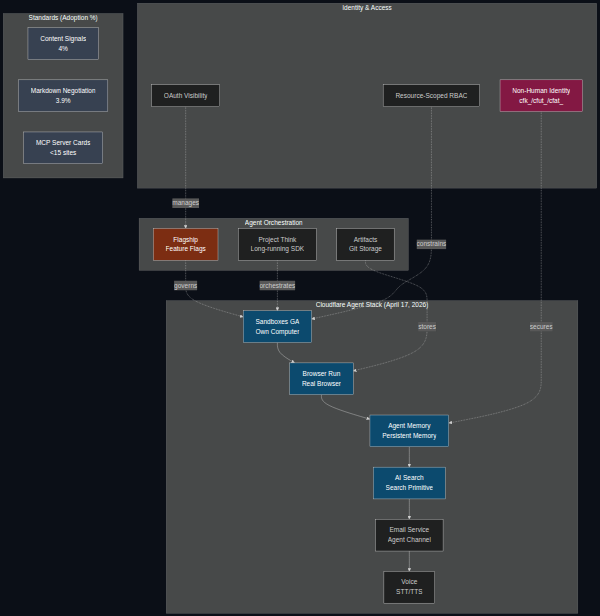
On April 17, 2026, Cloudflare shipped five blog posts in one day. By itself that's not news — Cloudflare ships blog posts the way McDonald's ships fries. What made it different was the topic: agents. Sandboxes, Browser Run, Agent Memory, AI Search, Email Service, Voice. Five primitives, one architecture, one thesis: the internet's next client isn't a browser.
Same week, they published isitagentready.com — a Lighthouse-equivalent that scores the top 200,000 domains on whether they work for AI agents. The score is brutal. 4% of sites have declared their AI usage preferences. 3.9% serve Markdown via content negotiation. Fewer than 15 sites in the entire dataset ship MCP Server Cards (source).
The infrastructure for the agent internet is shipped. The standards are published. The tooling is free. Adoption is in single digits because nobody bothered to write for an audience that doesn't render pixels.
The 32% problem
Cloudflare Radar published a number in April that quietly ended a decade of web architecture assumptions: 32% of all traffic across Cloudflare's network now originates from automated sources (source). That's search crawlers, uptime checkers, ad networks, and — increasingly — AI assistants doing retrieval-augmented generation.
#AI Agent#AI工程#Agent
Cloudflare Shipped the Agent Internet Stack. 96% of Sites Still Fail.
Within that 32%, AI crawlers specifically account for 80% of self-identified AI bot traffic. The vast majority is for training. Search is a distant second.
This is the new traffic shape. The internet learned to speak to browsers in 1995. It learned search engines in 1998. RSS in 2003. Mobile apps in 2008. Each transition took about a decade of broken sites, half-finished standards, and CMS plugins that mostly worked.
The agent transition is happening in months, not years. The infrastructure is being shipped faster than the standards are being read.
Why your CDN hates this
A typical human user visits maybe 10–50 pages per session, follows links, leaves, comes back tomorrow. Their access pattern is bursty, clustered, easy to cache. CDNs were built for this.
AI agents do something different. They iteratively loop to refine search results — the canonical pattern for RAG. Cloudflare's own measurement: agents maintain a 70%–100% unique access ratio (source). Each loop fetches new, unique content rather than revisiting previously seen pages.
Long-tail pages — the ones humans rarely touched — become the hot path. Common Crawl data shows that over 90% of pages are unique by content. AI crawlers target distinct content types. They don't follow optimal crawling paths. A substantial fraction of fetches from popular AI crawlers result in 404s or redirects, often due to poor URL handling.
This breaks the LRU cache eviction algorithm — the workhorse of every CDN — because the least-requested content keeps getting requested next. Pre-fetching stops working. Speculative caching stops working. The cache churns.
The damage is not theoretical:
Wikimedia: 50% surge in multimedia bandwidth usage from bulk image scraping (source).
Read the Docs: AI crawlers download large files hundreds of times daily — bandwidth costs went up enough that they reconfigured their CDN just to keep the site up.
SourceHut, Fedora, Diaspora: all reported service instability, slowdowns for human users, and in some cases had to geo-block entire countries to keep their sites functional.
The fix isn't to block AI traffic. That's a 2024 answer. The fix is to build a separate cache tier for agents — and that's exactly what
Cloudflare is now proposing.
The stack Cloudflare shipped in one week
The April 17 launch wasn't a single product. It was the full substrate:
The most interesting of the lot is Flagship — feature flags built specifically for the agent era. The framing is sharp: "Today, an AI agent writes code and a human reviews, merges, and deploys it. Tomorrow, the agent does all of that itself." Feature flags become the safety net — agents ship code paths behind flags, exercise them in production, ramp the rollout, or kill them based on metrics. Humans set the boundary. Flags control the blast radius (source).
That's not a feature flag product. That's a description of how autonomous systems get to ship to production safely.
The second-most-interesting is the MCP architecture Cloudflare published a few days earlier. The standard approach to MCP exposes a separate tool for every API operation. For a platform with thousands of endpoints, this exhausts the agent's context window. Cloudflare's fix is Code Mode — collapse thousands of tool definitions into two tools: search and execute. The agent writes JavaScript to find what it needs and call it. Measured result: 99.9% token reduction (source).
This is what mature infrastructure looks like. It's what the agent internet runs on, once it's running.
The lighthouse for agents
The most useful artifact Cloudflare shipped is the Agent Readiness Score at isitagentready.com. It scans your site across four dimensions:
Discoverability — robots.txt, sitemap.xml, Link headers
Bot Access Control — Content Signals, Web Bot Auth, AI bot rules
Capabilities — MCP Server Cards, API Catalogs (RFC 9727), OAuth discovery, Agent Skills
The current adoption on the top 200,000 domains:
robots.txt: 78% have one — but most are written for Googlebot, not agents
Content Signals: 4%
Markdown negotiation: 3.9%
MCP Server Cards + API Catalogs together: fewer than 15 sites in the entire dataset
This is not a Cloudflare-specific score. It's a snapshot of the entire internet. And it says: the content layer of the agent internet doesn't exist yet.
The site itself practices what it preaches. It exposes a stateless MCP server at /.well-known/mcp.json with a scan_site tool. It publishes an Agent Skills index at /.well-known/agent-skills/index.json with skill documents for every standard it checks. So agents not only know what to fix on your site, they know how to fix it.
The thinking is straight out of the Google Lighthouse playbook: score sites, publish the scores, shame the laggards, drive adoption. It worked for HTTPS. It worked for performance budgets. It might work here.
The non-human identity crisis
Underneath the cache and content problems is a scarier one. Cloudflare published the numbers from GitGuardian's State of Secrets Sprawl 2026 report: more than 28 million secrets were published to public GitHub repositories last year. AI is causing leaks to happen 5x faster than before.
The reason: AI coding tools commit code the way humans write emails — fast, without enough review, occasionally with embedded credentials. An agent that hardcodes an API token and pushes to a public repo creates a credential leak that scans can detect and attackers can weaponize in minutes.
OWASP now lists credential leaks, user impersonation, and elevation of privilege as the top three risks for agentic AI systems. Cloudflare's answer, published April 14, is three things:
Scannable token formats — cfk_, cfut_, cfat_ prefixes that scanners can detect with high confidence. Plus a checksum so the scanner can verify the token is real before revoking.
OAuth consent visibility — a central place to see which third-party applications have access to your account.
Resource-scoped RBAC — fine-grained policies that say "this agent can read from this bucket, and nothing else."
The pattern: principals, credentials, and policies have to be managed together. Cloudflare calls this the Passport + Visa model. A leaked token is a passport left on a park bench. A policy is the visa that determines what that identity can access.
The full architecture also includes a GitHub partnership that auto-revokes leaked Cloudflare tokens on every commit. "By the time you realize you made a mistake, we've already fixed it."
Why nobody's adopting
Here's the part Cloudflare won't say directly. The infrastructure exists. The standards are good. The Lighthouse-for-agents is up and scoring. And almost nobody is doing anything about it.
Three real reasons:
No economic incentive. HTML works. Mostly. AI crawlers can still extract content from rendered pages, even if they burn tokens doing it. The cost of non-adoption is hidden — it shows up as slower AI responses about your product, not in your AWS bill.
Nobody measures agent readiness in their job. Performance budgets get measured because they show up in Core Web Vitals and SEO rankings. Agent readiness doesn't show up anywhere a marketing team or a CTO gets graded on.
Standards are too new for legal/compliance teams to bless. Content Signals shipped in late 2024. MCP Server Cards are still in community charter. The legal team will not approve robots.txt directives whose spec might change next quarter.
The closer nobody wants to say out loud: the agent internet is being built in the dark. The infrastructure is here. The agents are here. The standards are here. The content layer doesn't know it's coming.
What to do about it
Five minutes of work, one endpoint to ship:
Run your site through isitagentready.com. Fix the four standard categories in order — Discoverability, Content, Bot Access Control, Capabilities.
Add Content Signals to robots.txt.Content-Signal: ai-train=no, search=yes, ai-input=yes — takes 5 minutes to write, zero infrastructure to deploy.
Implement Markdown content negotiation. When an agent sends Accept: text/markdown, serve Markdown. Cloudflare measured 80% token reduction in some cases.
Publish an MCP server if you have an API. The Lighthouse score includes it. The MCP spec is the easiest way for an agent to discover what your product can do without scraping your docs.
Use Cloudflare's scannable token formats (cfk_, cfut_, cfat_) for any credentials your agents will touch. They're free, they're more secure, and they auto-revoke on leak.
None of these are hard. All of them are missing from most production sites today.
The agent internet is real. The infrastructure is shipped. The agent readiness score is live and grading you right now. The reason 96% of sites still fail the test is that nobody is grading you on it yet — except Cloudflare Radar, and now, this article.
The internet learned browsers because Netscape and Microsoft made it impossible to ignore. It learned search engines because Google made page rank a status symbol. The agent internet will learn its standards the same way: someone has to start grading. Cloudflare just did. The rest is up to you.