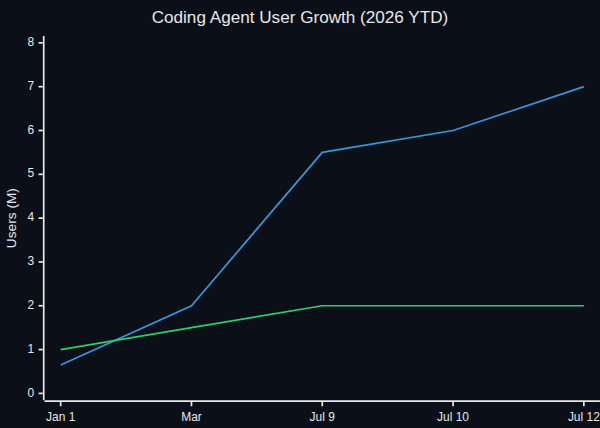
OpenAI Codex hit 7M users in mid-July, ~10x growth in 6 months. But the headline misses the real story: Anthropic metered programmatic Claude usage in May, and the unit metric shifted from $/M tokens to cost-per-task. The race stopped being about models.
Codex Hit 7M Users. The Real Story Isn't the Headline.
OpenAI Codex hit 7 million users on July 12, 2026. That's up from roughly 550k–700k on January 1 — about a 10x jump in six months, and a +1M users in the past day per Tibo (Source: Latent Space AINews, Jul 14).
Everywhere you read this week, the take is "Codex beat Claude Code." That's the wrong frame.
The user count is real. The comparison is broken. Anthropic quietly moved the bulk of Claude Code usage to Claude Tag — a Slack-resident harness with entirely different accessibility metrics — and stopped publishing weekly user numbers. The last public figure for Claude Code is from February 2026: roughly 2M users, $2.5B ARR, with weekly active users "doubled since January 1" (Source: Anthropic Series G press release).
You can argue Codex is bigger. You cannot argue Codex is 3.5x bigger. The metric surfaces aren't comparable anymore.
The interesting story isn't who's winning on users. It's that the race just changed categories.
What actually shifted: the metering decision
The structural break happened two months ago, on May 13, 2026. Anthropic announced that every Claude subscription now ships with API credits equal to the dollar amount of the plan. Pay $200 for Claude Pro, get $200 of programmatic credits — and nothing more.
Before May, third-party Claude harnesses (OpenClaw, OpenCode, Codex competitors) were running on an estimated 70–90% discount off list API price. That subsidy is gone. Communities called it a "rug pull"; Anthropic called it "official policy" (Source: Latent Space AINews, May 14).
Read the move carefully and a clear strategic posture emerges:
Anthropic wants Claude traffic on : Claude.ai, Claude Code, Claude Tag. Everything else gets metered.
#OpenAI#Anthropic#AI工程#Agent
Codex Hit 7M Users. The Real Story Isn't the Headline.
Anthropic-owned surfaces
OpenAI wants Codex on every surface: the CLI, ChatGPT Work, the Codex desktop app, plugin SDKs, third-party harnesses, custom agents. Limits stay generous; burn is acceptable.
The asymmetry is the story. Anthropic has decided to be a closed gas station that only services its own cars. OpenAI has decided to be a cheap wholesale fuel network that any car can pull into.
That's why Codex is growing 10x and Claude Code is going quiet on metrics. The user count isn't accidental — it's the direct consequence of a pricing architecture choice made eight weeks before GPT-5.6 launched.
From token price to cost-per-task
The second shift is in the unit of measurement, and it's more important than either user number.
For two years, every coding-agent benchmark was denominated in dollars per million tokens. That metric is dying.
Cognition ran Devin Fusion on Claude Fable 5 and reported it ended up cheaper per task than Claude Opus 4.8 — because in 81% of Fable-led runs, the lead model never made a code edit. Stronger delegation and judgment avoided wasted actions; the expensive model that did less actual writing was cheaper in the end (Source: Latent Space AINews, Jul 14).
GPT-5.6, launched July 9, is structurally built around this frame. Three sizes — Sol ($5/$30), Terra ($2.5/$15), Luna ($1/$6) per million input/output tokens — plus a 90% cache-read discount, plus a new ultra effort level that coordinates four agents in parallel. OpenAI's pitch to enterprise buyers is no longer "best model." It is "best dollars-per-task at any target performance level" (Source: Latent Space AINews, Jul 10; Sam Altman, @sama).
When the unit of measurement shifts, the leaderboard shifts. Coding-agent indices are already pivoting: skirano's explorer puts Terra Max slightly ahead of Fable 5 Max on score at materially lower cost. Arena placed GPT-5.6 Sol at #2 on its agent leaderboard from 7.8K real-world agentic sessions. The benchmarks are no longer measuring what builders care about.
What builders care about is: how many dollars does it take to ship a feature? Token price is one input. Turns, verbosity, cache hit rate, delegation failure rate, retry loops — each is a multiplier on the real cost. Cost-per-task is the actual answer.
OpenAI's bet — open surface, swallow the burn. Codex CLI, ChatGPT Work, the Codex desktop app that merges ChatGPT and Codex, Sites, programmatic tool calling, the multi-agent beta in the Responses API. Every two weeks there's a new surface; every surface ships with generous defaults. When GPT-5.6 Sol burned too hot under multi-agent, thsottiaux publicly walked through the fixes — context rolled back from 372k to 272k tokens, "juice" reasoning reverted, multi-agent overactivity fixed at high/xhigh. OpenAI's posture is operational transparency as a feature (Source: @thsottiaux, Jul 13).
Anthropic's bet — closed surface, premium brand, metered everything else. Claude Code as a flagship CLI, Claude Tag as a Slack-resident workflow wedge, every other surface pay-as-you-go at list price with a plan-credit cap. The bet is that brand + quality + workflow integration will keep users on Anthropic surfaces even when competitors undercut them on price. Anthropic's posture is to charge for the brand.
The model bet — small gap. Fable 5 and Opus 4.8 are within margin on most real workloads. GPT-5.6 Sol sits at #2 on Arena's agent leaderboard. There is no longer a single dominant coding model. The gap between top-three frontier coding models is now smaller than the gap between cost-per-task structures.
That is the inversion. Model is no longer the moat. Routing architecture is.
What this means for builders
If you build on the Claude API directly, you've already paid the metering tax. Budget for it; stop assuming the May subsidy was ever permanent.
If you build a third-party Claude harness — OpenClaw, OpenCode, or any custom wrapper — the cost economics flipped in May. Either renegotiate enterprise contracts or move the default model to a tier that doesn't punish you for existing.
If you build agent tooling, the unit metric you should be optimizing is dollars per shipped task, not dollars per million tokens. That means measuring: tokens per turn, turns per task, cache hit rate, retry rate, and the rate at which the lead model actually writes code. The cheapest agent in benchmarks is rarely the cheapest agent in production.
If you evaluate coding models the way you did in 2024 — leaderboards, $/M tokens, single-shot pass rates — you're optimizing for a market that doesn't exist anymore. The market that exists is routing, and routing rewards whoever runs the cheaper gas station.
The race isn't who has the smartest model
Codex 7M is real. Claude Code's silence on metrics is real. GPT-5.6 is cheaper per task than Fable on most workloads. None of those facts answer the only question that matters now: who runs the cheaper gas station, and who decides which cars can pull in?
OpenAI is letting everyone pull in. Anthropic is gating the forecourt.
The model gap will keep narrowing. The pricing-architecture gap is the moat for the next twelve months.