GPT-5.6's Trusted-Partner Release Means Frontier AI Is No Longer Public
Published on 2026-07-07
On June 27, 2026, OpenAI shipped GPT-5.6 — a 91.9% Terminal-Bench model that beats Claude Mythos 5 — but locked access to ~20 U.S. government-approved 'trusted partners.' The story is not the benchmark. It's the gate.
GPT-5.6's Trusted-Partner Release Means Frontier AI Is No Longer Public
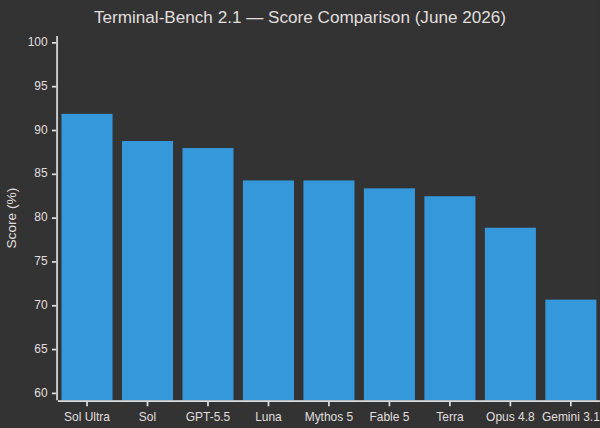
On June 27, 2026, OpenAI shipped the strongest model family it has ever built — and then locked the door. GPT-5.6 Sol, the new flagship, hit 91.9% on Terminal-Bench 2.1, beating Claude Mythos 5 by 7.6 points and doubling Gemini 3.1 Pro Preview's 70.7%. OpenAI also introduced Terra and Luna as a clean three-tier lineup, with pricing that undercuts Anthropic on the mid and low ends. Anyone paying attention assumed this would be a normal broad release: a model page goes up, the API opens, developers integrate by Friday.
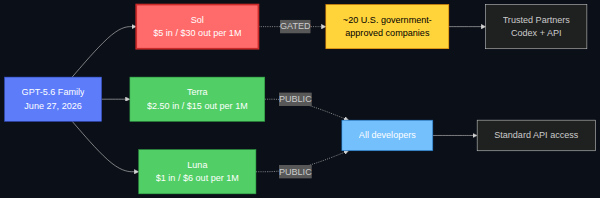
That didn't happen. OpenAI shipped GPT-5.6 as a "limited preview" to a pool of roughly twenty companies pre-approved by the U.S. government. Access is gated through Codex and the API. Broader rollout is "planned in the coming weeks." Sam Altman confirmed on X that OpenAI had originally planned a broader launch and switched to restricted release "at the request of the U.S. government."
This is the most important thing that happened in AI last week, and almost nobody is framing it correctly. The story isn't "GPT-5.6 is strong" — the story is that frontier intelligence is no longer a public commodity. Whether you can use the strongest model on Earth now depends on a permission slip from Washington, not on your credit card.
The numbers are real, and so is the gate
Let me put the capability gap in concrete terms. On Terminal-Bench 2.1, a benchmark that tests real command-line workflow competence, the scoreboard looks like this (sourced from OpenAI's preview post and cross-referenced by Latent Space's AINews):
GPT-5.6's Trusted-Partner Release: Frontier AI Is No Longer Public
GPT-5.6 Sol — 88.8%
GPT-5.5 (prior generation) — 88.0%
GPT-5.6 Luna — 84.3%
Claude Mythos 5 — 84.3%
Claude Fable 5 — 83.4%
GPT-5.6 Terra — 82.5%
Claude Opus 4.8 — 78.9%
Gemini 3.1 Pro Preview — 70.7%
Sol Ultra is the first model to clear 90% on this benchmark. It does so while being roughly half the output-token cost of Mythos 5 — Sol is $30/M output, Mythos 5 is $50/M. On the cyber benchmark ExploitBench, Sol is close to Mythos Preview performance using about a third of the output tokens, per OpenAI.
This is not a marginal release. The model is genuinely better, materially cheaper, and structurally more capable on the things that matter for production agents: long-horizon tasks, subagent orchestration, code workflows.
And almost nobody outside an approved list can use it.
The "trusted partner" pool is the actual product
The interesting architectural choice is not the three-model lineup. It's the rollout model. Latent Space's reporting, drawing on @kimmonismus and others tracking the X-thread reaction, pegs the initial pool at around twenty U.S.-government-approved companies, with possible expansion "next week" if further testing goes well. The list is not public. The criteria for inclusion are not public. The approval process is not public.
OpenAI framed the move as the company being "transparent" about a "reliable process" for early access. That framing is, charitably, optimistic. A more accurate description: a frontier model is being released to a permissioned network first, and the rest of the developer ecosystem will get access later — maybe.
The pattern is not new in spirit, but the scale is. The Defense Production Act, the CHIPS export controls, the early-2026 discussions about frontier-model compute thresholds — these have all been signals that the U.S. government is moving from "regulate AI after the fact" to "control the release of frontier AI at the moment of release." GPT-5.6 is the first time a top-tier commercial model has been formally gated on government approval at launch, with the company publicly acknowledging it.
The commentators who read the release correctly — @kimmonismus, @theo, @matvelloso — converged on the same point: frontier releases are becoming government-mediated. "Trusted partner first" is not a one-off. It's a label.
The three-tier lineup tells you what the gate is for
Look at the model family as a product decision and the structure clarifies. Sol is the flagship, at $5 / $30 per 1M tokens, trusted-partner-only — the model you'd use to build a frontier agent, gated. Terra is the mid-tier at $2.50 / $15, marketed as "GPT-5.5-competitive at half the price," and Luna is the high-volume, low-cost option at $1 / $6, matching GLM-5.2 on blended cost. Both Terra and Luna ship publicly.
The gate sits on the top of the stack. If you want the model that can do agentic cyber research, run subagent orchestration, or beat Mythos 5 on Terminal-Bench, you need a trusted-partner badge.
This is a tiered intelligence market. The tier you can buy is determined by Washington, not by your budget.
The technical innovations you can't get
Two product concepts ship with Sol that are not available in Terra or Luna:
"Max reasoning" allocates a longer deliberation budget to the model — it thinks longer, sometimes ten times longer, before producing output. Useful for hard math, complex code, multi-step planning.
"Ultra mode" orchestrates subagents — the model spawns child agents to handle sub-pieces of a complex task and aggregates the results. This is the same architectural pattern that serious agent teams have been hand-rolling for eighteen months. OpenAI productized it.
Both capabilities matter. If you're building an agent that needs to plan a migration, debug a distributed system, or run a multi-step research workflow, you want max reasoning and ultra mode. Both are gated.
A widely circulated reading, summarized by @tenobrus and others: OpenAI is now productizing patterns that the agent community treated as harness-level differentiation. That part is true. The part that isn't being said loudly enough: most developers can't run those patterns, because the model that supports them isn't available to them.
The runtime layer is moving fast too. GPT-5.6 Sol launches on Cerebras in July at up to 750 tokens per second — a number that changes what's possible for interactive agents. Real-time code generation, sub-100ms response loops, on-device-feeling latency from a hosted model. That capability is also gated behind the same trusted-partner fence, which means the speed advantage accrues to the same companies that already have access.
What this means for you, depending on what you do
Two audiences, two different impacts.
If you build consumer or SMB products on OpenAI's API: You're now in the Terra/Luna tier. The pricing is genuinely good. The capability is roughly GPT-5.5 with better cost structure. Build with confidence — this is a strong release for the use case you have.
If you build frontier agents and want Sol: The path is unclear. Apply for trusted-partner status, wait for the public rollout, or build on a non-gated model that approximates Sol. None of those are great options in the short term. The fact that OpenAI did not pre-announce a public GA date is itself the story. Expect enterprise procurement teams to ask, for the first time, "what's our continuity plan if the next flagship is gated for six months?" — a question that was absurd twelve months ago and is now reasonable.
Competitors, meanwhile, get a window. Anthropic, having just relaxed Mythos 5 controls, is the most credible alternative for developers who need frontier capability and access. The local-model story (Qwen, GLM, the open-weights frontier) becomes more compelling when the closed frontier is gated.
The bigger shift: from "release" to "allocation"
The natural frame for a model launch is "released today." GPT-5.6 is not a release in that sense. It's an allocation.
The U.S. government has not historically decided which companies can use the best commercial AI models. It decided that for the first time, formally, with GPT-5.6. The reason given — cyber risk, per the Preparedness Framework — is legitimate. Sol can identify bugs and exploitation primitives in Chromium and Firefox. OpenAI explicitly says Sol "does not cross the Cyber Critical threshold" because it didn't autonomously produce a full-chain exploit in their tests. But "did not cross" is a moving bar, and the next model will probably clear it.
The implication: the gating will probably get tighter, not looser. If Sol is gated at launch, and Sol Ultra is even more capable, the natural policy direction is to gate more, not less. Trusted-partner pools may become a permanent feature of frontier model distribution.
For developers, the practical question is no longer "which model is best" but "which models can I actually use, and for how long."
What's likely to happen next
Three predictions, each falsifiable:
OpenAI announces trusted-partner expansion to ~50-100 companies within 60 days, with formal criteria published. The current opacity won't survive enterprise procurement pressure.
Anthropic responds by making Mythos 5 more accessible, not less. They've already started this. The competitive move when your rival's flagship is gated is to keep your flagship open.
The open-weights community gets a tailwind. A gated frontier is the single best argument for local models. Expect 2026 H2 to be a strong release window for open-weights reasoning models, and expect enterprise interest in self-hosted inference to spike.
If prediction 1 doesn't happen, the gating gets more opaque and the developer backlash grows. If prediction 2 doesn't happen, Anthropic cedes the "open frontier" positioning to a Chinese or open-weights competitor.
The takeaway
GPT-5.6 Sol is the strongest model you can't use. That's a sentence nobody would have written a year ago.
The capability gap between Sol and everything else is real and large. The access model for Sol is now structurally different from every previous frontier release. Whether you read that as a one-time response to cyber risk or the beginning of a permanent allocation regime depends on what the U.S. government does over the next six months.
If you can use Sol: build. If you can't: pick the model you can build on, and keep an eye on the access rules changing under your feet. The frontier is moving. The gate is also moving. Both are moving in the same direction.
Sources: OpenAI "Previewing GPT-5.6 Sol" (openai.com/index/previewing-gpt-5-6-sol); Latent Space AINews 6/27 (latent.space/p/ainews-openai-gpt-56-sol-terra-luna); DeepLearning.AI The Batch issue 360; ifanr 6/27 benchmark summary; OpenAI and Sam Altman X threads; @kimmonismus, @reach_vb, @scaling01, @tenobrus, @theo, @matvelloso, @Yuchenj_UW.