The CLI Is the New GUI — Why Every Software Product Is Shipping an Agent-Optimized CLI in 2026
Published on 2026-07-06
Five companies — GitHub, Vercel, JetBrains, MiniMax, and Feishu — all shipped agent-optimized CLIs in the same quarter. The CLI has stopped being a power-user toy and become the only stable interface an AI agent can actually parse. Here are the three rules every agent-native CLI follows.
The CLI Is the New GUI — Why Every Software Product Is Shipping an Agent-Optimized CLI in 2026
In the first week of April 2026, five companies — GitHub, Vercel, JetBrains, MiniMax, and Feishu — all pushed the same kind of update: a CLI redesigned around agents. GitHub added /fleet to Copilot CLI so one Copilot instance could dispatch five sub-agents in parallel (https://github.blog/ai-and-ml/github-copilot/run-multiple-agents-at-once-with-fleet-in-copilot-cli/). Vercel rebuilt discover and guide so an agent could install a database and read the setup doc in one JSON round-trip. JetBrains wired Junie CLI into the running IDE. MiniMax shipped MMX-CLI with the design statement "built for agents, not for humans" on the first line of the release post.
This was not a coincidence. The CLI has stopped being a power-user toy. It is now the only stable interface an AI agent can actually parse.
The stack is flipping, and most teams haven't noticed
Walk through any developer tool's release notes from the last quarter and the pattern is unmistakable. The interesting updates are not new features in the dashboard. They are new flags in the CLI.
Feishu, the Chinese workplace SaaS with billions of chat messages, open-sourced the entire application as a CLI in late March. The release note from 数字生命卡兹克 (March 28, 2026) called it the equivalent of the day Feishu first became scriptable — except this time the operator is Claude Code, not a developer.
Read those five posts side by side and the question answers itself: why a CLI?
Why GUI breaks for agents
Computer vision models can now click buttons on a screen. Anthropic, OpenAI, and Google all ship "computer use" APIs that let an agent see a webpage and press the right pixel. The demo videos look magical.
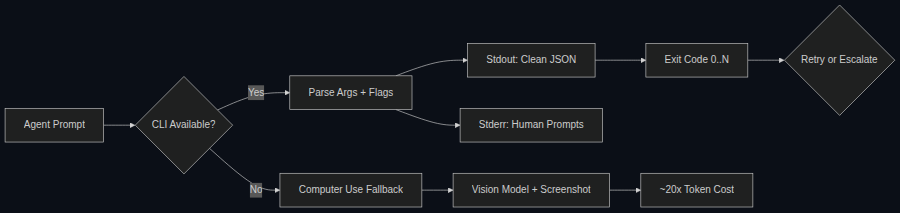
They are also a tax. Every click is a screenshot, every screenshot is a vision-model inference, every inference burns tokens. A workflow that would take 200 tokens through a CLI takes 4,000 tokens through a mouse cursor. Worse, the model has to re-derive what a human can read in a glance: which field is required, which button is the primary action, what error code 0x4f3a actually means.
GUI is an accessibility layer for human eyes. It assumes the operator has a retina and a saccade pattern. Agents have neither. They have a context window and an exit code.
The CLI is the protocol they actually want. Plain text in, plain text out, a status code to branch on, and the option to be driven from a shell script. No DOM parsing, no vision model, no ambiguity about whether the modal is loading or stuck.
This is why every team that woke up to agents in 2026 reached for the same fix. They didn't redesign the dashboard. They didn't build a brand-new MCP server. They added a --format=json flag and a non-interactive mode to the CLI they already had.
Rule 1 — Clean stdout, human noise on stderr. Progress bars, ASCII art, color codes, and "Press Enter to continue" prompts must go to stderr. Stdout only contains the data the next command (or the agent) actually needs: a file path, a JSON payload, an ID. Add --quiet and --output json to lock the contract. An agent parsing the output should never have to regex out a \u001b[32m ANSI escape code.
Rule 2 — Semantic exit codes. The bash convention says 0 is success, non-zero is failure. That is not enough. An agent has to decide whether to retry, give up, or escalate to a human. Return distinct exit codes for auth failure, parameter error, timeout, and network error. The agent reads one integer and branches. It never has to parse an English sentence to know what went wrong.
Rule 3 — Non-blocking, no interactive prompts. A missing argument must exit, not block. A long-running task must have --async so the agent can fire-and-forget and check back. There is no "press any key to continue" in an agent's world — there is no key.
JetBrains' Junie CLI adds a fourth dimension worth naming separately: environment awareness. Junie detects the running IDE and asks it for the project structure, the build configuration, the test runner. The agent stops guessing how to run npm test in a monorepo with five workspaces — the IDE already knows. This is the direction every CLI will go next: from "I speak JSON" to "I know the environment I'm in."
The branch on the right is where the industry is heading. The branch on the left is where 2026's spend is going.
What this means for builders
Three concrete implications if you ship any developer-facing product.
First, your CLI is now a first-class product surface, not a sidecar. The users showing up in 2026 are agents. They will never see your dashboard. If your CLI returns ASCII art on stdout, requires a TTY, or exits with a generic 1 on every error, you are invisible to them. Audit your CLI against the three rules above. Most teams find at least one of them broken.
Second, --format=json is the smallest unit of agent-readiness. Vercel did not rewrite vercel logs from scratch. They added the flag, scoped to git context by default, and made historical querying a one-liner. That is a 30-day project. A "full agent-native redesign" is a marketing phrase; a JSON flag is the actual deliverable. The original vercel logs call returned a streaming table the developer could read. The --format=json version returns one structured object per line — requestID, status, duration, message — and an agent can pipe the whole stream into a regex without ever rendering a pixel. That is the difference between "AI reads the screen" and "AI reads the API."
Third, expect every CLI to grow environment awareness next. Junie's IDE handshake is the template. Tomorrow it will be Kubernetes operators asking the cluster for the live pod state. The day after, agents asking other agents for service topology over a CLI. The CLI is becoming the protocol layer for software that talks to software.
The CLI is the protocol now
GUI will not disappear. Humans still need buttons, dashboards, drag-and-drop. But for software-to-software traffic — which is now the majority of API calls in an agentic workflow — the CLI has won. It is text, it is shell-scriptable, it returns integers, and it doesn't need a vision model.
The companies shipping Agent-optimized CLIs in 2026 are not doing it because their developer relations team had a good quarter. They are doing it because they measured the call volume and discovered that the new fastest-growing "user" of their platform is a model that can't read pixels.
The next question is whether the CLI itself gets replaced. Maybe agents will skip the shell entirely and negotiate directly over MCP, A2A, or whatever protocol comes next. But every protocol that replaces the CLI will, by definition, look like a CLI with extra steps.
So build the CLI now. Make the stdout clean. Make the exit codes count. Make the prompts go to stderr. The agent is already at the door — it just doesn't know how to read your modal yet.