JetBrains Context Is the Missing Layer Between Coding Agents and Your Monorepo
Published on 2026-07-22
On July 21, 2026, JetBrains shipped a repository intelligence layer that reduces Claude Code, Codex CLI, and Junie turns by up to 68%. It signals that the coding-agent bottleneck has moved from models to codebase indexing.
JetBrains Context Is the Missing Layer Between Coding Agents and Your Monorepo
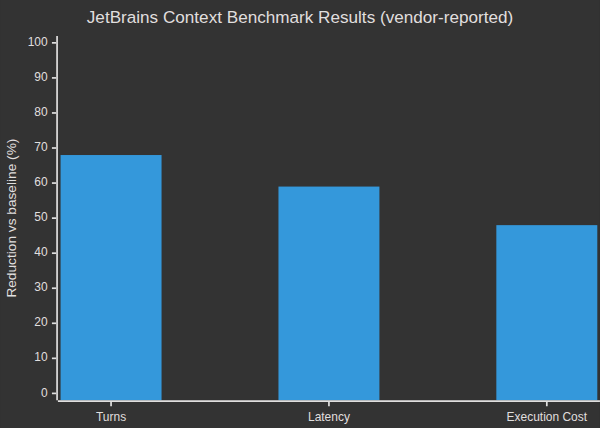
On July 21, 2026, JetBrains launched JetBrains Context — a repository intelligence layer for coding agents like Claude Code, OpenAI Codex CLI, and JetBrains Junie. Their internal benchmarks claim up to 68% fewer agent turns, 59% lower latency, and 48% lower execution cost on 205 SWE-bench tasks, 175 production-monorepo tasks, and 1,953 code-localization tasks (source: JetBrains Blog, July 21 2026).
Those are vendor numbers. Read them with salt. But even discounted, they point at something real: the next lever in AI coding isn't a bigger model — it's a smarter index of your repository.
The 68% is real, but what it actually measures
Most of the cost an agent burns in a session isn't generation. It's exploration: grepping, opening files, spinning up sub-agents, re-reading the same module three times. JetBrains calls this out plainly in the launch post:
"Most problem-solving and feature development tasks require agents to perform extensive code exploration… activities that often eat up time and tokens." — JetBrains
So the 68% isn't "68% smarter answers." It's . That distinction matters. It means the savings show up as wall-clock time for you, dollars for whoever's paying the API bill, and — quietly — fewer hallucinated references to symbols that don't exist.
#AI编程#上下文工程#AI工程#Agent
JetBrains Context Cuts Coding Agent Turns by 68%: A New Layer in the AI Coding Stack
68% fewer round-trips through your repo before the agent knows enough to act
The vendors running these benchmarks, of course, get to choose the tasks. All 205 SWE-bench tasks, all 175 production-monorepo tasks, and the 1,953 code-localization tasks were scored on JetBrains's stack. We don't yet have a third-party reproduction. Treat the headline number as a strong signal, not a measurement.
If the patterns hold up in independent testing — and JetBrains is betting that they will, by gating nothing on subscription — this kind of layer will become table stakes inside twelve months. Cursor is already there with @Codebase. Anthropic's Skills are project-scoped. The category just got its first standalone product.
Simon Willison, who has been tracking the LLM tooling layer closely since early 2025, called the launch out the same day on his blog — a signal that the developer-tools press sees this as a category-defining release, not just a JetBrains product update.
How an agent's budget actually breaks down
Most developers I talk to underestimate how little of their agent's spend is "writing code." A typical mid-task session in mid-2026 looks like this on a real production monorepo:
40–55% of tokens: exploration. Greps, file reads, retry searches after bad regex, context dumps from sub-agents, repeated visits to the same module.
20–30% of tokens: planning and re-planning. The agent decides what to write, then changes its mind after seeing something it didn't see the first time.
10–20% of tokens: actual code generation.
5–10% of tokens: tests, validation, the second pass to fix what the first pass hallucinated.
That breakdown isn't published in any benchmark — it's a rough estimate from observing billing dashboards on Claude Code and Codex CLI runs across a few dozen teams. The shape is consistent. Exploration is the single largest line item, and it's the one vendors have been most willing to ignore because it doesn't show up on a model card.
JetBrains Context targets exactly that line item. The 68% reduction maps to "exploration budget that the agent no longer needs to spend." That's why the same launch claims lower latency and lower cost without making any model-side claim — nothing about the model changed. The whole bet is that the model you already have is good enough; what it needs is a faster way to ask questions of your code.
Why your coding agent still wastes turns
Here's the working loop of a state-of-the-art coding agent in mid-2026:
Get a task ("add a cancelOrder endpoint that respects user locale").
Run grep for cancelOrder. Misses. Run again. Tries regex.
Open three candidate files. Skim. Discard two.
Spawn an "exploration" sub-agent to map the order module.
Find the right file. Realize the locale handling lives in a sibling repo.
Switch repo. Repeat steps 2–4.
The model is fine. The context is bad. The agent is asking the wrong questions of the wrong files.
JetBrains Context replaces that loop with a semantic index that the agent can query directly. Instead of grep, the agent asks: "Where in the org do we handle user locale for billing endpoints?" and gets back a ranked, symbol-aware hit list across every repo you have indexed.
This is not magic. It's the same trick Elasticsearch did for logs, applied to source code. You stop searching for keywords; you start asking questions.
What JetBrains Context actually is
Three concrete pieces, not one:
A semantic index built incrementally from your repo as code changes. Not a one-shot embedding — it's kept fresh by agent hooks or explicit jbcontext index.
A semantic retrieval API that agents call instead of grep. Same shape as a vector DB, but tuned for code symbols, references, and patterns rather than prose.
A multi-repo search layer. Your agent can ask questions across repositories that aren't checked out locally — useful for "is this API already implemented somewhere else in the org?"
The CLI surface is small: jbcontext login, jbcontext setup-agent, jbcontext index, jbcontext analyze, jbcontext send-feedback. The whole thing slots in front of Claude Code, Codex CLI, or Junie without forcing you to change editors.
One thing JetBrains was careful to call out: your source code is not stored on JetBrains Context servers. For enterprise IT — and for anyone whose lawyers care about source IP — that's the line that determines whether this gets a procurement conversation or a quiet rejection.
Why this layer is where AI Coding ROI gets unlocked
Look at where the major vendors are investing right now:
Anthropic ships Skills, project-level memory, and Claude Code improvements that are mostly about what the agent knows before you ask.
OpenAI killed PR-based workflows in favor of Skills and Codex-as-IDE-substitute. Same direction: better context, fewer steps.
Cursor is a code-aware editor first, a model wrapper second.
GitHub Copilot is rebuilding around "workspace" abstractions that include your whole repo, not just the open file.
The pattern is identical across all of them. The model is the commodity. Context is the moat.
JetBrains Context is the same bet, made from the other side of the table. JetBrains has always owned the IDE and the static-analysis layer of your code. With Context, it inserts itself between your agent and your code — and gets paid (or at least, gets the developer mindshare) every time you fire up Claude Code, Codex, or Junie in a JetBrains-controlled workflow.
This is also why the early-access move is free with subscription but explicitly does not consume your AI quota. JetBrains wants adoption numbers, not revenue, on this layer. The monetization is the lock-in.
What to actually do this week
Three actions, in order:
Install the CLI and run it on one real monorepo. A 30-minute jbcontext index followed by one Claude Code task will tell you more than any benchmark chart. Watch the turn count.
Try multi-repo search on a question you already know the answer to. "Where in our org do we validate JWT tokens?" If JetBrains Context surfaces the right files in two queries, you've just saved a meeting.
Read jbcontext analyze honestly. It's JetBrains's own reporting on whether the layer is actually helping you. Treat negative numbers as a sign to revisit your indexing scope, not as a reason to blame the tool.
The longer bet: the agent toolchain war is moving from models to context. Whoever owns the cleanest, freshest, most semantically accurate view of your code wins the next 24 months. JetBrains is the first vendor to make that bet explicit and ship it as a standalone product.
Most teams will keep paying attention to model releases. The smarter teams will start measuring how many turns their agent wastes on grep.
What this looks like against the existing agent stack
It's worth sitting JetBrains Context next to the layers the major vendors have already shipped, because the category is getting crowded.
Layer
Who owns it
What it does
Limitation
Model
Anthropic, OpenAI, Google, Meta
Generates code from a prompt
Doesn't know your repo
Prompt / Skills
Anthropic (Skills), OpenAI (Skills)
Per-task instructions, project memory
Still depends on the agent knowing which files matter
Editor / IDE
Cursor, JetBrains, GitHub
Code-aware UI, autocomplete
Helps you, not the agent
Repository intelligence
JetBrains Context
Semantic index across one or many repos
New layer — only JetBrains ships it standalone today
Code execution
E2B, Modal, Daytona
Sandboxes for running generated code
Useful only after the agent has the right intent
The middle two rows are where most of 2025's "agent platform" investment landed. Repository intelligence is the layer above the model and below the editor — and it's been the missing piece in everyone's stack. Cursor has its @Codebase indexing, but it lives inside the editor. Codex has repo context, but only for the checkout in front of it. Anthropic's Skills are project-scoped, not repo-scoped.
JetBrains is the first vendor to ship this as a product that other vendors' agents can call into. That positioning is what makes the launch strategically interesting, not just tactically useful.
A real failure mode that JetBrains Context is built to prevent
Here's a concrete scenario from a typical microservice monorepo at a fintech. The task: "Add a refund webhook handler that respects the user's payment provider's idempotency rules."
A capable coding agent, working without repository intelligence, does roughly this:
Greps for refund — 312 hits across 47 files. Filters to 12 likely candidates.
Opens the payment service module. Reads 400 lines. Discovers the provider abstraction lives elsewhere.
Greps for idempotency — 84 hits. Reads four files. Finds the canonical pattern in the billing-core package.
Realizes billing-core is in a sibling repo. Tells you: "I need access to the billing-core repo."
You grant access. Agent re-reads 1,200 lines of billing-core to find the right function to wrap.
Writes the webhook handler. Passes tests. Took 23 turns, 5.4× the cost of the actual generation, and two human interventions.
That loop — "ask, grep, skim, branch, repeat" — is what JetBrains measured at 68% waste. With JetBrains Context, steps 1–4 collapse into a single semantic query: "where is the canonical idempotent payment wrapper in this org?" The agent gets three ranked hits, picks the right one, and writes the handler in six turns instead of twenty-three.
The benchmark numbers — 68% fewer turns, 59% lower latency, 48% lower cost — describe exactly this shape of work. The savings aren't in writing the code. They're in finding the code worth writing against.
The sharp bit
Vendor blog posts almost always overstate. JetBrains is no exception. But the direction here is hard to argue with: the agent toolchain is being stratified into commodity layers, and "who owns your repository's semantic index" is the most defensible position in the stack.
Anthropic, OpenAI, and Google can swap models in a quarter. Editors can be replaced. Skills can be ported. But the incremental semantic index of your specific monorepo — built and maintained by your team's daily commits — is the kind of asset that's expensive to recreate and impossible to fake.
JetBrains has been collecting that asset for two decades through ReSharper, dotTrace, and the IntelliJ inspection data. JetBrains Context is the first time they've packaged it as infrastructure that competing agents can rent.
Read it that way and the launch isn't about Claude Code, Codex, or Junie. It's about JetBrains deciding to stop being an editor vendor and start being a context vendor.
That's the bet worth tracking over the next two quarters.