NVIDIA's Open Models Are Not Charity. They're CUDA With Weights
Published on 2026-07-27
NVIDIA's open models are a distribution layer for its hardware and software ecosystem: shared foundations, open recipes, and production deployment turn free weights into infrastructure adoption.

NVIDIA's Open Models Are Not Charity. They're CUDA With Weights
On July 27, ByteByteGo published an interview with Bryan Catanzaro, NVIDIA's VP of Applied Deep Learning Research, about the company's open-model program. The lineup spans reasoning models, world models, robotics, autonomous driving, biology, quantum computing, and weather.
That breadth is the clue. NVIDIA is not giving away a few checkpoints. It is trying to make open models the front door to a larger stack.
The weights are free. The habits they create are not.
The Reusable Foundation Trick
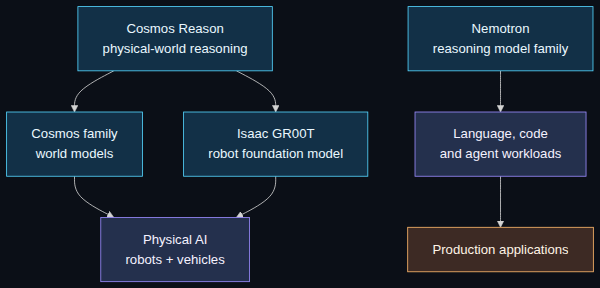
Catanzaro described a detail that deserves more attention: NVIDIA reused the reasoning core from Cosmos Reason inside Isaac GR00T, its robotics foundation model. The same capability can move from a physical-world model into a robot model instead of being rebuilt by a separate team.
This is more than an efficient engineering choice. A shared model foundation lets every new domain amplify the value of the original architecture and the infrastructure around it.
Think about the consequences. One foundation can serve language, robotics, autonomous driving, and other specialized systems. Engineers still need domain-specific data and post-training, but they do not have to reinvent the whole stack each time. The model family starts to behave like a platform primitive.
That also explains why NVIDIA's architecture choices matter. The ByteByteGo interview describes hybrid Mamba-and-attention designs, mixture-of-experts routing, and 4-bit NVFP4 training designed alongside NVIDIA's Blackwell hardware. These are not just model-card trivia. They are choices about how capability, memory, throughput, and hardware fit together.