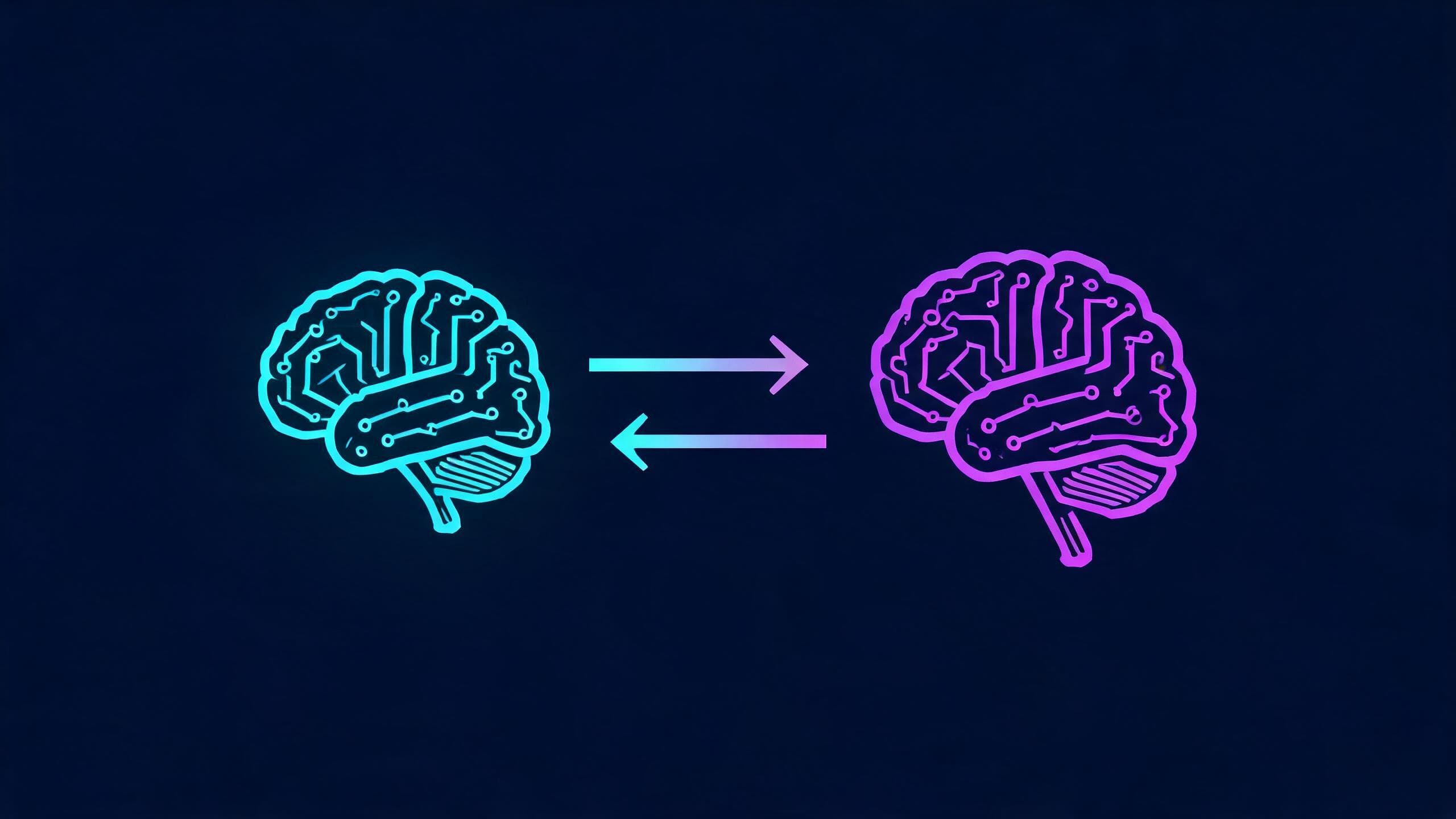
Two models in a loop: a fast one that does the work, and a slow one that thinks twice. The advisor pattern is quietly becoming the dominant architecture for serious AI workloads. Here's why it works, what it costs, and what it means for the AI stack.
The Advisor Pattern: Why Your Fast AI Needs a Smart Backup
There's a pattern emerging in production AI systems that no one is naming explicitly yet — but everyone is building. Two models in a loop: a fast, cheap one that does the work, and a slow, expensive one that thinks twice before the fast one commits a mistake. Call it the advisor pattern, and it's quietly becoming the dominant architecture for serious AI workloads.
It started as a trick. A hack. Someone realized that asking a small model "is this right?" before handing the output to a larger model caught edge cases that the small model missed. Then researchers at Berkeley published formal work on "Advisor Models." Anthropic shipped an advisor tool in its API. Harrison Chase retweeted it, and within a week there was open-source middleware for it in LangChain. The pattern moved from research paper to production best practice in the time it takes to merge a pull request.
The fundamental insight is simple: models are specialized by inference budget, not capability ceiling. Haiku is fast and cheap — but it regularly stumbles on multi-step reasoning. Opus is slow and expensive — but it catches the edge cases Haiku misses. So instead of choosing one, you use both. Haiku handles the 90% of cases it handles well. Opus handles the 10% that would have cost you a customer, a bug, or a hallucinated invoice.
The Numbers Behind the Pattern
The performance gains are not marginal. According to practitioner data cited at AI Engineer Europe 2026, Haiku + Opus more than doubled performance on BrowseComp compared to Haiku alone. Sonnet + Opus improved SWE-bench Multilingual scores while simultaneously reducing overall task cost — because Sonnet handled most of the straightforward work, and Opus only stepped in for the genuinely hard decisions.
That cost-reduction part is counterintuitive. You might expect adding an expensive model to every request to blow up the bill. But the math works out because of how sparse the hard cases are. In a typical code review workflow, 85% of comments are stylistic nits. The remaining 15% are actual bugs — and that's the part where the expensive model earns its price. You're paying Opus rates for 15% of the tokens, not 100%.
Why Now? Why Not Earlier?
The advisor pattern couldn't have existed two years ago for a boring reason: the fast models weren't good enough to be trusted with the first pass. They made too many mistakes, missed too many edge cases, and produced confidently wrong outputs that a human — or a second model — would have caught. The second model had to intervene so often that the latency and cost overhead negated any benefit.
The Advisor Pattern: When to Outsource Your Thinking | AI Engineering
What's changed is the quality floor. Haiku at 3.5, Qwen3-Coder at 8B, Gemini 3.1 Flash — these models are good enough at the straightforward 80% that involving a second model is genuinely optional for most of that work. They fail gracefully on the hard parts rather than confidently on everything. That failure mode — "I'm not sure, let me escalate" — is what makes the advisor pattern viable.
The second enabler is context. The advisor model needs to see the same context as the executor model to make useful judgments. As context windows grew to 1M tokens and cross-model state sharing became easier, the logistics of running two models in concert stopped being a systems nightmare.
The Architecture Is the Abstraction
Here's what's interesting about the advisor pattern from a systems design perspective: it's one of the first times the harness — the code that orchestrates model calls — has become a first-class product concern, not an implementation detail.
For the past three years, the implicit assumption was: pick the right model, call it in a loop, you're done. The model was the product. The harness was glue code.
The advisor pattern inverts that. The harness decides which model runs when. The model is infrastructure. This is a meaningful shift in the AI stack — similar to how early web apps treated the database as the product, until caching, replication, and read/write splitting turned the database into infrastructure and the application logic into the product.
In this framing, the interesting engineering questions become: How do you detect when the fast model is about to fail? What does a good escalation signal look like? When is it safe to trust the fast model's confidence, and when should you override it?
These are not model questions. They are systems questions. And they require thinking about AI pipelines the way you think about distributed systems — with failure modes, observability, and graceful degradation as first-class concerns.
The Observability Requirement
This is where most teams hit a wall. The advisor pattern is easy to prototype and hard to ship correctly.
The reason: you can't improve what you can't measure. If your fast model escalates to the slow model 40% of the time, is that good or bad? It depends entirely on what would have happened if it hadn't escalated. Are you catching real failures, or are you burning expensive inference on phantom concerns?
This requires trace-level observability into the full decision chain — what did the executor model receive, what did it output, what was the advisor's intervention, and what would the outcome have been without the intervention? That kind of counterfactual logging is non-trivial to build and expensive to store.
Teams that have solved this — LangChain's new tracing, Weights & Biases' Claude Code integration, Weave's auto-tracing — are the ones reporting the clearest wins. The rest are operating on gut feel, and gut feel in AI systems is notoriously unreliable because failures are often silent. The model doesn't throw an error when it makes a mistake. It just ships the wrong answer with the same confidence as the right one.
The Routing Problem Nobody Is Talking About
Model routing — automatically directing different tasks to different models — is becoming a product pain point, not a research question.
The practitioner complaint (as articulated by several engineers at AI Engineer Europe) is that top models are "spiky" — Opus often wins on frontend and agentic flow, while GPT-5.4 performs better on backend and distributed systems tasks. But tools like Claude Code and Codex are too provider-bound. They don't let you easily mix and match at the task level.
The advisor pattern is one answer to this. But it's an architectural answer, not a product answer. What the ecosystem is still missing is a clean abstraction for "given this task, run it against Model A, and escalate to Model B if confidence < X." Right now, that logic lives in application code — different for every team, every workflow, every model combination.
The pattern that will likely win is a routing layer that sits in front of models and makes these decisions automatically — not unlike how a load balancer distributes traffic based on health checks and latency thresholds, except the health check is an evaluation of whether the model's output is trustworthy.
Skills as the New Interface
One orthogonal trend that intersects with the advisor pattern: skills are becoming the portable unit of AI capability.
A well-designed skill encapsulates not just a prompt but the full loop — tool calls, error handling, escalation logic, and output formatting. As these become more portable (AGENTS.md as a convention, skill catalogs in frameworks like Hermes and crewAI), the advisor pattern becomes easier to deploy because the escalation logic can travel with the skill.
This is a shift from "prompt engineering" to "skill engineering." Prompts were fragile — a few words changed could flip the output. Skills are designed to be robust, versioned, and composable. The advisor pattern fits naturally inside a skill: here's the fast path, here's the escalation path, here's how you measure whether escalation was warranted.
What This Means for Builders
If you're building AI features today, the advisor pattern is worth taking seriously — not as a framework to adopt wholesale, but as an architectural principle: separate the work into what needs a fast pass and what needs a second look, and design your system accordingly.
The specific implementation — one model or two, synchronous or asynchronous, heuristic escalation or confidence-score-based — depends on your latency requirements and failure cost. A code completion tool that suggests the next line has a low failure cost; a tool that generates invoice amounts has a very high one. The same advisor pattern, different escalation thresholds.
The deeper point is that the AI stack is maturing. The model is no longer the only interesting layer. The harness, the routing, the observability, and the escalation logic are where the engineering happens now.
The advisor pattern is a symptom of that maturation. We stopped arguing about which model is best and started asking the more useful question: given this task, who should handle it, and who should check their work?
That's a more boring question than "is Claude better than GPT?" But it's the question that actually solves problems in production.