The Agent Runtime Wars: Who's Winning the Invisible Infrastructure Battle
Published on 2026-05-19
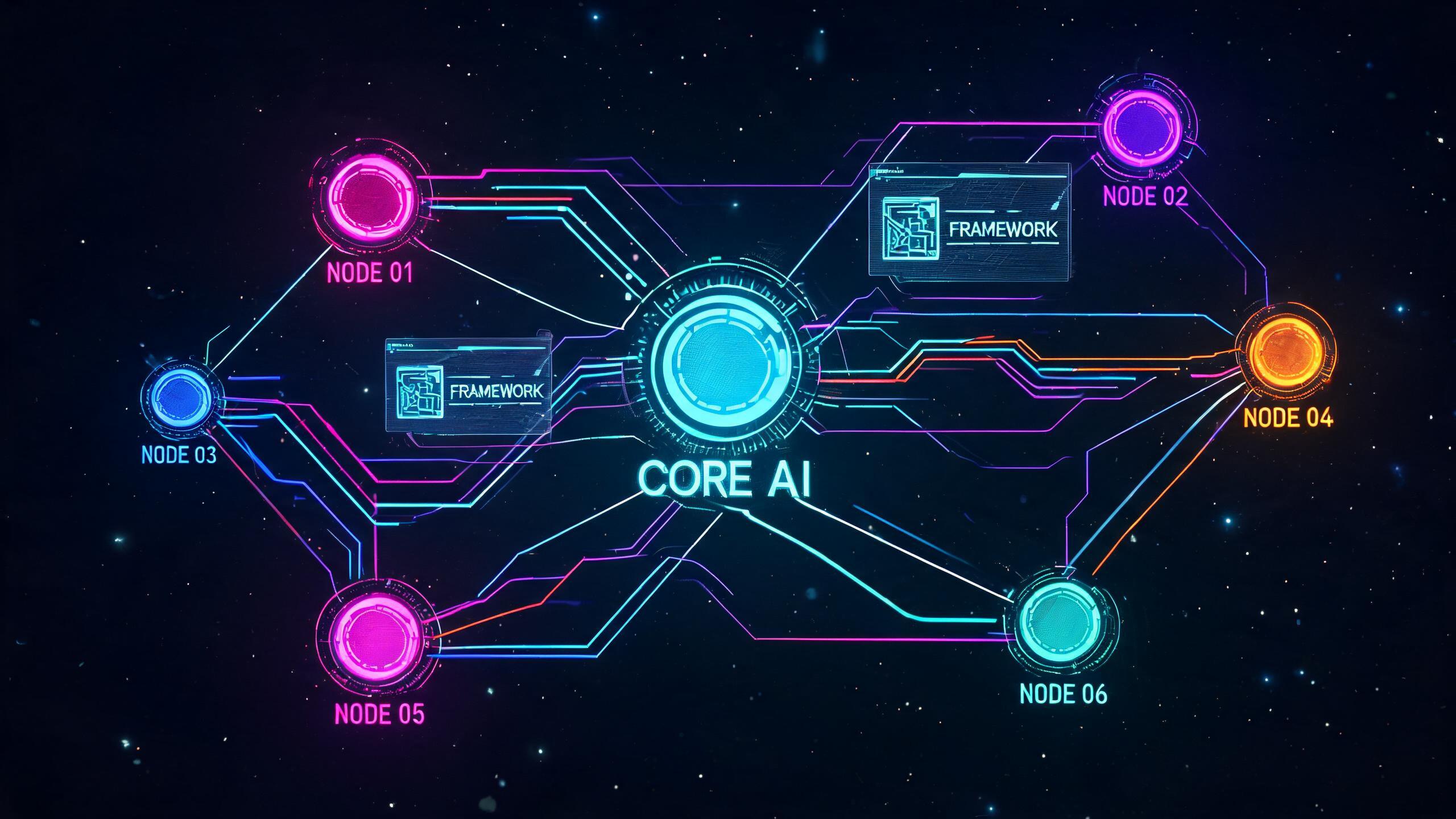
While everyone argues about which AI model is best, a quieter war is being fought in the agent runtime layer. LangChain, AutoGen, CrewAI, and LlamaIndex are competing — but the real battle is for which protocol becomes the USB-C of AI agents.
The Agent Runtime Wars: Who's Winning the Invisible Infrastructure Battle
While everyone argues about which AI model is best, a quieter war is being fought in the layer you've never heard of.
There's a fight happening right now that most people in AI don't even know they're part of.
It's not about which model has the most parameters. It's not about benchmark scores or context window size. It's about which software layer will become the operating system for AI agents — the infrastructure that decides how agents reason, when they act, how they remember, and who controls the whole stack when things go wrong.
The weapons are SDKs. The soldiers are framework developers. And the outcome will determine what AI applications look like for the next decade.
What Is an Agent Runtime, Actually?
Let's step back. When you build an AI application today, you have choices:
Use a model directly via API. Write your own orchestration logic. Connect it to tools. Handle errors. Manage context. Build the scaffolding yourself.
Or — use a framework. Something like LangChain, AutoGen, CrewAI, or a dozen others that promise to handle the plumbing: how agents plan, how they call tools, how they hand off to each other, how they recover from failure.
The Agent Runtime Wars: Who's Winning the Invisible Infrastructure Battle
That "scaffolding layer" is what we're calling the agent runtime. It's the difference between writing code that talks to an AI and writing code that deploys an AI.
Think of it like the difference between writing SQL queries by hand and using a database ORM. Both work. One abstracts away the mess and handles the edge cases. The runtime is the ORM for AI agents — except the edge cases include "the agent loops forever" and "the agent deletes your production database."
The Four Horsemen (And Why They're All Losing)
The current landscape looks like this:
LangChain — the early mover. LangChain became the default answer to "how do I build something with LLMs" in 2023. It was comprehensive, flexible, and increasingly complex. Too complex. The community joke is that if you need to read the LangChain documentation to understand your LangChain code, you're already lost. LangChain tried to be everything, and in doing so, became the complexity monster that everyone loves to complain about but can't stop using.
Microsoft AutoGen — the enterprise play. AutoGen came out of Microsoft Research and immediately felt different: serious, production-oriented, backed by a company with actual customers who would yell at them if things broke. The multi-agent conversation model was elegant. But "backed by Microsoft" is also a liability in the open-source world — enterprise credibility doesn't always translate to community love.
CrewAI — the simplicity bet. CrewAI made a bet that AI developers were tired of complexity and wanted something readable. Roles, crews, tasks. You could read a CrewAI script and understand what it did in thirty seconds. That simplicity was the product — and it worked. CrewAI became the framework people reached for when they wanted to ship fast without reading four Medium articles first.
LlamaIndex — the data-layer specialist. LlamaIndex made a different bet: that the real bottleneck in agent systems wasn't orchestration, it was data. Retrieval, indexing, context management. LlamaIndex positioned itself as the memory and knowledge layer, letting other frameworks handle the agent logic. Smart positioning, narrow focus.
Here's the uncomfortable truth: all four of them are losing.
Not to each other. To the inference providers.
The Invisible Standard
When a new category emerges, the market usually rewards whoever establishes the interface — the API, the protocol, the abstraction layer that everyone else builds on. Think HTTP for the web. USB for hardware. Kubernetes for containers.
In AI agents, that interface is currently being set not by the frameworks, but by the model providers themselves.
Anthropic released the Model Context Protocol (MCP) in late 2024. And suddenly, every framework discussion became secondary to a different question: does your stack support MCP?
MCP is a protocol, not a framework. It defines how AI models connect to external tools and data sources. And when a company with a dominant model position releases a protocol, something interesting happens: the frameworks start adapting to it, not the other way around.
LangChain added MCP support. So did LlamaIndex. CrewAI announced MCP integration. The frameworks became plugins to the protocol.
This is the infrastructure battle nobody's writing about. It's not "which framework wins" — it's "which protocol becomes the USB-C of AI agents." And right now, MCP has the lead position, Google has AA (Agent Arena, or Agent Alignment, nobody seems sure), and the open-source world is fragmenting into a dozen incompatible approaches.
The Hidden Architecture War
But here's what's really being decided beneath the surface:
Who owns the agent's decision loop?
An agent system has a core cycle: perceive → plan → act → reflect. Every framework implements this differently. Some are more prescriptive about the "reflect" step. Some let you hot-swap the planning strategy. Some abstract it entirely and call it "agentic RAG" or "tool-use orchestration."
The teams building production agent systems have learned something the benchmark articles don't capture: the decision loop is the product.
A customer service agent that routes inquiries correctly is worth more than one that writes better responses. A coding agent that knows when to stop thinking and start acting is worth more than one that thinks longer. The orchestration layer — the runtime — determines these behaviors more than the underlying model does.
This is why the runtime wars matter. It's not about which SDK is more popular. It's about which mental model of agent cognition becomes the default.
LangChain's mental model: everything is a chain. You compose chains. Tools are chains. Agents are chains. It's flexible and a little bit confusing.
AutoGen's mental model: agents are participants in conversations. They have roles, they have termination conditions, they delegate. The product is the dialogue.
CrewAI's mental model: agents have roles, and roles have goals. You build a "crew" and assign tasks. It's hierarchical and readable.
These aren't just different APIs. They're different theories of what an agent is.
The Winner Is Not a Framework
Here's my controversial take: the winning "framework" won't be a framework at all.
It will be a runtime standard — something boring, stable, and widely adopted at the infrastructure level, while the application layer remains creative and competitive.
This is how infrastructure wars usually end. Nobody remembers which CORBA implementation won the distributed object computing war. Nobody debates the philosophical differences between Linux and BSD process scheduling. The details got abstracted away, and everyone moved up the stack to fight over the interesting problems.
AI agents are heading toward a similar consolidation. The orchestration patterns will standardize. The differences between frameworks will narrow to configuration, not architecture. And the real differentiation will move to:
The quality of the models they can deploy
The safety boundaries they enforce
The observability they provide when things go wrong
The cost of running agents at scale
On these dimensions, the current frameworks are all roughly equivalent. None of them has a durable advantage. They're all one good engineering hire away from being equally capable.
What they don't have equally: the ecosystem. Who writes the plugins. Who writes the documentation. Who shows up to answer questions on Reddit at 2 AM when something breaks in production.
That's the actual battlefield. And right now, LangChain is winning it — not because its architecture is better, but because it has 3,000 GitHub stars and a community that generates more Stack Overflow answers per week than CrewAI has total contributors.
What This Means If You're Building Something
If you're choosing an agent framework today, here's the honest answer: it probably doesn't matter as much as you think.
Pick one that's active, well-documented, and has the model support you need. Learn it well. The skills transfer. The mental model is roughly the same everywhere.
What matters more:
1. Think about the protocol layer, not just the framework. If you're building something that needs to connect to external tools, check which protocol the ecosystem is standardizing on. MCP isn't the only game, but it's the one with the most momentum. Building on a protocol means your agents can port to different runtimes.
2. Watch the safety layer. Every framework handles agent errors differently. Some retry. Some escalate. Some hallucinate success. The safety architecture — how your agent handles loops, edge cases, and adversarial inputs — matters more than the orchestration pattern.
3. Pay attention to what's being abstracted away. Every framework abstracts something. LangChain abstracts prompt construction. CrewAI abstracts role assignment. Whatever gets abstracted away is where you'll hit a wall when you need to go deep. Know what your framework is hiding from you.
4. Plan for migration. The runtime wars aren't over. The winner hasn't emerged. Build your agent application with clean boundaries so that when the protocol layer consolidates, you can migrate without rewriting everything.
The Quiet Consolidation
The agent runtime wars look chaotic from the outside — a dozen frameworks, a dozen protocols, each with passionate advocates and convincing arguments.
But if you look closely, the consolidation is already happening. It's just happening at a different layer than the frameworks.
The real battle is for the control point: the place in the stack where decisions about agent behavior, safety, and resource allocation get made. Right now, that's diffuse — distributed across frameworks, model providers, and application developers.
Within two years, it will consolidate. One protocol will win. One or two runtimes will become the default. The rest will become footnotes, or specific-purpose tools for niche problems.
When that happens, the frameworks will look less like competing products and more like UI layers over the same underlying system. Just like how Flask and Django both run on WSGI, and nobody argues about WSGI anymore.
Until then: pick your battles carefully. Learn your framework well. Watch the protocols. And don't make architectural bets on any single runtime's long-term dominance.
The war is being fought in the dark, and the invisible front line is moving faster than anyone expects.