Vercel Flags Just Went GA — And It Tells You Exactly Where AI Coding Agents Are Headed
Published on 2026-07-08
On April 16, 2026, Vercel shipped Flags to GA and a plugin for OpenAI Codex, and OpenAI shipped the next Agents SDK. Read why these four releases are one product.
Vercel Flags Just Went GA — And It Tells You Exactly Where AI Coding Agents Are Headed
Vercel shipped Flags to general availability on April 16, 2026. OpenAI shipped "Codex for (almost) everything" the same day. Vercel pushed a plugin into the Codex app and CLI inside the same week (Vercel News, "Vercel plugin now supported on OpenAI Codex and Codex CLI"). Three releases, ninety-six hours, all pointing the same direction: the AI coding agent is leaving the editor and moving onto a platform.
Most of the AI-coding discourse in 2026 is still arguing about whose model writes the best function. That argument is becoming less interesting than the one underneath it — who owns the runtime the agent runs on. Flags, plugins, sandboxes, and SDKs are not features. They are the rails.
What Vercel Flags GA Actually Changes
Vercel Flags started as a beta, then settled into the dashboard as a managed feature-flag service with targeting rules, user segments, and environment controls. The April 16 changelog makes the model concrete:
Flags live in the Vercel Dashboard, not in a third-party tool
The Flags SDK is framework-native for Next.js and SvelteKit
A standalone OpenFeature adapter exists for any backend that already speaks the standard
Two of those three lines matter more than they look. The first — dashboard-native — turns flags from a sidecar service into a deploy artifact. The third — OpenFeature — turns Vercel into a node in a vendor-neutral graph, the same move OTel made for observability.
In practice: a Next.js team can now ship a feature branch, wrap a route in get(), set targeting on a segment, and roll it back from the same dashboard where they triggered the deployment. That is a workflow change, not a feature addition.
#OpenAI#Codex#AI Agent
Vercel Flags GA: The Platform Play Behind the AI Coding Agent
The shape of the call site is also different from the 2021-era flag client. Instead of if (flags.check('new-onboarding')) in component bodies, the Flags SDK encourages a decide() boundary near the data layer, with the dashboard carrying the segment definition. The reason this matters for the AI agent story is that the agent is now the writer of the call site, and a stable, declarative boundary is exactly the kind of surface an agent can be trusted to produce. An if (process.env.FOO) scattered across the codebase is hostile to agents; a decide() call against a managed flag is a contract.
The Plugin Number Is The Real Headline
Skip the Flags launch for a second. Look at what Vercel exposed into the Codex app. The Vercel plugin for Codex and Codex CLI ships with "over 39 platform skills, three specialist agents, and real-time code validation" (Vercel News).
Read that again. The number is 39. Three years ago the equivalent number in a developer tool would have been "a CLI flag." In 2026 it is a marketplace.
This is the move that the "Codex for (almost) everything" post was setting up. The desktop Codex app on macOS and Windows now bundles computer use, in-app browsing, image generation, persistent memory, and a plugin surface. The plugins are not decorations — they are how an agent learns the context of your stack. Vercel's plugin teaches Codex about Vercel: deployments, env vars, edge config, microfrontends, and now Flags. The agent is no longer a chat box; it is a runtime that knows where it is running.
Cursor Is The Proof Point That Flags Drive Revenue, Not Just Releases
Vercel published a customer story about Cursor's growth team unifying four web properties and roughly a hundred routes under cursor.com using Vercel Microfrontends, then layering Flags on top. The story reports a 5% lift in product-led-growth signups from the experimentation layer, plus a localization expansion from 4 to 11 languages (Vercel Blog, "How Cursor built a growth iteration loop with Vercel Microfrontends and Flags").
5% is not a story by itself. The story is that Flags let Cursor's growth team run that loop inside the same surface where they ship code, which collapses the gap between "we shipped the change" and "we know it worked." A growth engineer can flip a flag on a feature branch, watch a segment, and ship the winner — without opening LaunchDarkly, mixing context, or negotiating another vendor seat.
A 5% signup lift on Cursor's traffic is not a rounding error. It is the difference between a comfortable quarter and a board-meeting quarter.
There is a second number hiding in that same customer story that gets less attention: localization went from 4 languages to 11. That is not a translation problem; that is a rollout problem. Each new locale needed its own staged launch, its own internal-only window, and its own rollback if a phrase broke something. With Flags, "enable locale X for internal staff on Tuesday, for 1% of visitors on Friday, for 50% on Monday" is a dashboard change, not a deploy. The Vercel story is named a growth iteration loop, but the underlying loop is general — it works the same for locale rollouts, pricing experiments, and the "is this new auth flow safe in production" question every platform team asks on a Friday afternoon.
The Agents SDK Quietly Finished The Stack
One day before the Flags GA, OpenAI shipped "The next evolution of the Agents SDK." The post is short, and the two phrases that matter are buried in it: native sandbox execution and a model-native harness.
Sandbox is the boring part — every serious agent runner has one by now, from E2B to Modal to Fly Machines. The interesting move is the harness getting folded into the SDK. A harness is the wrapper that turns a model into an agent: tool registration, retry policy, context-window budgeting, and the permission map that decides what the model is allowed to do. Until now most teams built their own; Anthropic's harness engineering, LangChain's tool runtime, and the homemade wrappers inside Cursor and Devin are all variants of the same idea.
OpenAI is collapsing that category into the SDK itself. The trade-off is real: you give up some control over the loop, and you inherit OpenAI's failure modes. The upside is that the boring 60% of agent code disappears into the platform, which is exactly the wedge every prior infrastructure play — Stripe for payments, Twilio for messaging, Supabase for auth — used to take the category.
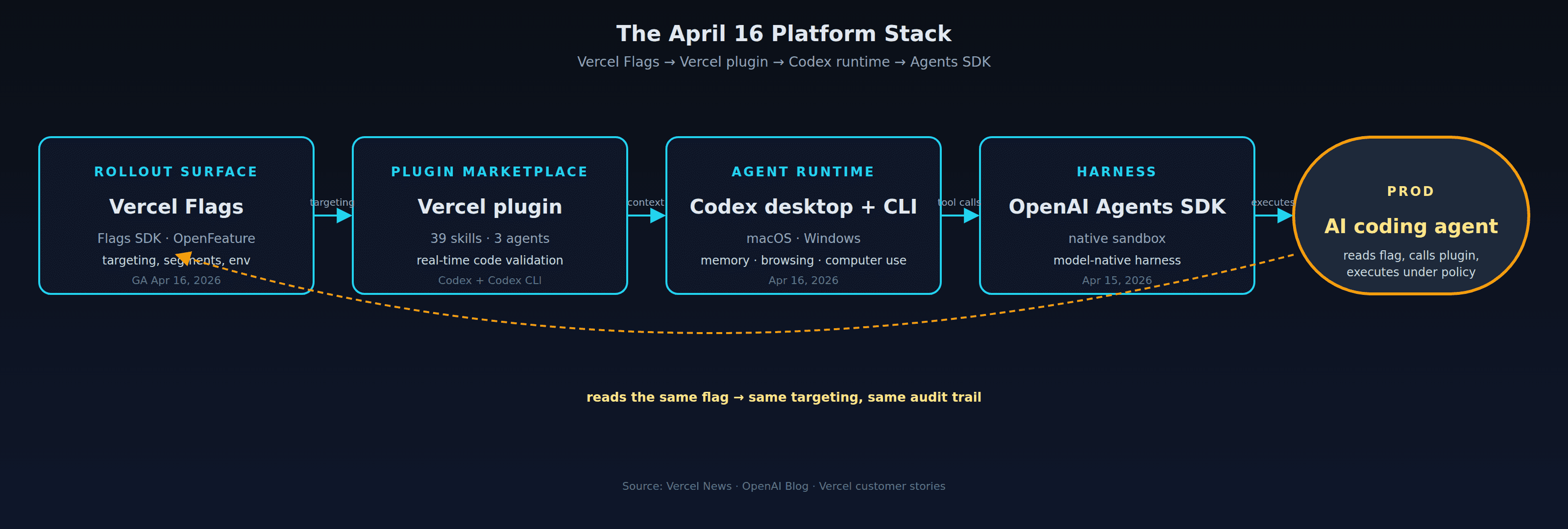
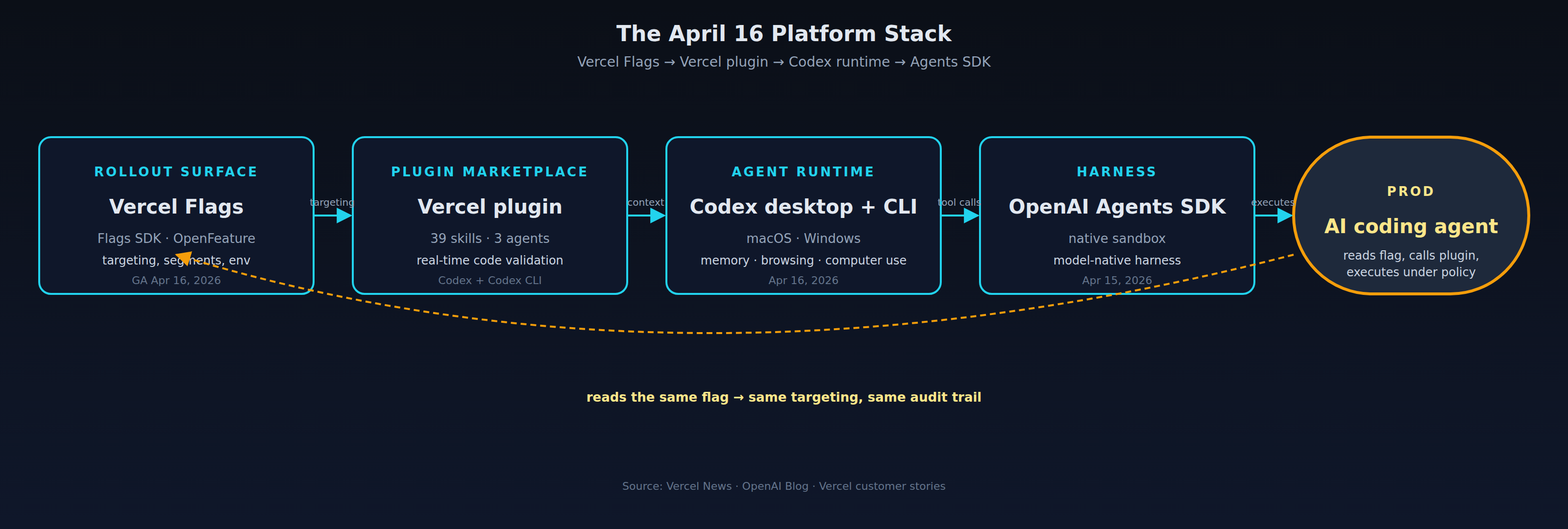
Put the four releases side by side:
Vercel Flags GA — managed experiment + rollout surface
Vercel plugin for Codex — 39 skills + 3 agents + real-time validation surfaced to the agent
Codex for (almost) everything — desktop runtime with computer use, browsing, memory, plugin host
That is a stack. Flag → Plugin → Runtime → Harness.
The Shopify Moment, But For Code
The closest historical analogue is 2012 Shopify. Independent online stores existed before Shopify. What Shopify did was productize the scaffolding around the store — checkout, tax, hosting, themes, an app store — so that anyone building a store no longer had to rebuild the scaffolding to test a hypothesis.
Vercel + OpenAI in 2026 are doing the same thing for the AI coding agent. The agent used to be a clever script glued to a repo. Now it ships with:
A runtime (Codex desktop, browser, CLI)
A plugin marketplace (39 Vercel skills as the leading example)
A rollout surface (Vercel Flags, OpenFeature-compatible)
A harness (OpenAI Agents SDK with native sandbox)
The store still belongs to you. The scaffolding got productized.
This is also why "flags are a config thing" is the wrong frame. Feature flags used to be a config file. In 2026 they are a runtime concern — the agent needs to read the same flag your app reads, in the same request, under the same targeting rules, with the same audit trail. That is why OpenFeature matters: it lets the agent and the app agree on the flag without agreeing on the vendor.
The Consolidation Layer Nobody Is Naming Yet
The category that quietly formed this week is the agent evaluation layer — the surface that decides which version of which behavior the agent should use, in which environment, for which user, under which policy. Flags are the visible tip. Underneath sit rollout policy, kill switches, model-selection routing, and the kind of targeting that used to live in a marketing CDP but now has to live in the request path.
OpenFeature is the seam. It is a vendor-neutral API the way OTel is a vendor-neutral API: a small set of primitives (getBooleanValue, getStringValue, etc.) that the application calls, and a provider that the platform plugs in. Vercel shipped that provider. Other vendors will follow, because not shipping one means losing the agent-shaped customer to the one that did.
The historical analog is OTel in 2021: nobody was forced to adopt it, and by 2024 it was the substrate every observability product had to interop with. Expect OpenFeature to follow the same curve, with feature flags as its first beachhead and policy-as-code (the OpenAI harness's "what is the agent allowed to do" map) as the second.
That is also why the four releases feel like one release. Flags, plugin, runtime, and SDK are not four products. They are four doors into the same building.
What Devs Should Actually Do This Week
Three actions, ordered by leverage.
1. Ship one feature behind a Vercel Flag this week. Pick something small — a button copy test, a new auth flow for 10% of users. Use the Flags SDK directly in a Next.js route, target by userId or cookies(), and read the result in the Vercel Dashboard. The point is to feel the loop close: branch → flag → segment → dashboard. That loop is the product.
2. Install the Vercel plugin in Codex. If you are on the macOS or Windows Codex app, install the Vercel plugin (Vercel News, "Vercel plugin now supported on OpenAI Codex and Codex CLI"). If you are on the CLI, the plugin ships there too. Treat this as a forcing function to find out which of the 39 skills your agent already wants to call but you never wired up.
3. Map your agent's blast radius with OpenFeature. If you are not on Vercel, the OpenFeature adapter on Vercel Flags means you can still use it as a managed backend while your application speaks the standard SDK. Map the policies you wish the agent had: which files it can read, which endpoints it can hit, which environments it can deploy to. The flags for that already exist as a category. Wire them up before the agent writes its first PR.
The Question That Is Still Open
The remaining question is not technical. It is pricing. Vercel has a flag dashboard and a plugin marketplace; OpenAI has a desktop runtime and an SDK. Neither has published how the unit economics of a flag-evaluated agent action will be billed when the agent is making thousands of evaluations per branch, per day, per environment.
That is the next thing to watch. The agent just got a checkout counter. We have not seen the receipt.