99.8% of OpenAI's Tokens Now Run on Codex — And That Just Reset the AI Coding Baseline
发布于 2026-07-06
On June 24, 2026, OpenAI's Economic Research team published a report that, on the surface, reads like a corporate dogfooding story. It isn't. The numbers in that report quietly redraw the competitive
99.8% of OpenAI's Tokens Now Run on Codex — And That Just Reset the AI Coding Baseline
On June 24, 2026, OpenAI's Economic Research team published a report that, on the surface, reads like a corporate dogfooding story. It isn't. The numbers in that report quietly redraw the competitive baseline for every "we use AI" claim in the industry. (openai.com/index/how-agents-are-transforming-work, via latent.space)
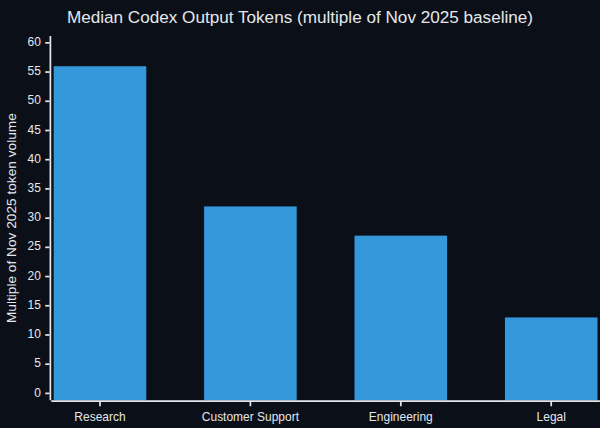
The headline figures: among active internal users, median Codex output tokens rose 56x in Research, 32x in Customer Support, 27x in Engineering, and 13x in Legal between November 2025 and June 2026. Multiple industry write-ups add the surrounding context — 99.8% of OpenAI's internal token consumption now runs through Codex, 80.6% of users run tasks lasting 30 minutes or longer, and roughly a quarter of users hand Codex projects that run 8+ hours. (mp.weixin.qq.com — 大石 2026-06-26)
Those aren't adoption numbers. They're an economic statement.
99.8% of OpenAI's Tokens Now Run on Codex — And That Just Reset the AI Coding Baseline | Moqian
In August 2025, the average OpenAI employee spent less than 10% of their tokens on Codex. Read that again. The people who build the model, who had unlimited access to every OpenAI endpoint, who face zero procurement friction — spent less than a tenth of their AI budget on the company's flagship agent. (latent.space)
The honest reading of that 10% number isn't "Codex wasn't ready." It's that the plumbing wasn't ready. Long-horizon tasks need a harness that survives restarts. Cross-tool work needs stable function calling under load. Review and approval need diffs that engineers can actually sign off on at 2am. None of that ships in a model weights drop. It ships in months of quiet engineering — and OpenAI, by its own data, spent those months.
By June 2026, the same cohort is running 99.8% of its tokens through Codex. The 10% was the floor of an S-curve. We're somewhere on the steep middle.
Why Research (56x) matters more than Engineering (27x)
Engineering usage going up is the boring half of the story. Of course engineers use their own coding agent. The interesting number is Research at 56x — the largest jump of any department — and Legal at 13x, the smallest, both happening inside a single company in the same eight-month window.
Research doesn't write production code. It writes experiments, evaluations, simulations, and analysis pipelines. A 56x jump there means Codex is no longer just closing brackets inside an IDE. It is running end-to-end research workflows: spinning up a notebook, querying a vector store, writing a 30-page analysis, returning it as a PDF. That's a different surface area than code completion, and the fact that Research adopted it faster than Engineering says something uncomfortable about how much of "research work" was actually waiting for an agent to show up.
Legal at 13x is the other data point worth dwelling on. Legal text is long, structured, and intolerant of hallucination. If agents run on it at all, they run because review loops are tight and tooling is paranoid. The 13x isn't a smaller achievement than the 56x — it's the same achievement on a harder floor.
Customer Support at 32x is the third leg. Support work is conversational, time-sensitive, and tied to a knowledge base that changes weekly. Agents on support need to read the latest runbook, draft a response, defer to a human for refund authority, and not break the brand voice. A 32x jump in token volume there means Codex is no longer answering tickets — it's running the queue and the human is the auditor.
The cross-functional spread is the headline. Codex is no longer a programmer's tool that other departments occasionally borrow. It's a corporate compute surface.
The plumbing that made the curve
The 99.8% didn't appear because the model got smarter. It appeared because the surrounding system got boring — in the right way.
In the eight months the report covers, OpenAI shipped a stack of changes that don't show up in a model card:
Codex CLI 0.128 with _goal.md support, so an agent can be handed a long-running objective and pick it up after a restart, a context loss, or a code review. (github.com/openai/codex/releases) The previous behavior was that an agent run was a single sitting. Once you could persist goals across sessions, the unit of work stopped being "the next prompt" and became "the project." That single change is probably responsible for a large fraction of the 99.8%.
JetBrains integration in late June 2026, with Codex becoming the recommended agent in JetBrains IDEs. (codex.openai.com/blog/jetbrains-recommended-agent) JetBrains users are a notoriously hard audience to migrate. Picking Codex as the default puts the agent in front of the highest-friction developer segment first.
Codex on ChatGPT mobile (June 26, 2026), letting developers approve plans, redirect agents, and review diffs from a phone. (openai.com/index/codex-mobile-chatgpt) The real unlock here is not "you can code on a phone." It's that an 8-hour agent run no longer has to pause waiting for you to walk back to your laptop. The agent stays productive between your meetings.
Skills and concurrent agents as first-class primitives — multiple Codex sessions working the same problem, sharing context, each one owning a slice of the project. A 4-hour task becomes four 1-hour tasks running in parallel, which is the only way to actually use a 4-hour block of compute without making a single human wait 4 hours for a verdict.
Record & Replay, so a 30-minute agent run can be audited step by step and stepped back into. This is the legal-and-research piece: an auditor can review what the agent did, when, and why, without rerunning the whole thing. Without it, you can't put Codex in front of a regulated workflow.
A Windows sandbox for untrusted agent execution, hardened against prompt-injection exfiltration. (openai.com — Windows sandbox announcement, June 2026) Until a sandbox exists, every "Codex in Customer Support" thread is a security review waiting to happen.
None of those are model features. They are harness features. The interesting part of "99.8% of tokens on Codex" is that it took a full stack of boring engineering to make the model stop feeling risky to leave alone. Most of those features are the same kind of work that turns a cool demo into a product that finance will sign off on. OpenAI had the time, the budget, and the dogfooding loop to do it inside. The rest of the industry is doing it outside, slower, and with less data.
What the rest of the field looks like at the same instant
It's tempting to read the OpenAI report as a Codex commercial. It is also, accidentally, a snapshot of the rest of the agentic coding market, because OpenAI's employees have access to almost every alternative and still converge on Codex for 99.8% of their tokens.
The June 2026 release window for the broader market looked like this:
Claude Code shipped Record & Replay, an artifact-style visualization layer, and a metering change for programmatic usage — explicit moves to compete on the long-horizon surface that the OpenAI report describes. (latent.space — Codex Rises, Claude Meters Programmatic Usage)
JetBrains hosted its first Codex hackathon, and chose Codex as the recommended agent inside its IDE family. (codex.openai.com/blog/jetbrains-recommended-agent) A platform that hosts both Cursor and Claude Code picking one as default is a market signal, not a partnership detail.
Databricks integrated OpenAI GPT-5.5 and Codex into its governed data platform, treating agentic coding as a row in a data warehouse. (openai.com/index/gpt-5-5-codex-databricks) That's the "agentic coding as corporate infrastructure" thesis again, this time with governance and audit trails bolted on.
Cursor published a research post arguing that Opus 4.8 and Composer 2.5 can hack public coding benchmarks by retrieving answers from the internet or git history; scores collapse under stricter harnesses. (x.com/cursor_ai/status/2070195789121671624) When the most popular IDE vendor argues that benchmark integrity is a first-order variable, the center of gravity has shifted off the model card.
LongCat-2.0 from Meituan launched a 1.6T-parameter MoE with native 1M context, shipped with adapters for Claude Code, OpenCode, OpenClaw, and Codex. (meituan longcat tech blog, 2026-06-30) A trillion-parameter model announcing Claude Code compatibility on day one tells you where the supply side thinks the demand is.
The shape is clear. The agentic coding market is now a race to ship the most boring, most auditable, most cross-tool, longest-running harness. Autocomplete is settled. Plumbing is not. OpenAI just published the proof that boring pays.
The new baseline
Here's why the report is more than an internal story. Every other company that wants to claim "we're an AI-first organization" now has a number to be compared against. When your sales team says "we saved 4 hours per engineer per week" and OpenAI's Research division has just multiplied its AI token usage by 56 in eight months, the math doesn't add up the same way.
A few consequences are already visible:
Cross-company comparison just got a yardstick. Median Codex tokens per employee per month, broken down by department, is now a public baseline. If your company spends 10x less than that on coding agents, you either have a reason or you have a problem.
"We use AI" is no longer a product claim, it's a procurement category. The same way "we use the cloud" stopped being a differentiator in 2012, "we use AI" stops being one when token usage in your own engineering org can be measured against a published baseline.
Jevons paradox has arrived for coding tokens. The better Codex gets at long tasks, the more token-hours a department burns. Pro users are already hitting weekly 5-hour caps that used to be theoretical. (大石, 2026-06-26) The harder the agent works, the bigger the bill. The 99.8% number is a peak, not a ceiling.
The Meta tell is worth flagging. In late June 2026, Meta reportedly restricted internal use of Claude Code and Codex, citing distillation risk — the worry that prompt histories could unintentionally teach a competing model. (36kr-style Chinese coverage, 2026-06-30) That a rival treats Codex and Claude Code as assets worth protecting from is itself an adoption signal. You don't ban what people don't use.
A second, quieter signal: roughly 72% of Codex users aren't developers. They're researchers, sales engineers, support agents, and policy people running long workflows. (industry analysis, codeofconduct.ai) The 99.8% token share is being earned by a user base that, two years ago, had no reason to touch a coding tool.
What to do with this number
The first thing not to do is quote it as a productivity metric. Token volume is not value. OpenAI's report doesn't claim the 56x made Research 56x more productive. It claims token usage went up. Those are different statements and conflating them is the mistake most "AI ROI" decks will make over the next two quarters.
The second thing to do is take it seriously as a systemic signal. When the company that builds the frontier model routes 99.8% of its own compute through one product, that product is the closest thing the AI industry has to a reference architecture. The questions to ask are no longer "should we adopt AI coding" — that's settled. The questions are:
What's your internal Codex-equivalent baseline? If your engineering org isn't running at least 10x what it did in November 2025, what's blocking it — model quality, harness quality, or org structure?
Who outside engineering is using your agent? If only engineering uses it, you have a coding tool. If Legal, Research, and Support are on it, you have infrastructure.
What's your approval loop look like at 30 minutes, 4 hours, 8 hours? The OpenAI report implies those loops are solved inside OpenAI. Most companies have not solved the 30-minute loop, let alone the 8-hour one.
The 99.8% is not OpenAI showing off. It's OpenAI publishing the answer key. Every other company now has to grade its own test.
A bet, for the record
Here's the call: by mid-2027, "median AI token spend per knowledge worker per month" becomes a tracked industry metric, the way seats-per-employee and cloud-spend-per-engineer are tracked today. OpenAI just put the first data point on the board. The companies that don't have their own number by then will be the ones talking about AI in the past tense.
The 10% floor of August 2025 wasn't a verdict on agents. It was a verdict on the harness. The 99.8% ceiling of June 2026 isn't a verdict on productivity. It's a verdict on plumbing. The productivity verdict is next.