Grok Build’s Repo Upload Scandal: Deletion Is Not a Privacy Control
发布于 2026-07-18
Grok Build’s Repo Upload Scandal: Deletion Is Not a Privacy Control CEREBLAB gave Grok Build CLI v0.2.93 an idle task: “reply OK, do not open any files.” The agent replied—but its network traffic did ...
Grok Build’s Repo Upload Scandal: Deletion Is Not a Privacy Control
CEREBLAB gave Grok Build CLI v0.2.93 an idle task: “reply OK, do not open any files.” The agent replied—but its network traffic did something else.
The client packaged the repository as a Git bundle and sent it to cloud storage. CEREBLAB cloned the captured payload and recovered 47 files, four commits, and the file the agent had been told not to read (CEREBLAB, July 13, 2026).
That test turns a fuzzy privacy debate into an engineering question: what can leave the machine when the task requires nothing?
A promise to delete data later cannot replace a boundary that prevents unnecessary transmission now.
One incident, four different controls
Coverage of coding-agent privacy often compresses four controls under the word “privacy.” Teams need to separate them.
Task access: which files, commands, secrets, and repositories the agent can reach.
Transmission: which bytes may leave the machine and which destinations may receive them.
Retention: what a provider stores after receiving those bytes, for how long, and for what purpose.
Remote control: which client behaviors a provider can change through server-delivered configuration.
These controls fail independently. A workspace permission can limit access without limiting network traffic. A zero-retention setting can reduce server-side storage without stopping transmission. An open client can expose a code path while a remote flag still decides whether that path runs.
#AI编程#代码治理#开源#AI工程
Grok Build Privacy: Why Deletion Is Not a Control
CEREBLAB’s report makes the distinction concrete. Its A/B test found that Grok Build’s privacy opt-out changed the server’s treatment of requests, while the same classes of requests still left the machine. The whole-repository upload stopped after the client received a global disable_codebase_upload: true setting. The report describes that setting as separate from the per-session retention choice (CEREBLAB).
Calling all four layers “privacy” is like labeling every switch in a breaker panel “electricity.” The label is technically related and operationally useless.
The test did not require guessing about intent
The strongest part of the incident is the shape of the experiment.
CEREBLAB routed the CLI’s traffic through mitmproxy, installed a locally trusted certificate, and issued a prompt that required no file access. A successful request to the storage endpoint contained the magic header for a Git v2 bundle. Cloning the captured bytes reconstructed the repository, including history. The lab says it reproduced the behavior on a second codebase and published a reproduction repository.
This establishes observed behavior. It does not establish why xAI built it that way, whether an engineer made a bad trade-off, or whether anyone intended to collect secrets. Those claims would need different evidence.
The distinction matters. Security reviews get weaker when outrage outruns the packet capture. Here, the packet capture is already enough.
A Git bundle has a wider blast radius than the current working tree. Teams routinely delete a credential from the latest revision while leaving it in history. Internal URLs, abandoned experiments, customer identifiers, and old configuration can survive there too. Whole-repository collection turns yesterday’s cleanup mistake into today’s outbound payload.
CEREBLAB also compared other hosted coding tools. Its tests found that Claude Code, Codex, and Gemini sent files they opened rather than bundling the whole repository. That finding does not make them offline tools. It defines the narrower anomaly: Grok Build collected the full repository and history during the tested version and configuration (CEREBLAB).
The open-source release created evidence, not absolution
After the backlash, xAI disabled default retention, said previously retained coding data would be deleted, and released the Grok Build harness under Apache 2.0. Simon Willison inspected the release and counted 844,530 lines of Rust, excluding comments and blank lines; he estimated that roughly 3% was vendored (Simon Willison, July 15, 2026).
The release gave reviewers something valuable: inspectable implementation details.
Willison found upload-related modules still present in the source. The inspected upload_session_state() path returned a hard-coded session_state_upload_unavailable error. The public repository also exposed prompts, tool implementations, and the terminal renderer. By July 17, bot-synced commits included changes described as controls for unsafe shell environments, HTTP-redirect SSRF bypasses, credential permissions, and remote plugin pinning (GitHub commit history).
Open source therefore changed the audit surface. Reviewers could inspect code paths and track hardening work instead of inferring everything from a binary.
It did not prove that historical data was deleted. It did not prevent a server flag from changing client behavior. It did not give an enterprise control over outbound traffic.
Source access lets you investigate a claim. Network policy lets you enforce one. Confusing the two is how “auditable” gets mistaken for “safe.”
The live GitHub repository identifies Rust as the primary language and Apache-2.0 as the license. It is an active project, not a frozen disclosure artifact. That is useful for scrutiny, but it also means assessments have a shelf life.
A real off switch must survive the vendor
The global flag in CEREBLAB’s report raises a broader design question. If a provider can turn collection off remotely, can it turn collection back on the same way?
A customer-controlled off switch should live below the application. Local policy must win when it conflicts with server configuration. The agent should fail closed if it cannot load that policy, and an administrator should receive an event when remote settings request a forbidden capability.
The product also needs to expose its collection plan before execution. “Read src/auth.ts and send relevant excerpts to the model” is reviewable. “Prepare workspace context” can hide an index, an archive, or a Git bundle. A useful disclosure names the source path, payload class, destination, and retention rule.
Consent prompts cannot rescue a poor design. If every tool call produces a modal, users will approve them by reflex. Put durable limits around destinations and data classes, then reserve prompts for rare expansions of scope.
This is the test for an off switch: a vendor outage, configuration mistake, or policy change should not widen the agent’s access. If the boundary disappears when the control plane behaves badly, the control belonged to the vendor all along.
Git history is a second dataset
Developers often treat .git as housekeeping attached to the project. For an attacker—or an over-collecting tool—it is a separate, high-value dataset.
The current tree shows what the team wants to ship today. History can preserve credentials removed last month, customer names from an abandoned test, old infrastructure addresses, and commit messages that explain internal failures. CEREBLAB’s experiment mattered because the captured Git bundle reconstructed commits, not merely visible files.
Teams should decide whether an agent needs that dataset. Blame analysis, regression hunting, and migration work may require history. A CSS fix probably does not.
For tasks that need only the current revision, export that revision into the sandbox without .git:
mkdir -p /sandbox/work
git archive HEAD | tar -x -C /sandbox/work
For tasks that need recent context, a shallow clone can reduce exposure, though teams should test how their tooling handles missing objects. When full history is required, treat that expansion as a named permission and scan reachable objects for secrets before the agent starts.
“Repository access” is too coarse a permission. The working tree and its history deserve separate controls.
Put the boundary outside the agent
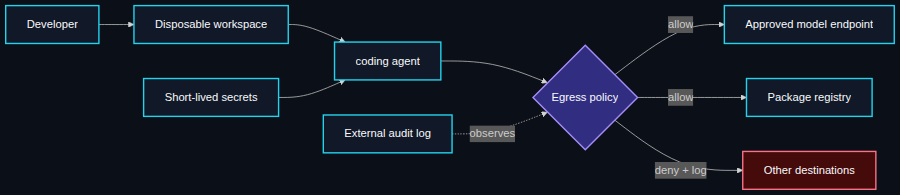
A coding agent should not be the final authority on its own access.
The agent is optimized to finish tasks. A provider may optimize context collection to improve completion quality. Neither incentive is identical to a security team’s mandate to minimize exposure. The enforceable boundary belongs in infrastructure controlled by the developer or organization.
A practical deployment has four parts.
1. Give each task a disposable workspace
Copy only the repository and revision the task requires into a short-lived sandbox. Do not start an agent in $HOME. Do not mount a parent monorepo when the task concerns one package. Keep password-manager databases, SSH directories, cloud credentials, and unrelated projects outside the namespace.
The hotel-keycard analogy fits: one task needs one room. A master key plus a promise of good behavior is a weak substitute for a door the key cannot open.
2. Deny outbound traffic by default
Allow the model endpoint and required package registries through an explicit policy. Block arbitrary object-storage destinations. Resolve and pin destination classes where the platform permits it, and inspect redirects rather than trusting the first URL.
Some hosted agents require broad provider domains or WebSockets. Record that exception. “The tool needs the internet” is not a destination policy.
3. Remove secrets before runtime
A .gitignore entry does not remove a tracked secret from history. A prompt that says “do not read .env” is not an access control. Inject short-lived credentials for the exact command that needs them. Prefer brokered tokens with narrow scopes, then revoke them when the sandbox exits.
Preflight scans should cover the working tree and reachable Git objects. If the agent does not need history, use a shallow export without .git.
4. Log data classes, not only request counts
A dashboard that reports request counts cannot distinguish a prompt from a full-repository bundle. Capture destination, method, byte count, timing, and content classification. Hash canary strings so monitoring can flag them without storing another copy of sensitive text.
This telemetry should live outside the agent process. An agent cannot be the sole auditor of the traffic it creates.
A 30-minute acceptance test
Teams can test a coding agent before approving it for proprietary repositories.
Plant two canaries. Put one unique string in an ordinary file and another in a file the agent is explicitly told not to open. Use synthetic values, never real credentials.
Issue an idle prompt. Ask for a fixed response that needs no tool or file access. Capture DNS, connection metadata, request sizes, and decrypted traffic where policy and test infrastructure allow it.
Test history separately. Commit a synthetic secret, remove it in a later commit, and confirm whether any outbound payload contains the historical value. Destroy the test repository afterward.
Run an opt-out A/B test. Repeat the same task with retention or training controls enabled and disabled. Compare traffic leaving the machine and the server’s response; do not treat settings-panel wording as proof of transport behavior.
Repeat after upgrades. Retest when the client version, provider policy, authentication mode, or remote configuration changes. The Grok Build case showed why a server-delivered flag belongs in the threat model.
Record the result as an artifact: client hash, version, timestamp, allowed destinations, observed payload classes, and test limitations. A screenshot of a privacy toggle is not evidence of network behavior.
The procurement questions should get uncomfortable
Before a team buys a coding agent, ask the vendor:
Can an administrator enforce transmission controls separately from retention controls?
Does the client ever create archives, Git bundles, embeddings, or indexes outside the visible model request?
Which behaviors can server-side configuration enable without a client update?
Can customers route traffic through their own gateway and block unapproved destinations?
What artifact proves deletion, and which independent party can verify it?
A vendor may have defensible reasons for repository indexing. Then the product should say what it collects, ask before collecting it, minimize the scope, and expose an enforceable off switch. Silent collection fails that standard even if retention lasts seconds.
xAI’s response—disabling the behavior, changing defaults, publishing code, and promising deletion—reduced risk and expanded scrutiny. Those steps deserve accurate acknowledgment. They do not rewrite the original boundary.
For coding agents, trust should mean the task cannot send what it does not need. Everything else is a policy statement waiting for a packet capture.