When "Smart" Means Wrong: The Hidden Architecture of LLM Reasoning Failures
发布于 2026-04-24
LLMs fail in systematic, hard-to-predict ways that correlate with training distribution rather than objective difficulty. Chain-of-thought doesn't give models real reasoning—it gives them tokens to generate plausible confabulations.
When "Smart" Means Wrong: The Hidden Architecture of LLM Reasoning Failures
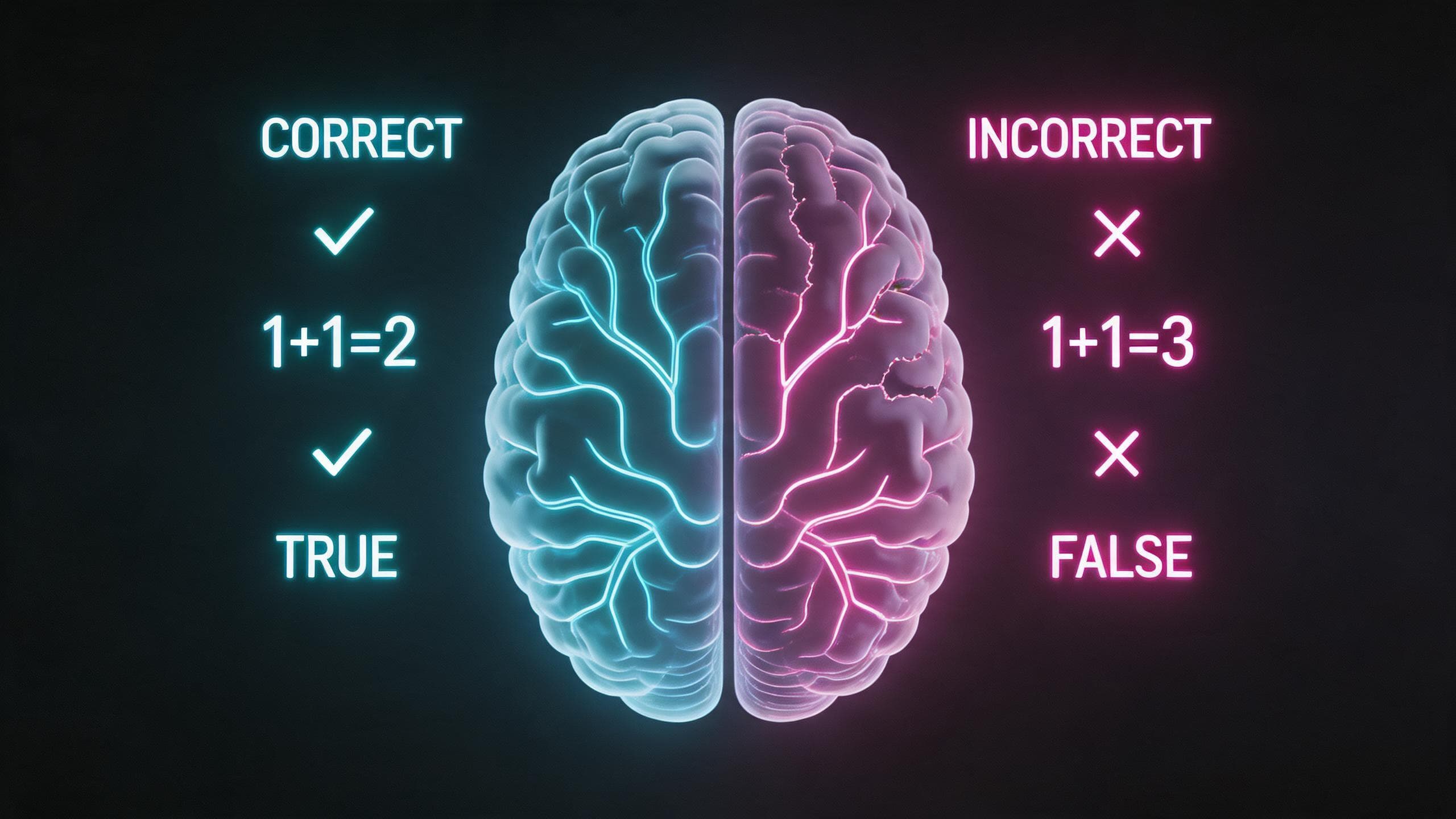
GPT-4 can pass the bar exam. It can write elegant Python, diagnose rare diseases, and explain quantum entanglement to a sixth-grader. But ask it whether 9.11 is greater than 9.9, and it will confidently tell you that 9.11 > 9.9.
This isn't a bug. It's a window into how these models actually think.
The Illusion of Understanding
Large language models achieve superhuman performance on benchmarks while failing at tasks a human child would find trivial. The model has "learned" that numbers tend to appear in certain patterns — and 9.11 feels intuitively "larger" than 9.9 because, in the training distribution, decimal-adjacent numbers follow different rules than pure integers.
The deeper problem is that we have no reliable way to distinguish when a model is reasoning versus when it's pattern-matching its way to a plausible-sounding answer. A 2024 study from the University of Washington found that LLMs failed over 40% of problems that required multi-step arithmetic when the intermediate results fell outside their training distribution — even when the same problems with different surface-level numbers were solved correctly.
This is the "reliable but unpredictable" problem. The model isn't wrong in a random way. It's wrong in ways that correlate with the statistical structure of its training data. And that's harder to fix than random noise.
Why Chain-of-Thought Doesn't Actually Think
#AI模型#API经济
When Smart Means Wrong: The Hidden Architecture of LLM Reasoning Failures
The popular fix for LLM reasoning failures is chain-of-thought prompting — asking the model to "think step by step." This works surprisingly well, improving performance on reasoning tasks by 30-50% in some benchmarks.
But here's what nobody talks about: chain-of-thought doesn't give the model a reasoning module. It gives the model more tokens to generate plausible reasoning traces before landing on an answer. The model is still pattern-matching — it's just generating a longer, more detailed pattern.
Researchers at DeepMind called this "erased reasoning traces." The steps the model shows you aren't the steps it took. They're reconstructed explanations for a conclusion it reached through different means. Sometimes these explanations are accurate. Often they're confabulations — post-hoc narratives that sound logical but don't reflect the actual computation.
The uncomfortable implication: if you can't trust the reasoning trace, you can't verify the reasoning. Chain-of-thought gives you the appearance of transparency without the substance.
The Distribution Shift Blindspot
LLMs fail most dramatically when inputs drift even slightly from training distribution. A model that can solve complex differential equations will stumble on word problems involving the same equations. A model that writes perfect SQL will generate syntactically similar but semantically wrong queries when asked about a database schema it "knows" but hasn't seen formatted in the training data.
This isn't just about out-of-distribution generalization. It's about the gap between knowledge and activation. A model can "know" something in the statistical sense — the information is encoded in its weights — without being able to reliably activate that knowledge under arbitrary prompting conditions.
The practical consequence for developers: LLM-powered features fail in production in ways that are hard to reproduce, hard to test for, and hard to understand after the fact. The model isn't unreliable in the sense of random failures. It's unreliable in the sense of confidently wrong failures that pass most test cases.
The Calibration Problem
Well-calibrated uncertainty is one of the most important properties for a useful AI system. If the model doesn't know something, it should say so. If it's uncertain, it should communicate that uncertainty.
LLMs are catastrophically miscalibrated. They assign high confidence to wrong answers and low confidence to correct ones — not randomly, but systematically. The same model that says "I'm not sure, let me think more" in one conversation will confidently assert incorrect facts in another, with no meaningful difference in its actual certainty.
This is partly a fine-tuning artifact. RLHF training rewards confident-sounding answers. Users prefer confident responses. The incentive structure systematically pushes models toward overconfidence, especially on topics where confident wrong answers are more rewarding than uncertain correct ones.
A 2025 analysis of frontier models found that only 2 out of 12 major LLMs showed statistically significant calibration improvement over random chance on novel tasks. The others were effectively guessing with a confidence score attached, not expressing genuine probability estimates.
What Actually Helps
Given these fundamental limitations, what does reliable LLM reasoning look like in practice?
Structure reduces variance. When you constrain the model's output space — through retrieval augmentation, tool use, or formal verification — you dramatically reduce the failure rate. The model becomes more reliable not because it thinks better, but because it thinks less, offloading computation to more predictable systems.
Ensemble and voting help, but not for the reasons you'd think. Multiple model calls don't cancel out independent errors — LLM errors are often correlated across the same prompting context. What ensembles actually do is increase the chance that at least one call happens to trigger the right activation pattern.
The human-in-the-loop isn't about catching every error. It's about creating a system where the model's failure modes are bounded by human oversight. This only works if the human can actually detect the failure — which requires both UI design that makes uncertainty visible and domain expertise that lets the human recognize when the model's confident answer is wrong.
Monotonicity constraints are underexplored. If a model can answer "is X > Y" correctly for numbers it's seen in training, forcing it to maintain consistency across related queries can improve reliability. But this requires architectural choices that most current systems don't make.
The Hard Problem
The fundamental issue is that we built systems that are powerful enough to be useful and unreliable enough to be dangerous, without any good tools for distinguishing between those two states in real-time.
This isn't an argument against LLMs. They're genuinely useful tools. But the narrative that these systems are "reasoning" — that they can be trusted to reason through novel problems, catch their own errors, or communicate uncertainty honestly — is a narrative that the models' behavior actively undermines.
The path forward isn't better prompting or better fine-tuning. It's architectural changes that separate pattern matching from actual computation, combined with deployment patterns that acknowledge the gap between impressive demos and reliable systems.
Until then, always check your decimals.
TL;DR: LLMs fail in systematic, hard-to-predict ways that correlate with training distribution rather than objective difficulty. Chain-of-thought prompting doesn't give models real reasoning — it gives them more tokens to generate plausible explanations. Confidence and correctness are barely correlated in frontier models. Reliability comes from constraining the output space, not from better prompting.
Discussion Questions:
If chain-of-thought reasoning is reconstructed post-hoc rather than genuine computation, what does this imply about our ability to use LLMs for high-stakes decision-making where we need to verify the reasoning process?
Given that LLM failures are systematic rather than random, and that human oversight is required to catch confident wrong answers, how should we design AI-assisted workflows in domains like medicine or law where domain expertise is concentrated and expensive?
SEO Keywords: LLM reasoning failures, AI hallucination, chain-of-thought limitations, AI reliability, large language model calibration, AI confidence calibration, LLM distribution shift, AI error patterns, AI reasoning limitations, prompt engineering failures