NVIDIA Bought Poolside's Brain — and the Open-Model Domino Just Started Falling
胡新宇
发布于 2026-08-22
NVIDIA spent $12B hiring Poolside's ~109-person AI research team while spinning Poolside into a 7GW data-center infraco. AT&T is now routing 40% of its AI traffic to open models at 56% lower cost. The bottleneck for frontier AI has moved from capital to physical infrastructure — here's what changes for builders.
NVIDIA Bought Poolside's Brain — and the Open-Model Domino Just Started Falling
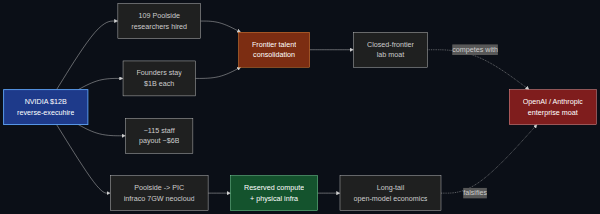
NVIDIA spent $12 billion last week on a deal the founders insist is "not an acquisition and not an acquihire." They hired 109 of Poolside's ~115 technical employees, kept the founders for ~$1B apiece, paid out ~$6B to remaining staff, and spun the rest of the company into a separate infrastructure vehicle called PIC, scaling toward 7 gigawatts of "neocloud" capacity (Latent Space, 8/19-8/20/2026).
It is the clearest public signal yet that the bottleneck for frontier AI is no longer capital. It's physical infrastructure.
If you're building anything on top of this stack — agents, copilots, internal tools — that reframe matters more than any model release this quarter. Here's why.
What NVIDIA actually bought
The headline number ($12B) is misleading. NVIDIA didn't buy Poolside's product. Poolside's coding model, Laguna S 2.1, was competitive but small — under 200 paying customers, no public ARR worth bragging about. NVIDIA also didn't buy Poolside's customers. They bought the recipe.
Poolside's "Model Factory" is what Jensen was paying for. Fewer than 70 researchers running 10,000–20,000 experiments per month, taking a model from pre-training to release in eight weeks (Latent Space, "Inside the Model Factory," 7/23/2026). That's the throughput frontier labs need to keep climbing the capability curve. Closed-model labs don't hire individual researchers anymore at this scale — they hire the factory.
The previous Jensen-to-Poolside relationship was investor to portfolio. Bloomberg confirmed in October 2025 that NVIDIA had committed up to $1 billion to Poolside. Six months later, the relationship got simpler: NVIDIA owns the people, Poolside owns the buildings.
The trigger: a 6-week window Poolside couldn't close
Poolside's founders didn't soften the cause. Direct quote:
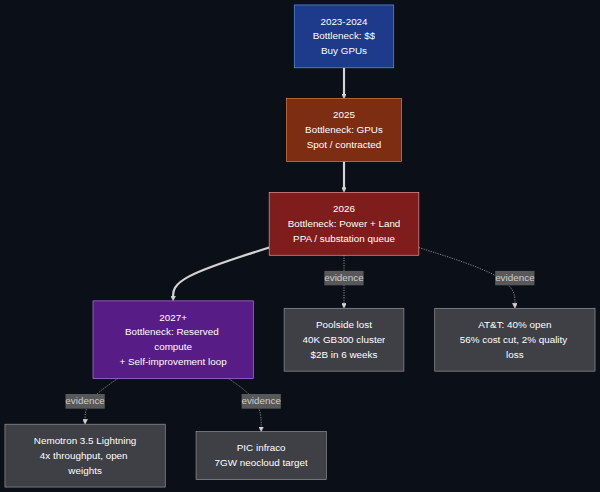
"At the end of last year, we had a 6 week window in which to raise $2 billion dollars to pay for a 40,000 GB300 cluster coming online in January. We didn't close it in time, and we lost the cluster." (Latent Space, AINews 8/21)
That sentence contains the whole story. Frontier training compute has gone vertical. A 40,000-GPU GB300 cluster — itself unremarkable by 2027's likely standards — required $2B in cash before it came online. Poolside, despite a $500M Series B and strong technical credibility, couldn't close the round in time. They lost the hardware. They lost the year.
Notice what that means: even technically excellent labs with strong investor backing can miss the frontier if they're not vertically integrated with compute supply. Capital is necessary but not sufficient. The new binding constraint is contracted compute and physical data center space.
NVIDIA — uniquely — has both. They also have the people now.
The open-model domino nobody's tracking
Here's the second half of the story, and most coverage missed it.
While NVIDIA was consolidating the frontier, AT&T — one of the largest enterprise AI buyers in the US — quietly crossed a threshold. Per Hesamation's summary of AT&T's internal deployment (X, 8/19/2026):
- 40% of employee AI usage already routes to open models, target 60-70%
- Coding costs down 56% for only a 2% quality drop
- Volume: 45 billion tokens per day
That last number is the bombshell. 45B tokens/day is not a research project. It's production. And AT&T has decided that two-thirds of that production should run on open-weight models that any team can self-host.
This isn't a fringe case. It's the largest US telecom, with compliance and reliability requirements that would make most open-model advocates nervous. They've drawn the line: frontier closed models stay reserved for the hardest tasks. The broad middle of enterprise demand has moved to open.
NVIDIA's positioning is now obvious in retrospect. While they're paying $12B to consolidate frontier talent, they're also shipping Nemotron 3.5 Lightning to AWS SageMaker JumpStart (8/17/2026) — a 30B-total / 3B-active hybrid MoE, 1M-token context, up to 4x higher throughput and 30% faster task completion on high-volume agentic workloads. Runs on a single GPU.
NVIDIA is selling both ends of the stack:
- Frontier — bought via the Poolside factory
- High-volume long tail — given away as open weights
The closed labs are not happy about the second half. OpenAI and Anthropic have built their enterprise moats on "you need our API for production quality." AT&T's 56% cost reduction at 2% quality loss falsifies that assumption for the bulk of enterprise traffic.
The mechanism: why capital is no longer the bottleneck
Three forces hit at once.

1. Power and land have become the rate-limiter. Building a new hyperscale data center takes 3-5 years for grid interconnection in the US. You can't accelerate the transformer queue with money. The constraint moved from "can you buy GPUs" (2023-2024) to "can you get a signed PPA and a substation interconnect" (2025-2026). NVIDIA owns a multi-year head start here because they're an existing hyperscaler with grid relationships. Poolside, even with $500M in the bank, did not.
2. Reserved compute > spot compute. When a frontier cluster takes 18-24 months to plan and finance, you cannot rent it on the spot market. You need a contractual reservation, often with a colocation partner. The PIC infraco — the entity Poolside became — is essentially a compute-reservation-as-a-service business. NVIDIA gets the people; Poolside-as-PIC gets to monetize the physical assets that frontier labs need to keep scaling. Both sides benefit.
3. Self-improvement compounds the gap. Founders noted: "The compute needed to be at the frontier of the current model recipe is going vertical, and as the world accelerates along the axis of Recursive Self Improvement this will only become more evident." Each generation of model eats more compute to train, and once it's good enough to write its own training pipeline, that gap widens on its own. The labs that control their compute supply chain will pull ahead of labs that don't. The Poolside deal is NVIDIA buying optionality on the next two generations of self-improving models.
What this means for builders
Three takeaways, ordered by urgency.
First: re-evaluate your routing. If you're sending every step of every agent to a frontier API, you're paying 5-10x what an enterprise buyer pays. AT&T's data shows you can route 60-70% of traffic to a strong open model (Nemotron 3.5 Lightning, Qwen3.6, Kimi K3) with <2% quality loss. Frontier goes to planning, multi-step reasoning, hard synthesis. The rest goes to the high-volume open tier. NVIDIA is making the second tier cheaper every quarter on purpose — that's the long game.
Second: stop assuming capital is the constraint. If you're pitching an AI infra startup, "we just need $500M for compute" is no longer the moat story that worked in 2023. The moat in 2026 is a signed power-purchase agreement and a substation interconnect queue position — capital alone won't get you there. If you don't have those, your seed deck should explain how you get them, not how you spend.
Third: watch PIC. Poolside-the-company isn't dying. It's becoming an infrastructure provider — the kind NVIDIA's competitors will need to deal with. If PIC scales toward 7GW as advertised, they'll be the Switzerland of frontier compute: rentable by anyone with a credit card and a frontier-model ambition, including labs that aren't NVIDIA-aligned. That's a non-trivial counter-move against vertical integration.
The sharp call
NVIDIA is winning the next 24 months. They have the people, the chips, the buildings, and the manufacturing process for frontier research. The Poolside deal is what a confident monopolist looks like — buy the talent, keep the IP inside, and let the original brand become an infrastructure utility.
OpenAI and Anthropic are now in a genuinely harder position. Their enterprise moat just got falsified at AT&T scale. Their talent moat just got repriced by NVIDIA. Their compute moat depends on continued access to NVIDIA hardware, which NVIDIA can ration when it wants to.
The open-model ecosystem won the long tail of enterprise traffic this week. Nobody announced it, but the receipts are public.
If you're building on this stack, the playbook has flipped. Don't build for a world where frontier APIs are the default. Build for a world where frontier is one tier in a system-of-models, and the high-volume tier is open, owned, and rented at marginal cost. That's the world AT&T is already running in. NVIDIA is now selling the pickaxes for it. The closed-frontier labs are still pretending the gold rush hasn't changed.
It's changed.
Sources:
- Latent Space AINews, "Poolside gets $12B reverse-execuhire to NVIDIA" (8/19-8/20/2026)
- Latent Space podcast, "Inside the Model Factory — Eiso Kant, Poolside AI" (7/23/2026)
- Bloomberg, "Nvidia to Invest Up to $1 Billion in AI Startup Poolside" (10/30/2025)
- AWS Machine Learning Blog, "NVIDIA Nemotron 3.5 Lightning now available in Amazon SageMaker JumpStart" (8/17/2026)
- Hesamation (X), AT&T internal AI deployment summary (8/19/2026)