Stripe’s $7B OpenRouter Bet Turns AI Routing Into a Cost Control Plane
发布于 2026-08-18
Stripe’s reported OpenRouter bid signals that model routing is becoming the ledger for enterprise AI policy, cost, and settlement.
Stripe’s $7B OpenRouter Bet Turns AI Routing Into a Cost Control Plane
On August 17, Latent Space reported that Stripe had agreed to acquire OpenRouter for more than $7 billion. The report arrived roughly 90 days after OpenRouter announced a funding round at a $1.3 billion valuation. Neither company had published a formal acquisition announcement in the material window, so the transaction remains reported rather than closed (Latent Space; OpenRouter).
The price still demands an explanation. OpenRouter does not train a frontier model. It routes requests among other companies’ models. A thin description makes it sound like an API switchboard with a spectacular multiple.
That description misses the asset Stripe would be buying: the decision point where a company chooses a model, incurs a cost, applies a policy, and records the result.
A model router is becoming the corporate card for machine work.
The reported economics look like software, not resale
Latent Space, summarizing financials reported by The Information, put OpenRouter at about $140 million in annualized revenue. Annualized serving costs were reportedly about $40 million, leaving roughly $100 million in annualized gross profit and a gross margin near 70%. The same report cited 8 million developers using the service (Latent Space).
Those figures are reported, not audited. They still explain why buyers would look past the “middleman” label. A business facilitating model access can carry software-like margins when customers pay for one integration, provider failover, unified billing, and a broad model catalog.
#AI 基础设施#商业分析#AI工程#AI模型
OpenRouter’s $7B Bet: Stripe’s AI Cost Control Plane
Usage was climbing even faster than the valuation story suggests. OpenRouter was reportedly facilitating 250 trillion tokens per month, up from 50 trillion in February. That is a fivefold increase in roughly six months. At a price above $7 billion and annualized revenue near $140 million, the headline revenue multiple lands around 50 times (Latent Space).
A multiple that high only works if routing grows beyond resale margin. Stripe’s strategic fit points to that expansion.
Every model call is becoming a financial event
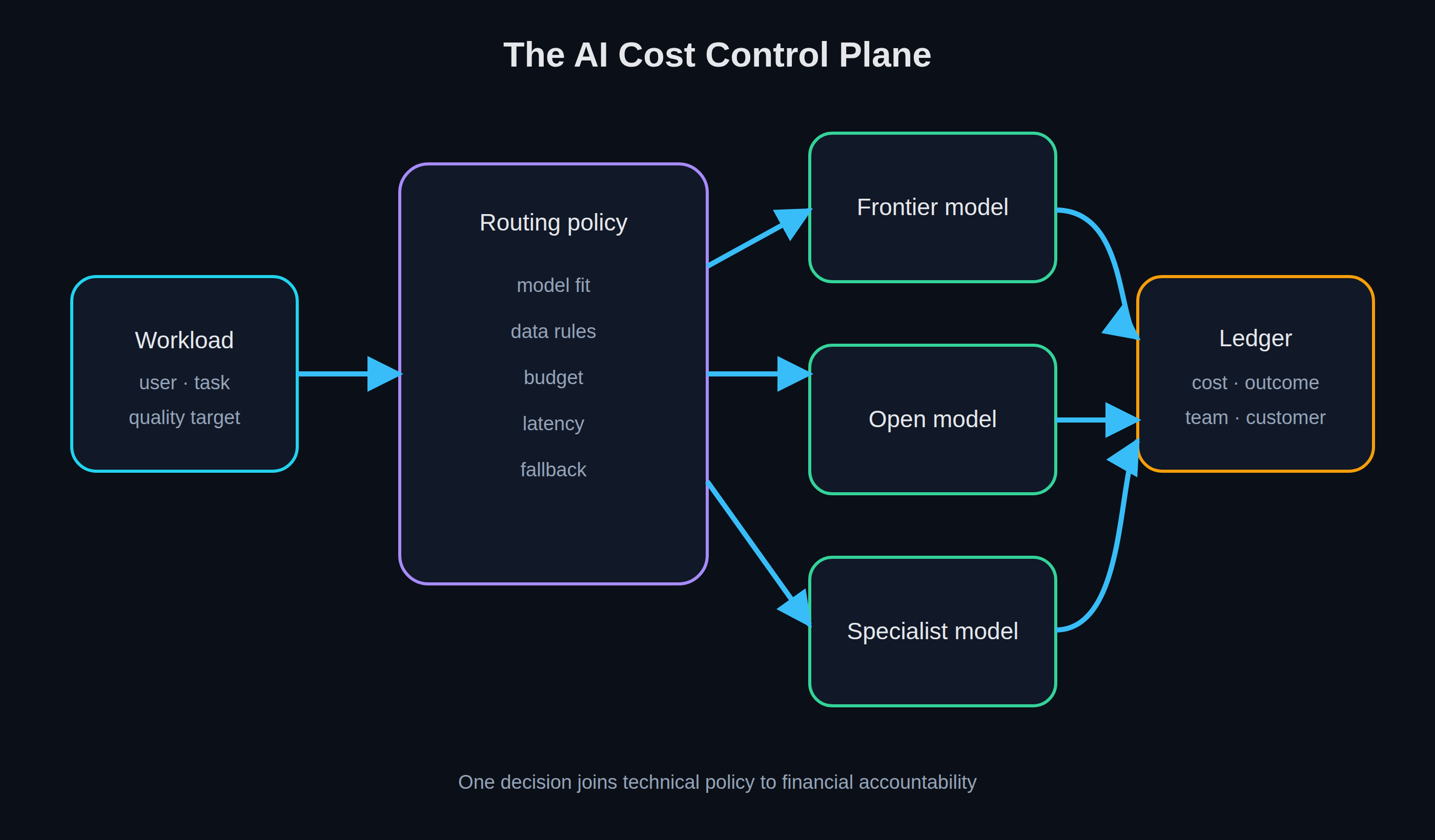
A production AI request carries more than a prompt. It has a user, a workload, a latency budget, a quality threshold, a data policy, and an account that pays the bill. A routing layer can evaluate those constraints before it sends the request to a provider. It can then record what happened after the response returns.
Think of the router as an air-traffic controller connected to the corporate card. It chooses a runway, records the fuel bill, enforces airspace rules, and redirects the flight when an airport closes. The model supplies the aircraft. The router governs the trip.
Stripe already operates where software usage becomes money. OpenRouter operates where AI intent becomes provider usage. If Stripe joins those ledgers, a business could connect each inference event to a team, product, customer, or accepted unit of work. Finance would see spend in business terms instead of receiving a pile of provider invoices at month-end.
That capability matters because model prices and workloads move continuously. The cheapest model for classification may be a poor choice for an ambiguous research task. A frontier model may rescue a difficult workflow while wasting money on routine extraction. Static procurement rules cannot express that difference at request time.
The winning router will price the decision, not merely count the tokens.
AI spend is starting to resemble dynamic payroll
OpenRouter CEO Alex Atallah described the operating problem in unusually direct terms during a recent long-form interview. Employees can choose expensive or cheap models, which makes their AI-assisted cost variable. He argued that companies will eventually compare an employee’s effectiveness with the model spend that produced the work (translated interview).
The phrase “dynamic payroll” sounds harsh, yet the accounting problem is already visible. A software engineer can run a local open model for routine transformations, call a frontier model for architecture work, and use several specialized models through an agent. The salary stays fixed. The machine labor attached to that worker changes with every decision.
Most dashboards answer, “How many tokens did the team buy?” Operators need better questions:
How much did an accepted task cost after retries and verification?
Which route produced the lowest failure-adjusted cost for this workload?
Where did a cheaper model create review work that erased the savings?
Which provider met the data-retention rule for this customer?
A router can observe the whole path. A single model provider sees only the calls that reach its endpoint. That difference gives the routing layer a useful dataset: price, latency, error, switching, and downstream acceptance across providers.
Atallah said OpenRouter measures retention and switching between models. He also described why users stay with an older model: their application already works, the price may improve over time, or they trust its output style. Routing therefore sits at the collision point between economics and reliability (translated interview).
The markup is the weakest part of the business
The acquisition thesis has a large crack. Model brokerage attracts competitors, and competitors can cut the toll.
Latent Space noted that OpenRouter and Vercel reduced GPT-5.6 Sol pricing during the same news window. Its summary framed routing as a pricing battlefield, with zero-markup alternatives threatening a stable brokerage fee (Latent Space). Model labs can also improve their own multi-model access, while large customers can negotiate directly with providers.
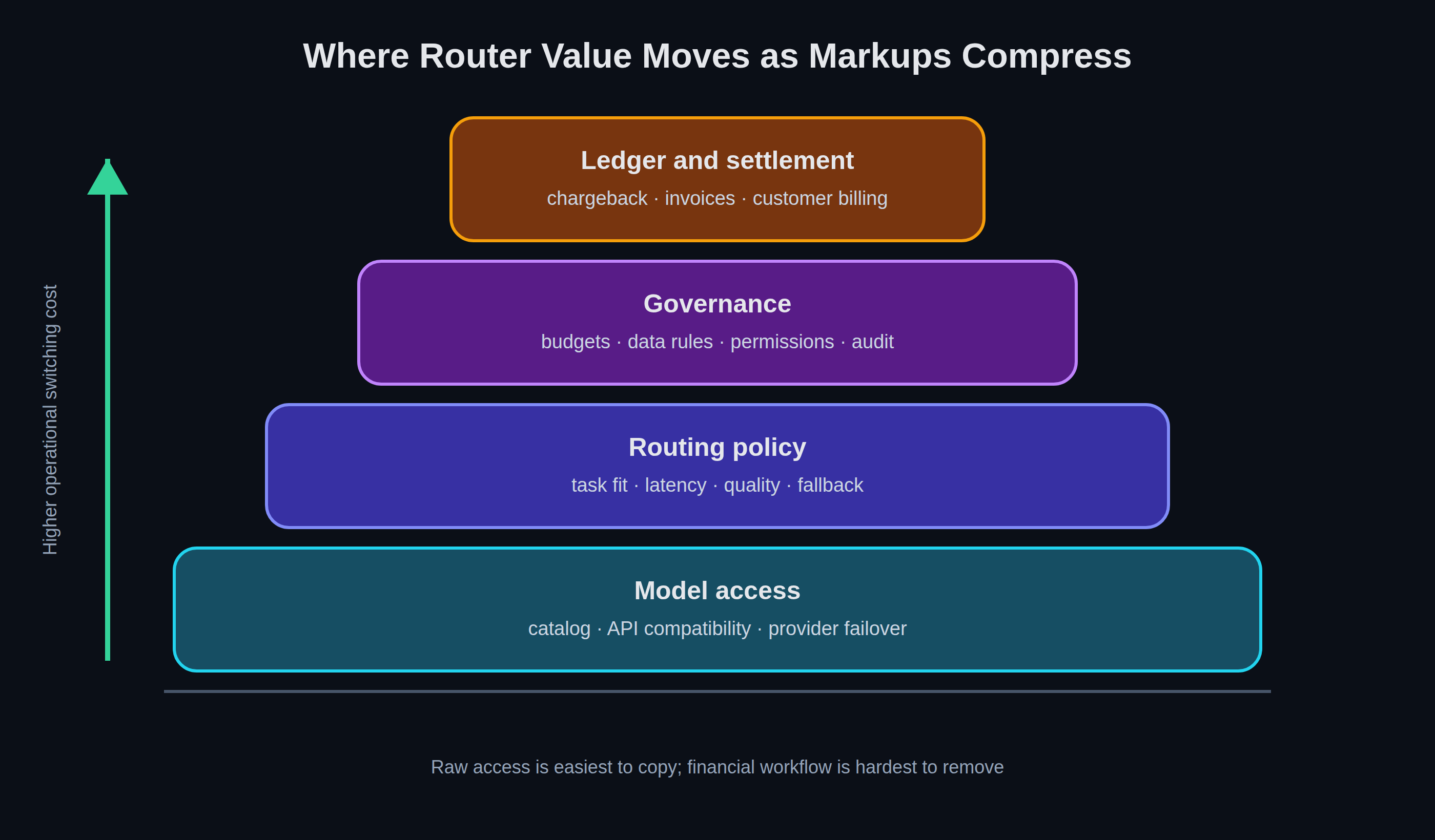
That pressure explains why payments and policy matter more than catalog size. A model list can be copied. A company-wide record of budgets, permissions, data controls, invoices, exceptions, and accepted work is harder to remove once finance and engineering rely on it.
The stack has a clear direction. Basic access sits at the bottom and faces margin compression. Routing policy adds workload-specific decisions. Governance adds data and budget controls. Settlement connects usage to invoices, internal chargeback, and customer billing. Each higher layer embeds the router deeper in operations.
Stripe could turn OpenRouter from a place developers buy model access into a system where companies govern machine labor. That would justify paying for the control point even if raw routing margins shrink.
The $7 billion bet only makes sense if the tollbooth becomes a ledger.
Ownership creates a neutrality problem
OpenRouter’s appeal depends on provider choice. A payments owner introduces a reasonable suspicion: will the route favor models, prices, or commercial relationships that benefit the parent company?
This concern does not require misconduct. Small design choices can shift traffic. Default rankings, fallback order, benchmark selection, and discount presentation all influence which model wins a request. Customers may distrust a routing policy they cannot inspect, especially when it controls both model selection and billing.
Stripe would need to make neutrality verifiable. Enterprise buyers should be able to inspect route decisions, set provider constraints, export traces, and compare the chosen route with alternatives. They should also retain a practical exit path. A cost control plane becomes dangerous when it doubles as a lock-in machine.
The conflict has a useful side effect: it reveals what mature routing needs. Transparent policy and portable records become product requirements. “Trust our ranking” will not survive enterprise procurement.
Builders should measure accepted work, not token discounts
Teams do not need to wait for the reported deal to close. The consolidation signal is enough to change architecture decisions.
First, separate routing policy from provider SDKs. Store the reason for each route alongside cost, latency, retry count, and evaluation outcome. Provider portability becomes much easier when the policy lives in your system rather than inside scattered application code.
Second, measure cost per accepted task. Token price alone rewards models that generate cheap failures. Include retries, verification, human review, and abandoned runs in the denominator. A more expensive model can be the cheaper route when it finishes the job cleanly.
The reported Stripe–OpenRouter deal does not prove that one router will own AI spending. It shows that the control point has become valuable enough to trigger a multibillion-dollar bid.
Models will keep changing. Prices will keep falling. The durable business may belong to the layer that decides what to use, proves why it used it, and settles the bill.