Vercel and Cloudflare both shipped agent-native feature flags in the same 48 hours of April 2026. This piece unpacks the architectural bets behind Vercel Flags GA and Cloudflare Flagship, what they share, where they diverge, and the lifecycle gap (flag retirement) that Kuaishou's QCon 2026 case study shows is the next thing to break.
The 48 Hours That Rebuilt Feature Flags for AI Agents
Vercel shipped Vercel Flags GA on April 16, 2026. Twenty-four hours later, Cloudflare dropped Flagship in the middle of their own "Agents Week." Two different companies, two different stacks, one convergent thesis: feature flags are the safety net under AI agents shipping to production — and the old flag systems weren't built to be that.
The numbers in the Cloudflare post are unusually blunt. When they describe the legacy pattern, they call it "a strange situation. Your application runs at the edge, milliseconds from the user. But the feature flag check forces it to reach back across the Internet to another API before it can decide what to render." That single sentence is the architectural indictment of every flag SDK that ships a fetch("https://flags.example-service.com/v1/evaluate", ...) call into the hot path of a request. It's also the reason the rebuild is happening now, not two years from now.
The 48-hour convergence
The timing is not a coincidence. Read the three changelogs in sequence:
April 16, 2026 — Vercel Flags GA. The full platform gets a first-class flag provider with targeting rules, user segments, and environment controls, plus an OpenFeature adapter for teams on other stacks.
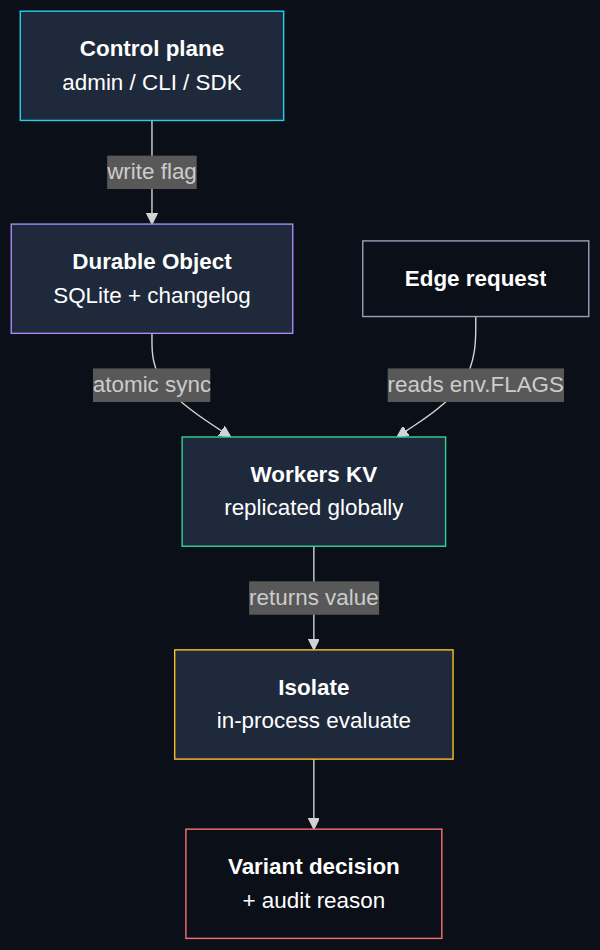
April 17, 2026 — Cloudflare Flagship closed beta. Built on Workers, Durable Objects, and KV. Evaluation happens inside the isolate that's already serving the user request.
Six weeks. Two vendors. Same direction.
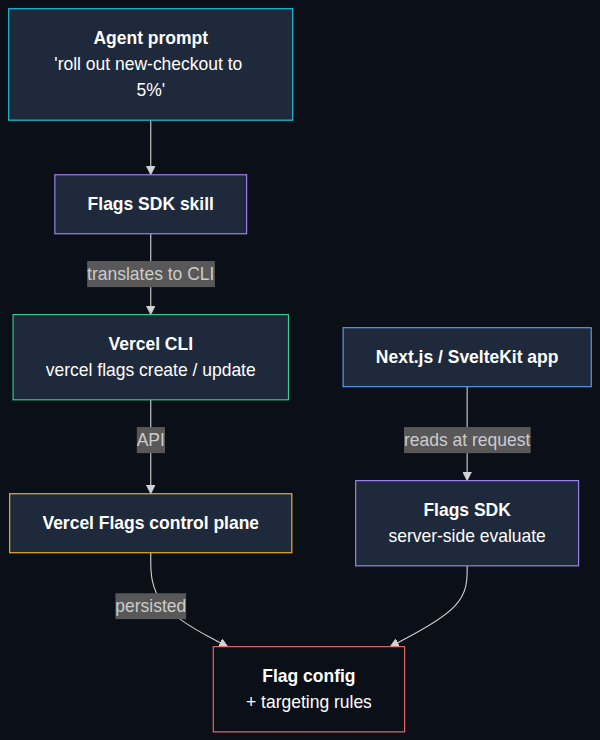
Vercel's bet is the agent workflow. Their skill lets an LLM say "open the new checkout flow for enterprise users in eu-central" and the CLI does the rest — server-side evaluation, segment targeting, OpenFeature-compatible provider switching. The agent never has to read the flag API; it just describes intent. Their changelog spells out the rationale: "enabling agents to implement server-side evaluation that prevents layout shifts and maintains confidentiality."
#AI Agent#AI工程#Human-in-the-Loop#Agent
The 48 Hours That Rebuilt Feature Flags for AI Agents
Cloudflare's bet is the network. Their post argues that the right place to evaluate a flag is "the same Cloudflare location already handling the request" — and the only way to do that on a serverless platform where isolates are created and evicted between requests is to bake it into a primitive that's already at the edge. They picked Workers KV as the read-side store, with a Durable Object (SQLite-backed, globally unique per app) as the source of truth and changelog.
The flag is no longer a release toggle. It's the blast radius control for an agent that ships code on its own.
Why flags needed rebuilding
The honest answer is that flag evaluation has always been the unsexy part of the release pipeline. It works, it's boring, and engineers ship boolean toggles in if statements when the system gets in the way. Cloudflare says this out loud: "One hardcoded flag becomes ten. Ten becomes fifty, owned by different teams, with no central view of what's on or off. There's no audit trail — when something breaks, you're searching git blame to figure out who toggled what."
That was tolerable when humans toggled flags once a week. It's not tolerable when an agent is creating flags per code path and toggling them per cohort, every few minutes.
Three forces converge:
1. The latency cost of a remote flag call is now a multiplier on agent cost. A human-driven feature ramp touches maybe a few hundred requests. An agent-driven ramp — read flag, decide, log, iterate — touches thousands. The "strange situation" Cloudflare calls out is the per-request RPC to a flag origin, sitting on the critical path of every single user request. Move the evaluation to the edge and the cost stops scaling with the agent.
2. The audit problem gets worse when the toggler is an LLM. "git blame" works because humans write coherent commit messages. An agent flipping a flag via a CLI subcommand leaves a different trail — and if the system isn't designed to capture it, you don't get an audit story at all. Cloudflare's Durable Object carries a changelog. Vercel's CLI logs the action. These are not accidents. They are the minimum that "the agent is in the loop" requires.
3. The volume of flags is going to explode. Kuaishou's QCon Beijing 2026 talk, "Let the switch die on its own: AI-empowered feature flag lifecycle governance," puts a number on it: 155 billion flag evaluations per second in the short-video main path, several million RMB per year in egress bandwidth just to ship flag values to clients, thousands of new flags added per year per division.
The same talk quotes an unnamed MIT professor: "AI is like a brand new credit card, letting us accumulate technical debt in ways we never could before." When humans write code slowly, debt gets paid down. When agents write code faster than they read, debt compounds. Flags are the only mechanism most teams have for bounding a release. And bounds only work if the flag system itself keeps up with the agent that creates them.
How the two rebuilds actually work
Cloudflare and Vercel picked different layers to attack, and the contrast is more interesting than the convergence.
The Cloudflare data plane treats flag reads like a CDN read: the value lives in the same network that already serves the user, the decision logic runs in the same V8 isolate that serves the request, and the SDK never makes a network call. The control plane is just Durable Objects writing to KV. The result: await env.FLAGS.getBooleanValue('new-ui', false, { userId: 'user-42' }) resolves locally, with type-safe accessors and a reason field for the audit log.
Vercel's design is more about agent ergonomics than network placement. The Flags SDK skill wraps the CLI; the CLI handles the API; the OpenFeature adapter keeps the user's flag-evaluation code portable. An agent doesn't see a flag API. It sees a natural-language target.
The two architectures differ on where they spend the complexity. Cloudflare spends it on the read path — KV, isolation, type-safe bindings. Vercel spends it on the write path — the skill, the CLI, the OpenFeature adapter that lets an agent compose with whatever provider a team already has.
They are not competitors, in the strict sense. Cloudflare is for teams that want the lowest possible read latency on the network they already own. Vercel is for teams that want the lowest possible integration friction with an agent that already knows how to use a CLI. A team could run Flagship on Workers for the read path and still use Vercel-style skills for the write path. The standards (OpenFeature) make the swap survivable.
What breaks when the system isn't agent-native
The Kuaishou engineering team is the cleanest production case study. Senior architect Yan Wenliang walked through their numbers in June 2026:
155 billion flag evaluations per second on the short-video main path (excluding upstream/downstream)
Several million RMB per year in bandwidth just to send flag values to clients
Thousands of new flags added per year per division
Real outage: a flag that had been 100% rolled out for years was still guarding the old code path. A bug elsewhere caused the flag fetch to fail. The old logic ran. The team spent the night finding it.
That last one is the one that should keep a CTO up. The flag was doing its job. The old code path was the time bomb.
Their solution is the AI+AST double engine. An LLM rewrites the code to remove the flag and its branch. A separate AST engine, driven by a directed graph of small atomic rules, rewrites the same code deterministically. If the two outputs match, the change ships. If they don't, a human reviews. The talk calls the two roles "explorer" and "validator" — and argues that the probability of both engines making the same mistake in the same way is "almost zero."
The reason this matters for the Vercel/Cloudflare rebuilds is the lifecycle gap. Both vendors ship excellent systems for creating and evaluating agent-driven flags. Neither has shipped, as of April 2026, a system for retiring them. Kuaishou's lesson is that the retirement story is where the worst incidents live. Stale flags, defaulting to old logic when the control plane hiccups, are the operational debt that grows fastest when humans are out of the toggle loop.
The remaining human responsibilities
If an agent is writing the diff, deploying it, evaluating the flag at the edge, ramping the cohort, and proposing the retirement — what's left for the human?
Three things, and they're the ones that don't fit in a CLI:
1. Define what is allowed to ramp. The "is this safe to expose to real users at 5%?" question is a policy question, not a flag question. Vercel's targeting rules and Cloudflare's segments are execution. The policy that says "checkout flow can ramp, billing changes cannot" has to come from a human who understands the business.
2. Define what must die. "Let the switch die on its own" only works if there's a rule for when "on its own" stops being acceptable. The Kuaishou double engine is a safety net, not a replacement for an explicit retirement policy: "this flag has been 100% for N weeks, this code path is no longer reachable, retire it." Without that, even an AI-managed flag set becomes a fossil bed.
3. Define who audits the auditor. An agent flipping flags via CLI logs an action. A Durable Object holds a changelog. An AST engine validates a diff. None of those answer "is the agent being measured against the right goals?" That's a humans-only question, and it's the one that, if you skip it, makes the entire stack a faster way to ship changes you don't actually want.
The 48-hour convergence between Vercel and Cloudflare is the easy part. The hard part sits above it. The audit layer that tells you whether the flag system, agent, and code change are all working toward the same definition of "safe to ship" doesn't ship as a primitive. Vercel and Cloudflare are now selling you the rails. The policy, the retirement rules, and the audit goals are still your problem.
If you can't trust an agent to flip a flag, you can't trust it to ship the diff behind that flag. So which one are you actually not trusting — and what would it take to make the answer "both"?