The Request Is the Transaction: How Cloudflare's x402 Gateway Kills the Attention Economy
发布于 2026-07-09
On July 1, 2026, Cloudflare quietly published the rails for the death of the 30-year attention web: the x402 open protocol + Monetization Gateway turns every HTTP request into a billable event. Per-seat SaaS is structurally incompatible with software that buys in microseconds.
The Request Is the Transaction: How Cloudflare's x402 Gateway Kills the Attention Economy
On July 1, 2026, Cloudflare published a blog post titled "Announcing the Monetization Gateway: charge for any resource behind Cloudflare via x402." Buried in the post is the death of the 30-year attention web.
The headline feature sounds boring. The new product lets any Cloudflare customer attach a price tag to a URL — pay-per-call for a search, pay-per-megabyte for an upload, pay-per-resolution for a support ticket. Settlement runs over stablecoins, peer-to-peer, in under a second. The price points go as low as fractions of a cent. None of that is the point. The point is what it does to the economic model the rest of us have been running on since 1995.
The 30-year attention web was built for humans to look at things. The next 30 will be built for software to pay for things. Cloudflare shipped the rails this week.
The bargain that ran out of road
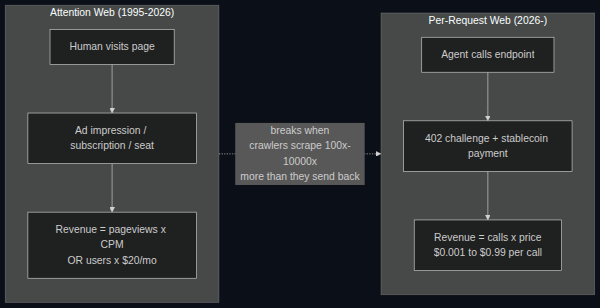
For three decades the web's economic bargain was simple. You built a page, a human looked at it, and the human's attention got sold — to advertisers, to subscription upsells, to a checkout button. That bargain funded the Internet. Almost every business model in software eventually learned to imitate it: monthly seats, per-user pricing, paywalls, ad-supported free tiers.
Agents don't look at things. They don't click banner ads, they don't read sponsored listicles, they don't renew their Notion subscription. They make a request, take the answer, and move on. Cloudflare's own data captures the asymmetry: "AI crawlers already request content anywhere from a hundred to tens of thousands of times for every visitor they send back" (Cloudflare, July 1, 2026).
#AI Agent#API经济#AI变现#商业分析#AI工程
Cloudflare x402: The Request Is the Transaction
That single number breaks the old bargain. A publisher whose content gets scraped 10,000 times per human visit can't pay rent on pageviews. A SaaS company that charges $20 per seat is selling to humans, but the work the user does during the seat is increasingly being done by the agent sitting in it. The seat is rented. The work isn't. Pricing the seat no longer prices the work.
The mismatch is structural, not transitional. Per-seat pricing does not describe the new unit of consumption, and the longer a business model refuses to admit that, the more it leaks.
x402 is the smallest protocol that could matter
The 402 HTTP status code has been sitting dormant since 1996. Reserved for "Payment Required," almost no server ever returned it because no one could figure out how a client would pay. Cloudflare and a coalition of 25+ companies just founded the x402 Foundation through the Linux Foundation to change that. The protocol is small on purpose.
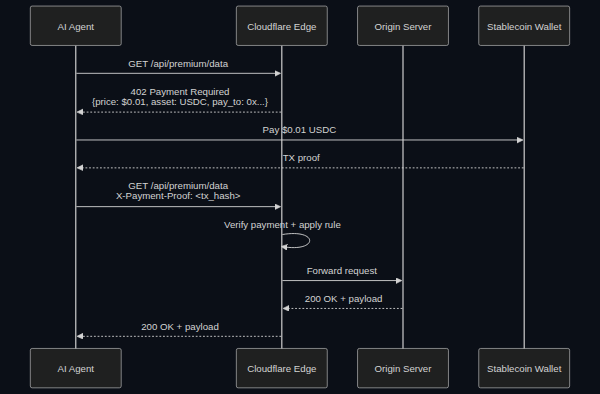
A client requests a payment-gated resource. The server responds with 402 Payment Required and a small payload: the price, the accepted asset, and where to pay. The client pays, repeats the request with proof of payment attached, and gets the resource. The handshake fits inside normal HTTP. No redirect, no separate checkout API, no cart, no signup (Cloudflare, July 1, 2026).
Two properties make this work for machines, not humans. First, the amounts can be tiny — fractions of a cent — because the protocol adds almost no overhead and stablecoin settlement costs a fraction of a cent. Second, the buyer needs no account with the seller. The payment itself is the credential. A new agent with no history, no API key, no signed contract can walk up to your endpoint, pay, and walk away. That detail is more important than the protocol.
Strip payments and auth out of the same request, and you have removed the entire reason the modern web needed signups in the first place. The friction that made the per-seat model tolerable — create an account, get an API key, store a secret, monitor for leakage, rotate on breach — disappears.
What the Monetization Gateway actually does
The Gateway is a rules engine that lives at Cloudflare's edge, running across 330+ cities. You write a rule — the same shape you'd write for any Cloudflare rule — that says: requests to /api/premium/* cost $0.01, the upload endpoint costs $0.001 base + $0.01 per MB, the support resolution endpoint costs $0.99 only on success. You commit it via dashboard, API, or Terraform. From that point on, every request gets a price tag, and the price is enforced at the edge before the request ever reaches your origin.
Cloudflare's example price points are deliberate. They are not aspirational. They are the kind of numbers that a developer shipping an API can imagine defending in a P&L meeting: a few cents per web search, billed per call; a $0.99 success fee for a resolved ticket; a per-megabyte egress charge (Cloudflare, July 1, 2026).
The architectural consequences are larger than the feature. Metering, payment exchange, and settlement now happen off your origin. You do not become a payments company to charge for your API. You write a rule. A paid endpoint is just another line in your infrastructure config. The independent developer with a clever new API can reach the same buyers, on the same terms, as the largest company on the web.
Who wins, who loses
Three groups of companies face this directly.
Winners: API-first builders. Anyone whose product is already a callable resource — model inference, image generation, geocoding, weather data, MCP tools, search — now has a way to bill per outcome without standing up a billing system. The Gateway removes the ops tax that kept indie developers on flat-rate pricing and kept them from experimenting with usage-based models. Stripe unbundled payments. Cloudflare just unbundled billing for the edge.
Losers: per-seat incumbents whose product is a tab. The companies that made billions pricing humans at $20 a month are the ones whose pricing model is now structurally off. When a single agent can do the work of an entire team "around the clock, making a flat one-time fee disconnected from actual consumption" (Cloudflare, July 1, 2026), the per-seat price tag is a rounding error in the buyer's actual cost structure. The product still has to be sold — but the price has to be per-call, per-token, or per-outcome. Otherwise the buyer goes around you.
Caught in the middle: ad-funded publishers. They have always known that AI crawlers are eating their content. The Gateway plus Pay Per Crawl (which Cloudflare shipped earlier in 2025) is the first credible way to flip the ratio — to charge machines, not humans. But the cost of operating a small publisher with a working x402 endpoint is non-trivial, and the platform dependency is real. Whoever owns the proxy layer owns the next web.
The proxy layer is the new real estate
Read the announcement again. "Cloudflare is one of the few places that will be able to settle all of it inside a single request, by verifying the agent, applying the rule, and checking the payment before the origin ever sees the call" (Cloudflare, July 1, 2026).
The company that owns the proxy layer gets to be the tax collector. AWS has the proxy for compute. CloudFront sits closer to the application. Vercel and Netlify are even closer to the developer. Stripe is strong on the payment rail but sits behind the application, not in front of it. Cloudflare is the only one with both the global network and the payment integration that can do identity + rule + payment in a single hop, and they just published the reference implementation.
The x402 protocol is open. The Foundation has 25+ members. The Gateway is not. Whoever builds the first production-ready, multi-cloud x402 stack before Cloudflare locks in the default wins the next decade of the agent web. That is the bet Cloudflare is making public this week.
Pick a side
The 30-year web was built for humans to look at things. The next 30 years will be built for software to pay for things. That is not a forecast. The protocol exists. The reference implementation exists. The waitlist is open.
If you build software that software calls, the new economy is yours. Ship a per-call rule, accept a stablecoin, and your endpoint becomes reachable by every agent with a wallet — no API key, no contract, no signup.
If you sell seats, you have 12 to 24 months to figure out per-call pricing before the seat becomes a rounding error in your customer's cost.
Either you build for the per-request economy in 2026, or your business model becomes unmonetizable by software. Pick now. The protocol isn't waiting for the rest of the industry to catch up.