DeepSeek V4 Flash Drew the New Agent Pricing Line — and It Only Needed 50x
Published on 2026-08-03
DeepSeek V4 Flash burned 8 trillion tokens in one day on OpenCode. The 50x cost gap with flagship models is reshaping how agents pick their default model.


DeepSeek V4 Flash Drew the New Agent Pricing Line — and It Only Needed 50x
One day. 8 trillion tokens. From a single model inside a single AI coding tool.
That is the usage record DeepSeek V4 Flash posted between July 31 and August 2, 2026 — through OpenCode, the open-source coding agent. 5 trillion came from the free tier, 3 trillion from paid OpenCode Go subscriptions. For scale, OpenRouter — the routing layer that aggregates more than 400 models — handles roughly 6.6 trillion tokens per day across its entire platform. One model, in one tool, in one day, shoved more tokens through the wire than the entire OpenRouter inventory does on an average day (ifanr, 2026-08-03).
This is not a freak accident. It is the price line being redrawn under the agent economy.
The "killing line" idea
V4 Flash does not need to be the smartest model on the planet. It just needs to be "good enough most of the time" — and it needs to be 50x cheaper than the alternatives that ship in the same shipping lane.
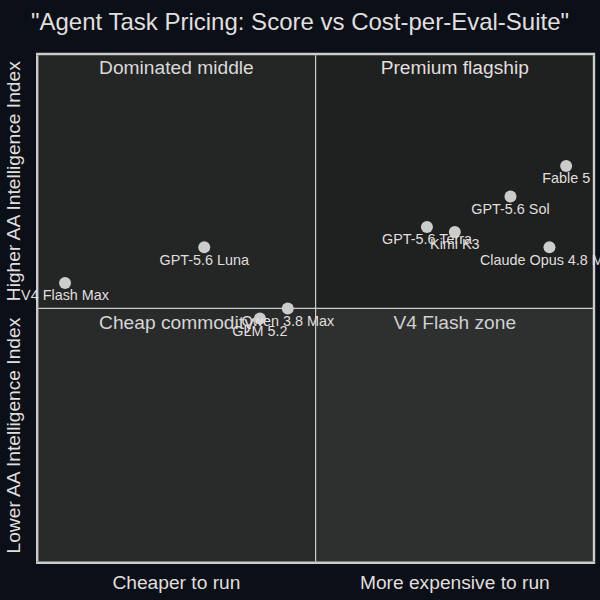
The clearest evidence is the Artificial Analysis Intelligence Index v4.1, run on August 2, 2026. V4 Flash Max scores 50. Claude Opus 4.8 Max scores 56. Run the same evaluation suite through both models and the bill tells the real story: V4 Flash costs about $72.02 to complete the suite. Claude Opus 4.8 costs about $3,752.55. Opus is 12% better on the score. It is 52 times more expensive (ifanr, 2026-08-03).
In any other market — CPUs, GPUs, cloud storage, bandwidth — that ratio would already be lethal. In the agent market, where a single task can involve dozens of model calls, hundreds of tool invocations, and hundreds of millions of tokens, the cost curve does not just bend. It breaks.
The 85x number on output alone
The published price list crystallizes the gap. Per million output tokens:
| Model | USD / 1M output | RMB / 1M output |
|---|---|---|
| DeepSeek V4 Flash | ~$0.28 | 2 |
| Qwen 3.8 Max | ~$5 | 36 |
| GLM 5.2 | ~$3.9 | 28 |
| Kimi K3 | ~$14 | 100 |
| GPT-5.6 Luna | $1.20 (post-July cut) | ~8.6 |
| GPT-5.6 Terra | $12 | ~86 |
| GPT-5.6 Sol | $30 | ~215 |
| Claude Opus 4.8 / 5 | $25 | ~170 |
| Fable 5 | $50 | ~358 |
(Sources: DeepSeek official API page; ifanr snapshot 2026-08-03; OpenAI July 2026 price cut announcement.)
Read the bottom row. Output price for Opus 4.8 is 85 times V4 Flash's. That is not a "premium tier." That is a different category of product.
Developer-side numbers are even more brutal. The analyst @SciTechera documented that completing a single Terminal-Bench 2.1 task on V4 Flash runs about $0.03. On flagship-priced models, that same task class runs in the dollar range. The X developer community that pushed Musk to follow DeepSeek's official account was not marveling at the model — it was marveling at the unit economics: single-call costs as low as $0.0005 (Source: 网易智能, 2026-08-03).
How you sell Maotai at mineral-water prices
DeepSeek's pricing reads like a market disruption, but it is really an engineering line item. The V4 architecture, described in the April 2026 Preview technical report, points to three deliberate moves:
- Sparsity at scale. V4 Flash has 284 billion total parameters, but activates only about 13 billion per token. The model carries the capacity of a giant model and the inference cost of a small one.
- Hybrid attention. V4 alternates two attention patterns — CSA (compress-then-attend) and HCA (heavier compression, full scan) — to balance long-context recall against compute. Per-token compute runs about 10% of V3.2; KV Cache about 7%.
- Post-training specialization. The July 31 release notes the architecture is unchanged from Preview; only post-training changed. DeepSeek trained separate math, code, agent, and instruction-following experts, ran them through SFT and GRPO, then merged them back via on-policy distillation from a dozen teacher models. Tool-calling got its own format work — Interleaved Thinking, DSec sandbox fleets for retry-and-correct loops.
The result is a model that does not pay the "smartness tax" on every token. It pays it only on the 13 billion parameters the router actually selects. The rest of the 271 billion parameters sleep through that inference call.

Maotai sold as mineral water is not a metaphor for "cheap." It is a metaphor for "the same SKU at a different cost curve."
What dies, what survives
The squeeze does not hit every tier equally.
Cheap models die last. Tiny models still own classification, extraction, and routing. They are not the target. The target is the middle.
Flagship models survive on the hard tail. Squeeze-out works on tasks where the model is "good enough most of the time." A 50x price discount does not matter if the failure rate is 10% and the task is a billion-dollar M&A contract. Frontier models keep the seat at the high-stakes table — coding final reviews, security audits, regulatory writing, last-mile verification.
The middle lot is doomed. The Pascal's-wager zone — models that are 10-20% better than V4 Flash but cost 30-50x more — has no business model. They do not win the easy majority of agent tasks by a meaningful margin, and they do not command the budget for the hard tail. They are priced for a market that is leaving.
Anthropic and OpenAI know this. Both have been forced to ship sub-brands (Haiku, Mini, Luna, Sol) and to publish price cuts in July 2026 to keep the floor under their stack. The flagship remains. The middle hollows out.
The agent economy rewrites the unit
The deeper change is not a price cut. It is a redefinition of the unit of value.
In the chat era, the unit was "answer quality." You compared models on a single response and picked the one that gave the best answer per query. In the agent era, the unit is "task cost." A task may run for hours, invoke dozens of tools, involve multiple agents, and produce hundreds of millions of tokens. One developer documented Opus 5 burning 690 million tokens — nearly $3,000 in API spend — to produce a single HTML page for a 3D game (ifanr, 2026-08-03). That is not a "bad model." That is a model optimized for the wrong unit.
V4 Flash wins because it is the first model priced for the new unit. It does not need to be the smartest model. It needs to be the model whose cost-per-task lands below the value-per-task for the median agent workload.
The 8 trillion tokens in one day is the proof. Developers did not pick V4 Flash on vibes. They picked it because the bill at the end of the month was an order of magnitude smaller, and the failure rate on their actual tasks was within an acceptable band. That is the new selection function.
The bet
DeepSeek is not trying to win the leaderboard. It is trying to win the default-call slot. The slot where a developer hits "go" on an agent task and the routing layer picks the cheapest model that can plausibly finish the job. If V4 Flash lives in that slot by default for 80% of agent traffic, the 50x cost gap does not need to close. It just needs to keep existing.
The agent era will not be won by the model with the highest benchmark. It will be won by the model that is good enough for 1/50th the price, sitting in the default position, every time.
That is the killing line. Maotai does not need to be popular. It just needs to be the bottle behind the bar.