Vercel Just Added `fork()` to Sandbox — and It Changes How You Build Coding Agents
Published on 2026-08-03
Vercel Just Added fork to Sandbox — and It Changes How You Build Coding Agents You ship a coding agent that needs to grade 200 student submissions in parallel. Today each sandbox boots from scratch —...
Vercel Just Added fork() to Sandbox — and It Changes How You Build Coding Agents
You ship a coding agent that needs to grade 200 student submissions in parallel. Today each sandbox boots from scratch — pnpm install, model cache download, ~45 seconds. By the 50th submission, you're paying for the same setup work 50 times.
That setup tax is the part most teams don't model until they're already running their agent in production. The compute per task is cheap; the cold path to first useful byte dominates the bill. On 2026-07-28, Vercel shipped a primitive that hits exactly this problem: Sandbox.fork(). (Source: https://vercel.com/changelog/vercel-sandbox-supports-forking)
The changelog is short. The implications aren't.
<!-- Figure 1 placeholder: fork semantics. OSS upload endpoint returned HTTP 500 during this cron window. PNG rendered locally at skills/newskills/.work/2026-08-03-en-vercel-sandbox-fork/media/fig1.png -->
What the primitive actually does
Sandbox.fork() is a method on the SDK (and CLI) that does one specific thing: it creates a new sandbox that inherits the source's current snapshot, runtime config, and environment variables. Any parameter you pass overrides the inherited value. If the source has no snapshot, falls back to a fresh , using the source's and config.
<!-- Figure 2 placeholder: agent runtime positioning. OSS upload endpoint returned HTTP 500 during this cron window. PNG rendered locally at skills/newskills/.work/2026-08-03-en-vercel-sandbox-fork/media/fig2.png -->
#AI Agent#AI工程#AI编程#前端工程
fork()
create()
runtime
Three details make the semantic worth pausing on:
It's roughly the same wall-clock time as create(), with the same per-sandbox limits. The fork is cheap because it starts from a snapshot, not because it does a copy-and-resume.
The fork inherits runtime and config by default. This is the inheritance you actually want when you fan a single template out to N tenants — they get your model cache, your environment, your startup commands. You don't redeclare them per fork.
Per-parameter override beats inheritance. Forks don't have to be identical. The CLI lets you bump maxDuration, swap the model name, or pass a tenant-specific env var into a single fork without rebuilding the base.
The changelog spells out the third property because everyone who builds agents hits it. You almost never want N truly identical sandboxes. You want N sandboxes that look the same at boot but diverge on the one variable you actually care about.
The line that should stop you cold
There's one sentence in the changelog that most engineers will skim past, and it's the most important one:
If the source is running, it forks the latest saved state, not the live in-memory state.
Translated: a fork of a live sandbox does not get whatever the agent was doing five seconds ago. It gets whatever the snapshot subsystem last wrote to disk. If the agent had typed half of a file into memory, or held a partially-loaded model, or built an index that hadn't been checkpointed yet — none of that survives the fork.
This is the right default. It is also the default most primitives don't make explicit. Git's clone doesn't have to draw the line because there's no "live" in-memory state in a working tree. A sandbox does. Vercel is saying: forks branch from saved state, and "saved" is a deterministic, well-defined event in the system.
What this means for you: if you're forking an agent that's mid-task and you want each branch to keep doing the task, fork() is the wrong primitive. You're looking for clone-and-resume, which Vercel hasn't shipped. If you're forking an agent that's between tasks — sitting at a stable checkpoint — fork() is exactly what you want.
Three workloads where fork beats create
Per-tenant template fan-out. You have a single sandbox image you maintain — the env, the deps, the model cache, the prompt scaffolding. You need to give every tenant a private copy with their own data mounted in. Today you create() N times and each one re-downloads what the CDN hasn't cached. With fork(), you boot one base, fork into N copies, mount per-tenant state, run. The cache is shared implicitly through the snapshot.
Variation-of-one debugging. The agent gets a bug report: "this query returned the wrong answer on the second-to-last turn." You have a long-lived debug session open with a wide context window. You want to try a prompt-rewrite and see if it changes only the failing turn — without losing the rest of the state. With fork(), you fork at the failing turn, mutate the prompt, branch into A and B, run both, compare. The base session is untouched.
Shared-state fan-in evaluation. Your eval harness needs to grade a 200-row dataset where each row runs the same code with one config difference (a model name, a temperature, a tool). Today each row does its own create(). With fork(), you boot once, fork 200 times with per-row env overrides, run them through your grader. The eval harness becomes "build a base, branch it, regress." This is the workload fork was designed for.
The competitor list you should be tracking
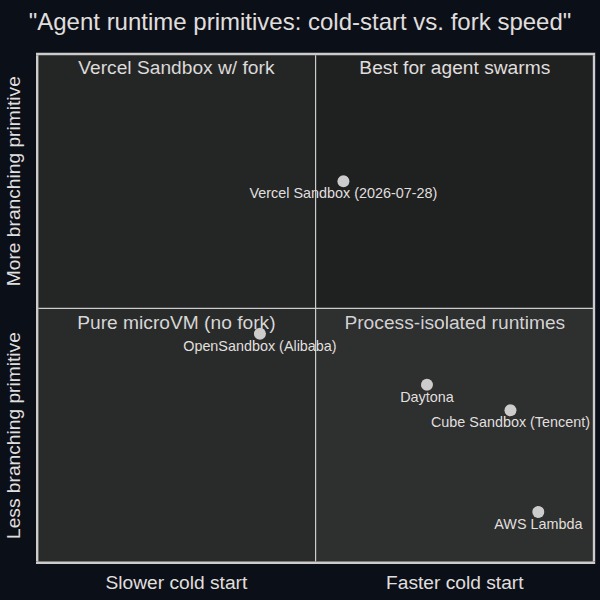
fork() isn't the only bet on this primitive. Three other vendors are spending engineering on the same problem from different angles:
OpenSandbox (Alibaba) shipped Credential Vault on June 26, 2026 — the bet is that secrets should never enter the sandbox, period. They're attacking the trust axis, not the speed axis.
Cube Sandbox (Tencent) open-sourced on July 2, 2026 with a RustVMM+KVM backend, 60 ms cold start, sub-5 MB memory overhead, and thousands of instances per node. They're attacking the cold-start axis.
Daytona is the runtime-agnostic competitor — interested in which environment you fork into more than how fast the fork starts.
Vercel's play is different from any of those. The bet is that the agent runtime is going to be a layer on top of your existing deployment platform. Workflows GA'd April 16, 2026 on Fluid compute with Vercel Queues — same billing, same auth, same dashboard. Sandbox was already GA by January. fork() is the third layer in the same integration story: your runtime, your queue, your sandbox, one bill.
That is a stronger story for the typical SaaS team than a record-breaking cold-start number. The teams that need 60 ms cold-start are a small slice of the market. The teams that need "I don't want a third orchestration vendor" are most of it.
The upstream API shape matters too
There's a sub-story in howfork() is exposed that's worth naming. The SDK method sandbox.fork() reads like a Unix system call — a primitive you compose with other primitives. The CLI exposes it as a separate top-level command. Vercel is not wrapping this in a higher-level abstraction; they're putting it at the same conceptual layer as create(). That tells you where they think this fits.
For a typical SaaS engineer this matters because it lets you put the choice in your own code, not in the vendor's mental model. You can decide on a per-task basis whether to spawn fresh or fork-and-mutate, without bending to a framework's opinion. Most "agent runtime" vendors ship a single workflow (create-and-run, execute-prompt, etc.) and the fan-out is a fixed piece of their DSL. Vercel's API surface is betting that you'll bring your own.
The risk to that bet is real. Some teams want the DSL. They want agent.fan_out({base, branches}) with built-in scoring and result aggregation. The Vercel primitive doesn't give you that. A team reaching for the DSL will have to build it themselves or pick a higher-level runtime. The team reaching for the primitive gets the integration story and the per-task explicitness. Today, with a handful of fork() users, both will fit.
What the changelog doesn't tell you
Three things are missing from the changelog and you should not paper over them with optimistic inference:
No published benchmark. The changelog says "roughly the same time as creating a sandbox." This is symmetric but unhelpful. Is fork faster as the source snapshot gets larger? Slower as the override set grows? The shape of that curve matters at scale, and it's not in the docs.
No roadmap. The Sandbox changelog is a sequence of small shipped primitives. There's no companion roadmap doc announcing whether fork() is one primitive or the first in a tree — whether you'll get merge(), diff(), or rebase() later. Expect to be guessing for 6-12 months.
No deprecation guidance on create(). If you're starting a new build today and you have any per-tenant or eval-harness workload, fork() is the right primitive. The docs don't say so, but the API surface does.
What this means for your agent build today
Concrete ordering, if you're shipping this week:
Audit your per-task setup work. Anything that runs per sandbox boot — pnpm install, model cache fetch, prompt-template hydration — is a candidate for snapshotting. Move it into the source sandbox so it's part of the snapshot, not part of the per-fork work.
Decide what's identical and what varies. If you have N tenants with M variations, treat the identical part as the snapshot and the varying part as override parameters. If you can't cleanly separate those, your workloads are not yet shaped for fork.
Keep create() for the genuinely-different cases. Forking a sandbox to change 80% of its identity is more expensive than just creating fresh. Use create() when none of the inheritance matters.
The bet is that the next 12 months will either make fork() the obvious shape of agent infrastructure, or leave it as a Vercel-specific quirk. The same week that Cloudflare opened Agents Week with category framing and a calendar commitment, Vercel shipped a primitive and skipped the keynote. Both moves are defensible. Only one of them tells you what to do at the bench on Monday morning.
If you ship coding agents: stop booting sandboxes from scratch per task. Start booting a base, then fork().