AWS Just Made Claude Code Enterprise-Shaped — and the Bottleneck is the Point
发布于 2026-08-12
AWS just shipped a production reference architecture for the Claude apps gateway — a self-hosted chokepoint that lets enterprises put Claude Code behind SSO, per-group model policy, OTLP telemetry, and inline spend caps. We walk through the five primitives, the five deployment patterns, the contract trap AWS documented but didn't resolve, and what to do on Monday.
AWS Just Made Claude Code Enterprise-Shaped — and the Bottleneck is the Point
On 2026-08-11, AWS Machine Learning Blog published a production reference architecture for a piece of software most teams have never heard of: the Claude apps gateway (https://aws.amazon.com/blogs/machine-learning/deploying-anthropic-claude-apps-gateway-for-aws-for-enterprise-workloads/). It ships inside the same claude binary developers already run. You start it with claude gateway --config gateway.yaml. It sits between your developers and Amazon Bedrock. And it solves a problem that has almost nothing to do with AI.
It solves the governance problem. And the way AWS chose to solve it is the whole story.
The chokepoint thesis
The biggest obstacle to rolling Claude Code out across a 500-person engineering org is not model quality. It is the procurement / IT / legal question that gets asked the moment finance sees the line item: who is using this, what are they using it on, and how do we turn it off if something goes wrong?
In 2010, the answer to a similar question — who is using the corporate network, and on what terms? — was a VPN concentrator. A deliberate bottleneck. Every packet from every laptop went through a box the company controlled. It was not elegant. It did not have to be. It was defensible: when the auditor asked for the log, the log existed; when the CFO asked who was on the system, the system had names; when legal asked where the data went, the answer was "our building, our cable, our rules."
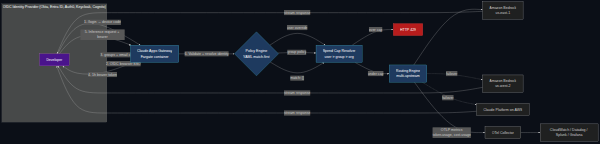
<!-- 配图:The five governance primitives and their request flow -->
<!-- 配图:Decision tree for choosing which deployment pattern -->
#Anthropic#Claude#AI Agent#代码治理#AI 基础设施
AWS Claude Apps Gateway: The VPN for Coding Agents
The Claude apps gateway is the same shape. One container, one YAML file. Every Claude Code request from every developer goes through it. AWS did not build a product. AWS built a chokepoint on purpose. That is the most interesting thing happening in enterprise AI this week.
Five primitives, five tradeoffs
The gateway exposes five server-side enforced capabilities. Each one is small. Each one hides a real decision that the platform team is now making explicitly instead of implicitly.
1. Identity — OIDC, delegated, no local user store. The gateway delegates authentication entirely to your existing identity provider: Okta, Microsoft Entra ID, Auth0, Keycloak, or Amazon Cognito. After the developer signs in once through browser SSO, the gateway issues a 1-hour bearer token and refreshes it silently in the background. The gateway keeps no user directory of its own. No accounts to pre-create. No SCIM sync to configure. Offboarding is removing the user from the IdP; their session dies within the configured TTL, with no credential rotation required (AWS blog §Identity).
The trap: if you use Microsoft Entra ID, the token does not include role claims by default. Without one line in your YAML — groups_claim: roles — every developer matches only the catch-all policy at the bottom. They are all "unmatched users." They get whatever you put in match: {}. AWS documents this in a callout box. Most teams will miss it.
2. Policy — server-side model access, first match wins. You define which models and capabilities each IdP group gets in a single YAML block. Policies are evaluated in declaration order, the first match is selected, then merged onto the match: {} catch-all base. End the list with a match: {} policy. Without one, unmatched users receive full catalog access (AWS blog §Policy).
This shape is the same shape as an AWS IAM policy or a Linux iptables chain. Engineers already know how to reason about it. The server-side enforcement is what matters: a developer whose group only grants Claude Haiku cannot bypass the restriction, even with a modified client. The model picker in Claude Code and Claude Desktop shows only permitted models.
3. Telemetry — metrics on, logs and traces off by default. The client emits usage metrics (claude_code.token.usage, claude_code.cost.usage, claude_code.active_time.total) attributed to the authenticated identity. The gateway relays them over OpenTelemetry Protocol (OTLP) to a collector you configure. AWS-supported backends: Datadog, Splunk, Grafana, and Amazon CloudWatch (via the AWS Distro for OpenTelemetry collector).
Logs and traces are opt-in. The reason, in AWS's own words: "they can contain source code and prompt content." AWS is being explicit that they know what is in the pipeline, and that the default is the safer one. That is not nothing. Most observability products default to "collect everything," then ask forgiveness.
4. Routing — multi-upstream failover, with a contract trap. You configure one or more upstreams in declared order: Bedrock in us-east-1, Bedrock in us-west-2, Claude Platform on AWS as cross-provider fallback. The gateway routes to the first, fails over automatically on rate-limit or outage. Cross-provider failover changes the applicable service terms and the data-processing geography.
That second sentence is the one your legal team needs to read. The same code path, run twice in the same hour, can land in different legal regimes depending on which upstream answered. AWS wrote it. AWS did not explain how to handle it in the contract stage. That work is yours.
5. Spend caps — inline, not post-hoc. Caps are set at three levels: organization-wide defaults, per-group, and per-user overrides. The gateway resolves the effective limit for each request as user override > most restrictive group cap > org default, then enforces it before inference. When a developer hits the ceiling, the gateway returns HTTP 429 immediately. Counters reset at the start of each period (daily, weekly, monthly).
The interesting defaults: spend is estimated from token counts at list price, not negotiated rate or committed-use discount. It is a real-time circuit breaker, not an invoice. If the Postgres database that holds the counters is unavailable, the gateway fails open by default — inference continues. Organizations that need strict enforcement set fail_closed_on_error: true to block requests instead.
The cap is enforced separately from model access. A group may have access to Opus, Sonnet, and Haiku. Caps govern how much that access costs, not which models are available. AWS did not conflate those two. Most teams would have.
Five patterns, one question
The blog documents five deployment patterns, each with a different org-shape → architecture mapping. They are not interchangeable. Each answers a different question.
Pattern
What it answers
When to use
A. Single team, single Region
"How do we start?"
First deployment. One Bedrock upstream, one org cap. Three days.
B. Multi-team tiered access
"How do we make cost differentiation work?"
Platform engineering $50/day, app developers $20/day, contractors $5/day, contractors also denied web tools.
C. Bedrock + Claude Platform failover
"How do we trade availability for legal complexity?"
Bedrock is preferred; Claude Platform on AWS is overflow. Accept the contract trap.
D. Gateway for dev tools, direct Bedrock for prod
"Where is the governance boundary?"
Developer tooling needs SSO, spend caps, telemetry. Production apps need native Bedrock features the gateway does not proxy (Knowledge Bases, Agents, Flows).
E. Multi-account shared services
"Who pays for what?"
Central platform team operates the gateway; each business unit owns its Bedrock access in a separate account, gets a separate AWS bill.
Pattern B's dollar ladder — $50 / $20 / $5 — is a real signal. Those are the budgets AWS expects a team to set per developer, per day. If your number is higher, you are not budgeting, you are subsidizing.
The real question every pattern is answering: where does the "AI compute" line item live in the org chart? Under IT (governance-heavy, capped)? Under Engineering (developer autonomy, generous)? Under Finance (per-BU billing, separate AWS accounts)? The gateway does not pick for you. It makes the choice visible. That is the point.
What is missing
Three things AWS did not ship, that you should expect to build yourself.
No admin UI. Spend caps are managed entirely through the Admin API. There is no console. AWS's recommendation: "automate this with a script that syncs limits from a checked-in config file as part of the deploy pipeline, or through Terraform calling the API." In 2026, a "no GUI" enterprise tool is a deliberate choice. It says: the platform team should be writing code, not clicking buttons. That is a defensible position. It is also a position that excludes a lot of IT shops.
Spend cap = circuit breaker, not invoice. The cap is estimated from list price. CUD and negotiated rates are not reflected. If you need authoritative billing, reconcile against Amazon Bedrock invocation logs or the AWS Cost and Usage Report. The cap is a backstop, not the system of record.
Trust assumption. The whole architecture assumes you trust AWS: Fargate runs the gateway, RDS holds the session state and spend counters, Secrets Manager holds the upstream API key. There is no "fully self-hosted, no AWS-managed component" option. For most enterprises that is fine. For regulated workloads — financial services, healthcare, defense — the conversation is not over.
No published latency overhead. AWS did not publish per-request overhead numbers for the gateway. The platform team's first job is to measure. AWS did not promise a number. They will not.
The real story
AWS did not ship a product. AWS shipped a deliberate chokepoint that turns "developers using Claude Code on their own AWS accounts" into "developers using Claude Code on the company's terms." The whole architecture is five primitives and five patterns, totaling roughly 350 lines of YAML and one container image.
That is the smallest possible thing that gives an enterprise what it needs to say yes.
The same pattern played out three times in the last fifteen years: VPN (2010, network), SSO (2015, identity), zero-trust (2020, session). Each one was a small piece of software that did not invent a new capability. It just made an existing capability defensible — auditable, attributable, reversible. The product was not the point. The product was the excuse to put the chokepoint in.
The Claude apps gateway is the 2026 version. The capability is coding agents. The chokepoint is the gateway. AWS is betting that the company that standardizes the chokepoint standardizes the deployment.
What to do on Monday
If you are evaluating Claude Code for your org: do not start with the model. Start with the IdP, the financial ownership, and whether legal will accept cross-provider failover. The model is the easiest question. The governance is the actual question.
Do not start with Pattern E. Start with Pattern A. One Bedrock upstream, one org cap, three days to deploy. The complexity in patterns B through E is real and you will get it wrong the first time. Earn the complexity.
Treat the spend cap as a circuit breaker, not an invoice. Reconcile against Bedrock invocation logs or AWS CUR. If your finance team is using the cap numbers as the source of truth, they are wrong by the CUD percentage. Make sure they know.
The hyperscaler race for "AI coding agent enterprise governance" is on. AWS has the first move. Azure and Google Cloud will follow. The interesting question is not who wins — it is who defines the shape of the chokepoint. Right now AWS is defining it. The shape is: one container, one YAML, one Postgres database, five primitives, five patterns, and one opinion: a coding agent inside your company should be no more free-range than a laptop on your VPN.