The Pelican Benchmark Finally Broke. That Is the Result.
发布于 2026-08-12
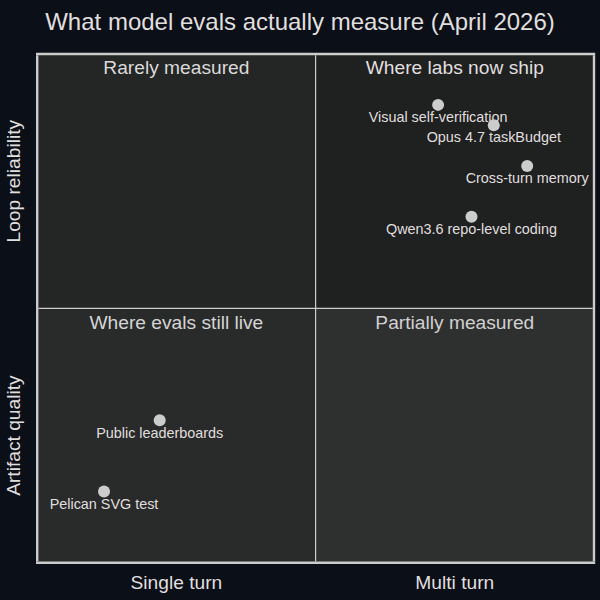
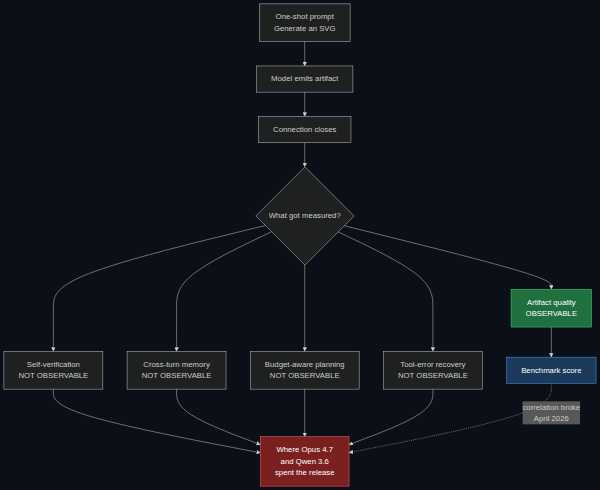
On April 16 2026, a 20.9GB quantized Qwen3.6 running on a laptop beat Claude Opus 4.7 on Simon Willison's pelican-riding-a-bicycle SVG benchmark. The benchmark's author immediately said it means nothing about usefulness. Both statements are true, and the gap between them explains where model capability actually moved.

The Pelican Benchmark Finally Broke. That Is the Result.
On April 16, 2026, a 20.9GB quantized model running on a laptop drew a better bicycle than Claude Opus 4.7 drew on Anthropic's servers.
Simon Willison ran his pelican-riding-a-bicycle SVG test against two models released the same morning: Qwen3.6-35B-A3B from Alibaba, quantized by Unsloth to a Q4_K_S GGUF and served through LM Studio on a MacBook Pro M5, and Claude Opus 4.7 from Anthropic. He gave it to Qwen. Opus "managed to mess up the bicycle frame" (simonwillison.net, Apr 16 2026). He re-ran Opus with thinking_level: max. The frame came out wrong in a different way.
Then he did the part that matters. Suspecting the labs might be training on a benchmark he has been publishing for eighteen months, he burned a held-out test he had never posted: a flamingo riding a unicycle. Qwen won that too, with sunglasses, a bowtie, and an <!-- Sunglasses on flamingo! --> comment in the SVG source. His conclusion: "I don't think Qwen are cheating."
So the local model won clean. And the person who ran the test immediately told everyone not to believe it: "I very much doubt that a 21GB quantized version of their latest model is more powerful or useful than Anthropic's latest proprietary release."
Both statements are true. That combination is the interesting part.
The eighteen months when the joke worked
Willison started drawing pelicans in October 2024 as a bit. The task is absurd on purpose — a running commentary on how silly model comparison had become. The first batch was, in his word, junk.
Then the joke kept working. Pelican quality climbed alongside everything else. By February 2026, Gemini 3.1 Pro was producing SVGs he described as "illustrations you could actually use somewhere." For a year and a half, an intentionally stupid test tracked real capability well enough that people started quoting it seriously, which annoyed its author.