final
发布于 2026-08-11
AI can generate finance outputs quickly. The hard part is building a reviewable decision path with evidence, controls, and accountable sign-off.

1|# AI Finance Is Fast Until Someone Has to Sign It
2|
3|On August 10, OpenAI described an internal finance team working toward a zero-day close and continuously updated forecasting. The wording matters: the company says it is working toward both goals, not that the monthly close has vanished.
4|
5|That distinction is the story.
6|
7|Finance teams can now generate analysis, spreadsheets, and decks at startling speed. Their harder problem starts one step later. Someone must verify the evidence, challenge the assumptions, explain the exceptions, and put a name beside the decision.
8|
9|AI has made financial output cheap. Reviewable financial judgment is still expensive.
10|
11|## The benchmark that exposes the gap
12|
13|A second OpenAI case study, published the same day, gives the cleanest picture of this new bottleneck. Model ML evaluated GPT-5.6 Sol on finance workflows that end in native PowerPoint and Excel files.
14|
15|The model produced a PowerPoint in 100% of test cases. Opus 5 did so in 76%. Yet only 43.3% of the GPT-5.6 Sol outputs cleared Model ML’s professional-readiness gate, compared with 26.7% for Opus 5 (source: Model ML’s Composite evaluation).
16|
17|Completion and readiness are different metrics. A file can open correctly, contain polished charts, and still demand substantial review. In Model ML’s benchmark, GPT-5.6 Sol scored 77.9% on aggregate visual quality but 43.3% on professional readiness. The software artifact existed. The accountable work remained.
18|
19|Model ML also reports that GPT-5.6 Sol used 36% fewer tokens per Excel workbook than Opus 5. That is useful, vendor-reported evidence. It still says less about operating value than the readiness rate. Saving tokens on an output that requires several rounds of correction can be a false economy.
20|
21|A cheaper model call is visible on an invoice. Rework hides in calendars, message threads, and late-night checks.
22|
23|## Stop measuring the document
24|
25|Most enterprise AI projects count the easiest objects: prompts, seats, tokens, generated files, and hours allegedly saved. Finance cannot stop there because its deliverables feed capital allocation, forecasts, investor communication, and audit work.
26|
27|The better unit is a decision packet.
28|
29|A decision packet contains the proposed conclusion, its source evidence, the assumptions used, the calculations performed, unresolved exceptions, and the identity of the approver. A deck may present that packet. A workbook may calculate part of it. Neither file is the packet by itself.
30|
31|OpenAI’s internal examples point in this direction. Its finance team built IR-GPT on approved investor-relations materials. The system can draft an answer in seconds, while the investor-relations team checks context and consistency before anything leaves the company (source: OpenAI finance case study). The speed comes from bounded evidence. The trust comes from named ownership.
32|
33|The same pattern appears in the company’s zero-day-close ambition. OpenAI describes a continuously reconciled view connecting spending plans, ledger actuals, purchase orders, accruals, and transaction detail. AI prepares an initial variance explanation and flags exceptions. Finance validates the numbers and owns final sign-off.
34|
35|That is a stronger design than asking a chatbot to “analyze this month.” It narrows the model’s job and makes failure inspectable.
36|
37| 38|
39|## Build the evidence path before the agent
40|
41|Teams often begin with the visible interface: a chat box, an agent, or a dashboard. Finance should begin underneath it.
42|
43|The first layer is approved evidence. Each number needs a stable source, access policy, timestamp, and lineage. If a forecast adjustment depends on a sales conversation, the system must preserve the relevant evidence rather than reduce it to an unsupported sentence.
44|
45|The second layer is AI preparation. Models can classify transactions, retrieve support, draft variance explanations, propose scenarios, and assemble editable files. These are high-volume tasks where speed matters and errors can still be intercepted.
46|
47|The third layer is deterministic checking. Totals must reconcile. Formulas must survive recalculation. Required fields must exist. Currency, period, entity, and version must be explicit. A language model should not grade its own arithmetic and call the result controlled.
48|
49|The fourth layer is human authorization. Review should concentrate on material exceptions, changed assumptions, and decisions with external impact. Asking people to reread every AI-generated cell wastes the machine’s speed. Asking nobody to review the exceptions wastes the company.
50|
51|The winning workflow does not remove people from finance. It removes scavenger hunts from their day.
52|
53|OpenAI reports that 40% of finance professionals’ specialized AI use involves work outside traditional finance, while 22% involves engineering-related tasks (source: OpenAI workplace research). That finding fits the architecture above. Finance professionals are becoming tool builders because they understand which evidence and controls make an output usable.
54|
55|## The spreadsheet is becoming an interface
56|
57|For decades, the spreadsheet was the model, database, interface, and audit trail squeezed into one file. AI exposes the limits of that arrangement.
58|
59|A continuously updated forecast cannot rely on someone copying values into a workbook before a meeting. It needs governed connections to operating data, versioned assumptions, scenario logic, and an approval record. The spreadsheet can remain an editable surface, but it should no longer carry the entire system on its back.
60|
61|Model ML calls its approach “surface-agnostic.” A user can begin in email or its application, then continue in Microsoft Office without restating the assignment. The important feature is continuity of context and evidence, not the novelty of another chat window.
62|
63|The reported productivity gains are large. At one global asset manager, Model ML says a bespoke tearsheet that took about an hour now takes about five minutes. Its agents also processed a virtual data room containing more than 100,000 rows and hundreds of files in one pass (source: Model ML case study).
64|
65|Those numbers deserve attribution because the vendor supplied them. They also illustrate where AI is strongest: gathering, transforming, formatting, and tracing large bodies of material. The finance professional still checks assumptions, sources, and the message before sharing the result.
66|
67|## A scorecard that a CFO can defend
68|
69|A credible AI scorecard should connect cost to dependable work. Four measurements are enough to expose most weak deployments.
70|
71|First-pass readiness measures how often an output reaches substantive review without repair to sources, formulas, or structure. “The agent finished” does not count.
72|
73|Exception burden measures the number and materiality of items sent to a person. A workflow that automates 95% of transactions but misses the risky 5% may create more exposure than value.
74|
75|Evidence coverage measures how many consequential claims and numbers link to approved sources. Coverage should be machine-checkable where possible.
76|
77|Decision-cycle time measures the interval from new evidence to an approved action. This captures the value of continuous forecasting better than token consumption does.
78|
79|
38|
39|## Build the evidence path before the agent
40|
41|Teams often begin with the visible interface: a chat box, an agent, or a dashboard. Finance should begin underneath it.
42|
43|The first layer is approved evidence. Each number needs a stable source, access policy, timestamp, and lineage. If a forecast adjustment depends on a sales conversation, the system must preserve the relevant evidence rather than reduce it to an unsupported sentence.
44|
45|The second layer is AI preparation. Models can classify transactions, retrieve support, draft variance explanations, propose scenarios, and assemble editable files. These are high-volume tasks where speed matters and errors can still be intercepted.
46|
47|The third layer is deterministic checking. Totals must reconcile. Formulas must survive recalculation. Required fields must exist. Currency, period, entity, and version must be explicit. A language model should not grade its own arithmetic and call the result controlled.
48|
49|The fourth layer is human authorization. Review should concentrate on material exceptions, changed assumptions, and decisions with external impact. Asking people to reread every AI-generated cell wastes the machine’s speed. Asking nobody to review the exceptions wastes the company.
50|
51|The winning workflow does not remove people from finance. It removes scavenger hunts from their day.
52|
53|OpenAI reports that 40% of finance professionals’ specialized AI use involves work outside traditional finance, while 22% involves engineering-related tasks (source: OpenAI workplace research). That finding fits the architecture above. Finance professionals are becoming tool builders because they understand which evidence and controls make an output usable.
54|
55|## The spreadsheet is becoming an interface
56|
57|For decades, the spreadsheet was the model, database, interface, and audit trail squeezed into one file. AI exposes the limits of that arrangement.
58|
59|A continuously updated forecast cannot rely on someone copying values into a workbook before a meeting. It needs governed connections to operating data, versioned assumptions, scenario logic, and an approval record. The spreadsheet can remain an editable surface, but it should no longer carry the entire system on its back.
60|
61|Model ML calls its approach “surface-agnostic.” A user can begin in email or its application, then continue in Microsoft Office without restating the assignment. The important feature is continuity of context and evidence, not the novelty of another chat window.
62|
63|The reported productivity gains are large. At one global asset manager, Model ML says a bespoke tearsheet that took about an hour now takes about five minutes. Its agents also processed a virtual data room containing more than 100,000 rows and hundreds of files in one pass (source: Model ML case study).
64|
65|Those numbers deserve attribution because the vendor supplied them. They also illustrate where AI is strongest: gathering, transforming, formatting, and tracing large bodies of material. The finance professional still checks assumptions, sources, and the message before sharing the result.
66|
67|## A scorecard that a CFO can defend
68|
69|A credible AI scorecard should connect cost to dependable work. Four measurements are enough to expose most weak deployments.
70|
71|First-pass readiness measures how often an output reaches substantive review without repair to sources, formulas, or structure. “The agent finished” does not count.
72|
73|Exception burden measures the number and materiality of items sent to a person. A workflow that automates 95% of transactions but misses the risky 5% may create more exposure than value.
74|
75|Evidence coverage measures how many consequential claims and numbers link to approved sources. Coverage should be machine-checkable where possible.
76|
77|Decision-cycle time measures the interval from new evidence to an approved action. This captures the value of continuous forecasting better than token consumption does.
78|
79|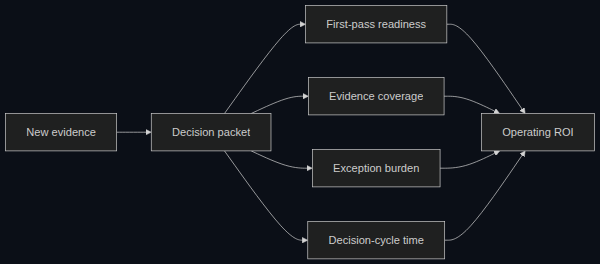 80|
81|Model cost belongs in the denominator, along with employee review time and rework. OpenAI’s finance team makes the same practical point: the cheapest model may cost more overall if it needs repeated attempts and heavier review (source: OpenAI finance case study).
82|
83|This changes procurement. A model with a higher per-token price can win if it raises first-pass readiness. A specialized document tool can justify itself if it preserves formulas and citations. A flashy autonomous agent loses if auditors cannot reconstruct what it did.
84|
85|## Start with one consequential workflow
86|
87|A finance team does not need a department-wide agent strategy on day one. It needs one workflow with clear evidence, recurring pain, and a named owner.
88|
89|Choose a task such as variance explanation, an audit request, or an investment-committee packet. Record the current cycle time and error burden. Map every source, calculation, approval, and handoff. Let AI prepare the packet. Use deterministic checks for arithmetic and required evidence. Keep authorization with the person already accountable for the result.
90|
91|Then measure first-pass readiness and decision-cycle time for several cycles. Expand only when the evidence shows that the workflow is dependable.
92|
93|OpenAI’s zero-day close is an ambitious north star. The more immediate opportunity is less theatrical: shorten the distance between evidence and an approved decision without weakening the trail between them.
94|
95|The companies that win will not generate the most spreadsheets. They will know which AI-produced decisions are ready to trust, which need attention, and exactly who signed them.
96|
80|
81|Model cost belongs in the denominator, along with employee review time and rework. OpenAI’s finance team makes the same practical point: the cheapest model may cost more overall if it needs repeated attempts and heavier review (source: OpenAI finance case study).
82|
83|This changes procurement. A model with a higher per-token price can win if it raises first-pass readiness. A specialized document tool can justify itself if it preserves formulas and citations. A flashy autonomous agent loses if auditors cannot reconstruct what it did.
84|
85|## Start with one consequential workflow
86|
87|A finance team does not need a department-wide agent strategy on day one. It needs one workflow with clear evidence, recurring pain, and a named owner.
88|
89|Choose a task such as variance explanation, an audit request, or an investment-committee packet. Record the current cycle time and error burden. Map every source, calculation, approval, and handoff. Let AI prepare the packet. Use deterministic checks for arithmetic and required evidence. Keep authorization with the person already accountable for the result.
90|
91|Then measure first-pass readiness and decision-cycle time for several cycles. Expand only when the evidence shows that the workflow is dependable.
92|
93|OpenAI’s zero-day close is an ambitious north star. The more immediate opportunity is less theatrical: shorten the distance between evidence and an approved decision without weakening the trail between them.
94|
95|The companies that win will not generate the most spreadsheets. They will know which AI-produced decisions are ready to trust, which need attention, and exactly who signed them.
96|