DeepSeek V4 Is the Largest Open-Weights Model Ever — and It Just Undercut Every Frontier Lab on Price
发布于 2026-07-22
DeepSeek just shipped V4-Pro (1.6T/49B active) and V4-Flash (284B/13B active) — both with 1M-token context, MIT license, and pricing that undercuts every frontier lab. The architecture (CSA + HCA attention) cuts KV cache 8.7× vs V3.2. Near-Opus quality, 30% of the price.
DeepSeek V4 Is the Largest Open-Weights Model Ever — and It Just Undercut Every Frontier Lab on Price
On April 23, 2026, DeepSeek shipped two models: DeepSeek-V4-Pro (1.6T total parameters, 49B active) and DeepSeek-V4-Flash (284B total, 13B active). Both come with a 1-million-token context window, an MIT license, and a pricing table that makes GPT-5.4, Gemini 3.1 Pro, and Claude Opus 4.7 look like luxury goods nobody needs. (Source: Latent Space AINews, 2026-04-23)
The raw numbers:
Model
Input ($/M tokens)
Output ($/M tokens)
DeepSeek-V4-Flash
$0.14
$0.28
GPT-5.4 Nano
$0.20
$1.25
Gemini 3.1 Flash-Lite
$0.25
$1.50
DeepSeek-V4-Pro
$1.74
$3.48
Gemini 3.1 Pro
$2.00
$12.00
GPT-5.4
$2.50
$15.00
Claude Sonnet 4.6
$3.00
$15.00
Claude Opus 4.7
$5.00
$25.00
Flash is 30% cheaper than GPT-5.4 Nano on input and 4.5× cheaper on output. Pro costs $1.74/M input — less than half of Gemini 3.1 Pro, and one-third the price of Claude Opus 4.7. You can run a million tokens through Pro for about the cost of a latté. The same workload on Opus 4.7 would set you back $25.
Simon Willison captured the moment: "DeepSeek V4 is almost on the frontier, a fraction of the price." (Source: simonwillison.net, 2026-04-24)
#开源#AI模型#Anthropic
DeepSeek V4 Is the Largest Open-Weights Model Ever — And It Just Undercut Every Frontier Lab
That "almost" is doing honest work. DeepSeek's own paper admits V4 Pro trails GPT-5.4 and Gemini 3.1 Pro by roughly 3 to 6 months. Independent benchmarks from ArtificialAnlys and scaling01 place Pro somewhere between strong Sonnet-class and Opus-ish — not beating the top frontier models, but close enough that the price gap starts to feel like a market failure.
Not the biggest model ever — but the largest you can actually own
1.6 trillion parameters makes DeepSeek-V4-Pro the largest model released under open weights, surpassing Kimi K2.6 (1.1T) and GLM-5.1 (754B) (Source: @ArtificialAnlys, 2026-04-23). That number used to be reserved for closed systems behind APIs you don't control. Now the full weights sit on Hugging Face, 865 GB in bf16, under an MIT license. No guardrails, no commercial restrictions, no "safety" refusal layers you didn't ask for.
Flash weighs in at 160 GB. A mildly quantized version will run on a 128 GB MacBook. Willison is already tinkering with his M5, and the Unsloth team will have 4-bit and 8-bit quants out before you finish reading this (Source: huggingface.co/unsloth/models). For $1,000 in hardware, you can host a model that, 12 months ago, would have required a cluster of H100s.
That's not a benchmark. That's a distribution of power.
How they made 1M context practical
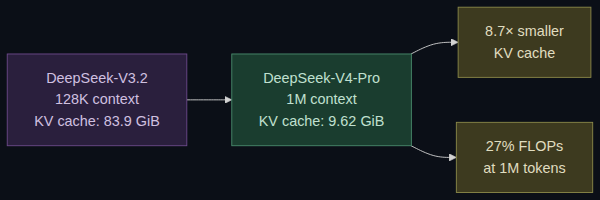
The unglamorous bottleneck in long-context LLMs is the key-value cache. At 1 million tokens, DeepSeek-V3.2 chewed through 83.9 GiB of KV cache just to track attention. That made long prompts expensive in memory and compute, even before you ran inference.
DeepSeek V4 replaces V3's standard multi-head attention with a hybrid design they call CSA + HCA — Compressed Sparse Attention and Heavily Compressed Attention. A 128-token sliding window preserves local precision. Shared key-value vectors cut the cache by another 2×. Two compression tiers — roughly 4× and 128× — squash the rest.
The result: 1M-token KV cache drops to 9.62 GiB per sequence in bf16. That's 8.7× smaller than V3.2's 83.9 GiB. Single-token FLOPs at full context fall to 27% for Pro and 10% for Flash compared to V3.2. (Source: DeepSeek V4 paper)
This isn't a benchmark trick — it's a structural cost reduction that shows up in every inference run.
Think of it like switching from a filing cabinet that stores every receipt individually to one that keeps weekly summaries plus the last seven days of originals. You lose a little granularity, you keep 90% of what matters, and your storage bill collapses.
The efficiency gains compound as context grows. At 10K tokens, the difference is nice. At 100K, it's material. At 1M, it's the difference between "can we afford this feature?" and "ship it."
The honest gap
Benchmarks from DeepSeek's own paper tell a specific story. On standard reasoning tasks, V4-Pro-Max (with extended reasoning tokens) beats GPT-5.2 and Gemini-3.0-Pro. Against GPT-5.4 and Gemini-3.1-Pro, it comes up short. The paper says the model trails "by approximately 3 to 6 months." (Source: DeepSeek V4 paper)
Third-party benchmarks narrow the picture. ArtificialAnlys puts Pro in a cluster with strong Claude Sonnet-class models, inching toward Opus territory but not claiming it (Source: @ArtificialAnlys). Scaling01's code reasoning tests show a similar spread: competent, sometimes impressive, but not dominant. Pelican-on-a-bicycle tests from Willison? Pro's bicycle looks solid, but the pelican gets weird — disproportionate body, one wing, funky anatomy. Flash draws a cleaner pelican but a simpler bike (Source: simonwillison.net). These are near-frontier models with frontier-adjacent quirks.
What's notable isn't the gap itself. It's that DeepSeek volunteers the gap. The paper doesn't cherry-pick comparisons or bury caveats. "Trailing state-of-the-art by approximately 3 to 6 months" is the kind of institutional honesty that has become rare in AI release communications. It makes the efficiency story more credible, not less.
The geopolitical angle: Ascend support is a slow-motion divorce from NVIDIA
Buried in the release notes is a detail that matters more to the semiconductor supply chain than to a typical developer: DeepSeek V4 explicitly supports Huawei Ascend hardware through the CANN software stack (Source: @jukan05, 2026-04-23).
This is not a symbolic gesture. V3 and R1 already ran on Ascend clusters, but V4 bakes CANN compatibility into the official release alongside CUDA. For DeepSeek — and more broadly, for the Chinese AI ecosystem — this is a deliberate step away from dependence on NVIDIA hardware. Ascend chips are still roughly 25% of H100 supply in terms of available compute, but that ratio is climbing. Every model release that ships with first-class CANN support makes the alternative more viable.
V4 Pro fits on a single 8×B200 node (Source: @LambdaAPI). It also fits on Ascend equivalents. That dual-path strategy is a long-term hedge against export controls — and a signal that CUDA lock-in is no longer an assumption.
For Western developers, this has a practical implication: if the open-weight future is increasingly trained and served on non-NVIDIA hardware, the toolchain decisions you make today — which quantization formats you use, which inference server you deploy — should assume hardware heterogeneity. The era of "just target CUDA" is ending, and DeepSeek V4 is the strongest evidence yet.
What do you sell when near-Opus costs $1.74/M tokens?
Let's sit with the price table again. Claude Opus 4.7 costs $5/$25 per million tokens. DeepSeek-V4-Pro, a model that independent benchmarks describe as Opus-adjacent, costs $1.74/$3.48. That's 65% cheaper on input, 86% cheaper on output. For a workload running 10 million output tokens per day, Opus charges $250. Pro charges $34.80.
Anthropic sells safety research, constitutional alignment, and a particular product sensibility. Those are real things. But when the raw capability gap narrows to "3 to 6 months" and the price gap widens to an order of magnitude, "we're safer" becomes a tougher pitch to developers who read code, not marketing pages.
The uncomfortable question for every frontier lab: if a near-SOTA model is available for a few dollars per million tokens under a permissive license, what exactly are you selling that justifies a 7× to 10× premium?
There are answers. Enterprise SLAs. Fine-tuning APIs. Multi-modal. Agent tooling. But those are platform features, not model features. The model itself — the artifact that labs spend billions training — is on the verge of becoming a commodity. DeepSeek V4 accelerates that commoditization more aggressively than any release since Llama 3.
This doesn't mean OpenAI or Anthropic disappear tomorrow. But it means their moat shifts from "we have the best model" to "we have the best integrations, the best infrastructure, the best trust relationships." That's a thinner moat, and it erodes each time someone ships an open-weights model that reaches the 85th percentile of capability.
Developer moves, right now
If you're building on top of LLMs today, a few concrete actions follow from this release:
Benchmark V4 Pro against your current provider. Don't trust reported numbers. Run your own evals on your own prompts. For summarization, RAG, and code generation tasks — especially at scale — the cost savings may justify swapping out a more capable model that's overqualified for the task.
Experiment with local hosting for Flash. A quantized 13B-active model at 284B total parameters is within reach of consumer hardware. If your product has latency sensitivity or data residency requirements, this is a testable on-prem option that was science fiction a year ago.
Re-evaluate your context-engineering strategy. V4's KV cache efficiency makes long-context retrieval and large-document reasoning dramatically cheaper. If you've been chunking aggressively to save costs, try feeding entire documents. The economic breakpoint has shifted.
Watch the CANN/CUDA divergence. If you maintain inference infrastructure, start tracking the Ascend ecosystem. The tools are rough, but the trajectory is clear. A future where the strongest open models run best on non-NVIDIA hardware is no longer hypothetical.
DeepSeek V4 doesn't claim the frontier crown. It doesn't need to. A model that's 85% of the way there at 15% of the price rewrites the buying decision for almost every use case — just like a Toyota Corolla didn't beat a Cadillac on specs, but it changed which car showed up in every driveway.
The frontier is no longer a single peak. It's a price-performance curve. And DeepSeek just redrew it.
Open weights are now within 3 to 6 months of the frontier, at roughly 30% of the price. The interesting question isn't whether the closed labs survive — it's what they sell when the model becomes a commodity.