Stop Counting Agents. Start Counting Who Decides.
发布于 2026-07-23
Cursor's internal Agent swarm ran the same SQLite rewrite twice and got 70,000 conflicts the first time, 47 the second. The hardware and the models did not change. The org chart did. Here is what every team shipping coding Agents should steal on Monday.
Stop Counting Agents. Start Counting Who Decides.
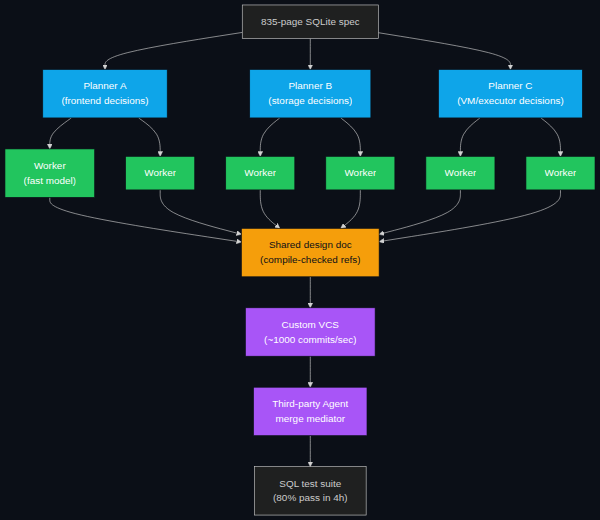
Cursor gave a thousand Agents one job: rewrite SQLite in Rust from a PDF. The legacy swarm logged 70,000 merge conflicts in two hours and crashed. The redesigned swarm logged 47 conflicts on the most-edited file and passed 80% of retained SQL tests in four hours.
The two runs used the same models, the same time budget, and the same 835-page SQLite spec. The only difference was the structure: who decides what, how shared memory is written, and what happens when two Agents touch the same line at the same time.
The bottleneck of an Agent swarm is not the model. It is the org chart.
The 70,000-Conflict Run
The setup was deliberately brutal. The swarm received:
- The 835-page SQLite documentation
- No source code, no test suite, no SQLite binary, no internet
- A single goal: produce a working SQL database in Rust
The legacy swarm was modeled on "more parallelism = more throughput". A peak run had 1,173 agents editing the same file — the SQL parser — with no coordination beyond a shared commit log. Within two hours the system had accumulated over 70,000 merge conflicts and was suspended. The output was 54 Rust crates, three of which were competing SQL parsers that all individually worked but could not coexist.
The redesigned swarm ran the same task with the same models. The output stabilized at 9 Rust crates and reached 80% SQL test pass-rate in four hours using Grok 4.5. The single most-edited file saw only 47 authors.
The hardware, the models, and the spec did not change. The org chart did.